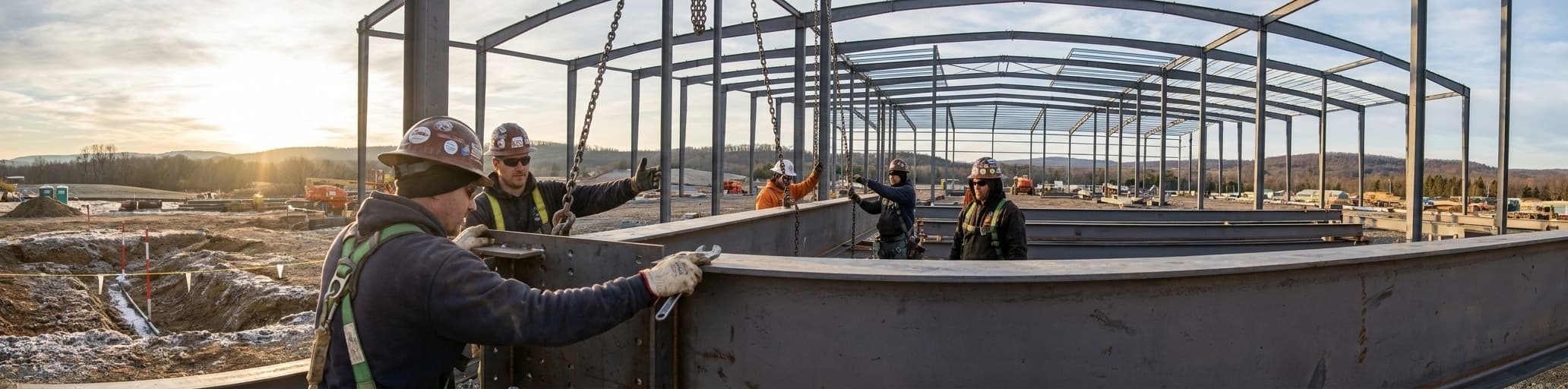

We help Pennsylvania builders understand why single-source steel contractors deliver better value, faster timelines, and fewer coordination headaches than managing multiple vendors separately. Choosing an integrated partner with in-house fabrication and erection eliminates the accountability gaps where projects hemorrhage time and money.
Why Pennsylvania Builders Choose Single-Source Steel Contractors
Single-source steel contractors eliminate coordination burden by placing design, fabrication, and erection under one accountable party responsible for your project's completion.
The Cost of Juggling Multiple Vendors in PA Construction
Pennsylvania has a documented history with multi-prime project delivery — a structure where owners contract separately with each trade rather than working through a single general contractor.
For public projects, the state's Separations Act has required this approach for over a century, and legal analysis of the system is blunt: the perceived savings from eliminating a GC's markup are largely illusory, because the management void that results drives up actual project costs.[1] On private steel building projects, the same dynamic applies.
When you coordinate separately with a structural fabricator, a foundation crew, an erector, and a finishing trade, you become the de facto general contractor — responsible for sequencing work, resolving schedule conflicts, and filling gaps no individual vendor owns.[1] Multiple vendors operating on the same site tend to be self-focused rather than project-focused; each prime contractor's definition of a successful job is completing their own scope, not your overall completion date.[1] The compounding overhead is real: separate insurance certificates to track, different billing formats to reconcile, and distinct communication threads to manage — all consuming staff time that never appears as a line item in any contractor's original quote.[2] Choosing a single-source steel contractor eliminates that coordination burden by placing design, fabrication, and erection under one accountable party from the first call to final handoff.
How National Steel Buildings Eliminates Coordination Headaches
The mechanics of single-source delivery are straightforward: one team covers design, fabrication, and erection under a single contract, closing the handoff gaps where problems typically fall through.[5] Contractors that both fabricate and install steel have a built-in quality incentive — the shop that cuts the steel also bolts it together on your site, so sloppy fabrication creates immediate field problems for the same crew.[4] Construction companies that operate with a genuine unified-team strategy — aligning staffing, expertise, and relationships across every phase of a project — consistently produce better value and fewer surprises than those who assemble separate vendors for each scope.[5] When something unexpected surfaces on site, a single-source contractor owns the resolution immediately rather than spending days determining which vendor bears responsibility.
That accountability gap is where multi-vendor projects hemorrhage both time and money, and it's the problem a fully integrated steel building contractor in Pennsylvania eliminates before the first bolt is tightened.
Pennsylvania's Harsh Weather: Why Steel Outperforms Wood and Masonry
Pennsylvania's climate is genuinely punishing for buildings.
Western PA roofs face snow, ice, rain, wind, hail, and summer heat and humidity in the same calendar year, and the northern and central regions carry heavy snow and ice loads that test structural limits every winter.[6][7] Wood frame construction demands ongoing protection from moisture and pests to preserve structural integrity — the maintenance burden is built into the material itself, not a worst-case scenario.[8] Steel, by contrast, resists moisture, rot, and pests without chemical treatment or repeated intervention.[8] Properly engineered steel structures carry high structural integrity to resist gravity, wind, and snow loads simultaneously, with redundancy from multiple interconnected members providing robustness that wood framing cannot match at comparable cost.[8] Masonry offers durability and fire resistance, but requires regular inspections and maintenance to identify issues before water infiltration compromises integrity — a meaningful operational cost in a state where freeze-thaw cycles repeat dozens of times each winter.[8] Protective coatings on steel, such as GALVALUME(R), resist rust and staining even through repeated freeze-thaw cycles, giving your building durable corrosion defense without seasonal maintenance windows.[7] For a Pennsylvania steel building contractor engineering structures to meet local snow-load requirements, steel is the material that simply works with the climate rather than fighting it year after year.
What to Look for in a Pennsylvania Steel Building Contractor
Contractors who self-perform steel erection keep quality, scheduling, and safety under one command, eliminating the 25-60 percent markup and coordination delays of outsourced installation.
In-House Erection vs. Outsourced Installation: Quality and Timeline DifferencesThe single most consequential question to ask any steel building contractor in Pennsylvania is whether the crew that bolts your frame together works directly for them or for a separate erection subcontractor.
When a contractor self-performs erection, their own ironworkers, cranes, and supervisors set the steel — meaning schedule decisions, quality standards, and safety protocols all sit under one chain of command.[9] An outsourced erector operates with its own priorities: each crew juggles multiple clients simultaneously, and if a higher-value job surfaces elsewhere, your frame waits while they remobilize.[9] Steel erection sits on the critical path of virtually every build — decking, cladding, mechanical, and electrical all follow the frame — so a delay in erection translates nearly one-for-one into a delay at final handoff.[9] Quality accountability follows the same logic.
A contractor whose shop fabricated the steel and whose crew installs it has an immediate incentive toward precision, because sloppy fabrication creates field problems for the same organization that caused them.[10] An outsourced erector, operating under a separate contract with narrower liability, is accountable for installation accuracy but not typically for coordination failures, sequencing conflicts, or schedule-driven change orders that bleed into downstream trades.[10] The pricing gap between models deserves scrutiny as well: outsourced erection adds a markup that commonly runs 25 to 60 percent over base labor rates, while a contractor that captures erection in-house builds that margin into a fixed-cost structure your project directly benefits from.[9] On the safety side, steel erection carries a fatality rate several times the construction industry average, and self-perform consolidates safety culture and supervision under a single command rather than splitting accountability across two organizations with different standards and incentive structures.[9] When you review vetting criteria for steel erectors near you, the question of in-house versus outsourced crews should appear at the top of your list — before price, before lead time, and well before contract execution.
Local Code Knowledge: Permits, Snow Loads, and Inspection Readiness
Pennsylvania's permit landscape is genuinely fragmented, and that fragmentation catches generalist or out-of-state contractors every time. The Commonwealth enforces the Uniform Construction Code (UCC) statewide, but municipalities layer their own requirements on top — and those local additions can be decisive. Allentown began enforcing 2021 IBC standards on January 1, 2026, with a transition window for applications submitted under the previous code only if they met specific conditions under Section 304 of the UCC.[11] Whitehall Township added its own amendments requiring any new commercial or industrial structure to submit engineering plans bearing the seal of a registered design professional before a permit issues, and applications not acted on within 90 days of a complete submission are deemed abandoned.[12] In Schuylkill County, permit requirements differ township by township: Washington Township requires a zoning permit before a building permit for any structure over 100 square feet, plus an Impervious Coverage Worksheet for stormwater compliance, while Schuylkill Township requires a scaled site plan and a Use and Occupancy Permit after construction completes before the building can legally be occupied.[13] Permit fees across the county typically run $50 to $300 depending on scope, with zoning approvals clearing in a few days but full UCC packages taking one to two weeks — and missing a single document on the front end resets that clock entirely.[13]
Snow load is where local code knowledge moves from paperwork into structural design. The Pennsylvania UCC requires roofs in the Schuylkill County area to withstand a minimum ground snow load of 30 pounds per square foot, a threshold driven by the wet, heavy snow accumulating in Appalachian valleys and higher elevations.[13] Whitehall Township's frost protection amendments set the frost line at 36 inches below grade, requiring foundations to extend to that depth unless built on solid rock — and footings must sit at a minimum of 27 inches below exterior grade.[12] Parts of Schuylkill County push that frost line to 36 to 40 inches, compounded by coal mining history that creates soil instability and differential settlement under new construction.[13] A steel building contractor in Pennsylvania who does not engineer to those site-specific loads upfront faces re-engineering costs, permit rejections, and potential stop-work orders — all of which compress your timeline without warning. For a closer look at how Western PA snow load requirements translate into actual structural specs, the engineering details that determine whether a building passes or fails inspection start with those ground snow load numbers.
Inspection readiness is the downstream consequence of getting permits and engineering right from the start. Whitehall Township requires 24-hour advance notice before each required inspection milestone and places responsibility for code compliance squarely on the applicant — the absence of a full-time inspector does not excuse non-compliance.[12] A certificate of occupancy issues only after the building official confirms full compliance with all applicable ordinances, meaning a single open item from a prior inspection phase can block occupancy at the end of an otherwise completed project.[12] Contractors unfamiliar with Pennsylvania's inspection sequencing — foundation sign-off before backfill, framing review before cladding, mechanical approvals before final CO — create schedule collisions that cost weeks. The advantage of a steel building contractor in Pennsylvania who has moved multiple projects through these sequences is the ability to pre-stage documentation, coordinate inspection timing with erection milestones, and carry your project to occupancy without a single avoidable delay.[12][13]
Contractor Vetting Essentials: 7 Questions to Ask Before Signing (Downloadable)
Seven direct questions, asked before any contract moves to signature, separate contractors who will own your outcome from those who will manage their own exposure. Ask them in this order, and compare answers across every bid you receive.
- Are you licensed, bonded, and insured for commercial steel work in Pennsylvania? Ask for physical copies of current certificates and verify them independently — a license confirms state and local code competency, insurance covers property damage and crew injuries on your site, and a bond protects you financially if the contractor fails to complete the job or defaults on subcontractor payments.[15]
- How many Pennsylvania steel buildings have you completed, and can you provide references from recent comparable projects? Relevant experience is what matters — a contractor who builds residential additions may not understand UCC requirements, occupancy classifications, or steel erection sequencing; ask for references and actually call them.[15]
- Do you self-perform erection, or is installation subcontracted? The answer determines who is accountable for schedule, quality, and safety when steel goes up, because an outsourced erector operates under a separate contract with narrower liability and its own competing priorities.[14]
- Who is responsible for permits, inspections, and the certificate of occupancy? The right answer is always the contractor — if they ask you to pull permits in your name, walk away, because that arrangement transfers code compliance liability onto you and typically signals the contractor is not properly licensed.[15][16]
- What does the payment schedule look like, and what milestones trigger each payment? Payments should be tied to completed, verifiable phases — foundation, framing, cladding — rather than a large upfront sum; be cautious of any contractor who requests a significant percentage before work begins.[14][15]
- How do you handle change orders and unexpected site conditions? Every scope change should be documented in writing with updated cost and timeline figures, and no additional work should proceed without your written approval — a contractor who cannot explain this process clearly before signing will not improve once the project is underway.[15]
- What warranty do you provide on workmanship, and how do you support claims on structural components? A standard workmanship warranty covers labor defects for at least one year, while structural components carry separate manufacturer warranties — a responsible contractor will help you navigate a manufacturer claim rather than treating warranty scope as someone else's problem.[14][15]
Lay all seven answers side by side across competing bids. A contractor who answers each one clearly, produces documentation without being asked twice, and applies Pennsylvania-specific knowledge to questions three and four will be obvious. So will the ones to avoid.
Steel Building Applications Across Pennsylvania's Industries
Steel's GALVALUME coating withstands Pennsylvania farm environments where moisture, ammonia, and freeze-thaw cycles degrade wood frames and standard painted panels.
Agricultural Storage and Equipment Shelters for PA Farms
Pennsylvania farms put buildings through conditions that expose every material weakness — grain moisture, livestock ammonia, silage acids, repeated freeze-thaw cycles, and equipment that generates vibration and impact loads year-round.
Steel in agricultural applications carries a documented track record across grain bins, stock tanks, and animal confinement structures, specifically because the material tolerates moisture and chemical exposure that degrades wood frames over time.[18] For equipment shelters and hay storage, clear-span steel frames eliminate interior columns — the feature that lets you drive a combine or baler through without precision maneuvering around posts.
On the corrosion side, GALVALUME(R)-coated panels combine aluminum's corrosion resistance with zinc's galvanic protection, a pairing that holds up against the wet, acid-heavy interior environment of working farm buildings better than untreated or standard painted panels.[18] Pennsylvania zoning rules classify agricultural structures separately from commercial buildings, and in many rural counties a zoning permit rather than a full UCC building permit may be sufficient for accessory farm structures — but that threshold varies by municipality, and "agricultural exemption" claims that skip permits entirely carry real liability if a building later fails inspection or triggers an insurance dispute.[17] For farms sizing out hay storage, equipment bays, or multi-use agricultural structures, a qualified agricultural steel building contractor will verify local zoning classification before design begins, not after a permit rejection.
Commercial Warehouses and Distribution Centers
Pennsylvania's position along the I-78, I-81, and I-83 corridors makes the state a natural hub for warehouse and distribution activity, and pre-engineered steel is the dominant structural choice for good reason.
Clear-span steel frames eliminate interior columns, which matters enormously in a working distribution center where forklift lanes, racking systems, and staging zones need unobstructed floor-to-ceiling space.[19] Steel joists, girders, and columns are engineered to carry substantial roof loads while accommodating wall systems ranging from insulated metal panels to precast concrete, giving operators flexibility to match enclosure type to climate control requirements without altering the structural frame.[19] For Pennsylvania projects specifically, snow load engineering is not optional — local building codes in high-elevation and northern counties require roofs to withstand 30 or more pounds per square foot of ground snow load, which directly affects the steel specification and therefore the material budget.[20] In 2026, steel material costs for warehouse-scale structures run $12 to $19 per square foot for the structural package alone, with labor adding $5 to $10 per square foot and permits ranging from $5,000 to $50,000 depending on jurisdiction — putting a 30,000-square-foot warehouse between $605,000 and $1.22 million fully installed before tenant improvements.[21] Turnkey pre-engineered packages compress that timeline meaningfully: offsite fabrication reduces on-site labor hours and eliminates the coordination delays that inflate costs when structural, enclosure, and mechanical trades overlap.[19] One practical budget note for 2026 — steel quotes typically expire in 30 to 60 days, and nonresidential construction input prices rose at an annualized rate of 7.1% in January of this year, so locking in material costs with a down payment or letter of intent before design is finalized protects your budget against mid-project price adjustments.[20] For a detailed industrial warehouse cost breakdown by size, the per-square-foot economics shift significantly between 10,000-square-foot and 50,000-square-foot footprints — a difference worth modeling before you commit to a building size.
Aviation Hangars and Industrial Facilities
Aviation hangars represent some of the most technically demanding steel building applications, and the engineering requirements diverge sharply from standard commercial construction from the first design decision. Clear-span widths of 100 to 200+ feet eliminate interior columns entirely — the defining requirement for aircraft storage, since wingspan clearance and maneuvering space cannot be compromised by structural posts.[22] Eave heights must accommodate tail clearance for specific aircraft, and door system selection — choosing between bi-fold, hydraulic, sliding, overhead, or swing configurations — determines structural header design and foundation requirements, making door choice a structural engineering decision rather than a finish-out detail.[23] Pre-engineered steel components arrive fabricated, pre-cut, and pre-drilled, reducing on-site construction time by up to 30% compared to conventional methods, a meaningful advantage when airport authority schedules or lease commencement dates define your occupancy target.[22] Shell structures for aviation applications typically run $25 to $40 per square foot, while turnkey hangars with foundation, doors, utilities, and interior finishes range from $60 to $150+ per square foot depending on span width, door system complexity, and buildout scope.[22][24]
Industrial facilities introduce a distinct structural layer: overhead crane systems at 10-ton capacity and greater require purpose-engineered crane runway beams designed for lateral and longitudinal loads, while floor systems must carry heavy equipment point loads that far exceed standard warehouse specifications.[22] Pennsylvania contractors who have moved both hangar and industrial projects through state and local permitting carry institutional knowledge that matters here — NFPA 409 fire suppression compliance for MRO maintenance facilities, FAA setback coordination for airport-adjacent structures, and geotechnical investigation requirements for sites with crane systems or heavy floor-supported equipment.[22][23] Aviation hangar projects must frequently satisfy both local building codes and airport authority standards simultaneously, making permit-ready stamped engineering drawings a baseline requirement rather than an optional upgrade.[23] A steel building contractor in Pennsylvania who handles fabrication and permitting under one contract closes the coordination gap between structural engineers, permit officials, and airport authorities that multi-vendor approaches leave open — and when an FAA filing or a fire marshal approval controls your occupancy date, that gap is expensive. For Pennsylvania projects where permit sequencing directly affects opening timelines, the PA Steel Building Permits: County Timeline & Checklist details exactly what documentation each county inspection authority requires before a certificate of occupancy issues.[22][23]
From Quote to Completion: What to Expect with a Pennsylvania Steel Contractor
When your Pennsylvania steel contractor designs and erects the structure themselves, every engineering decision faces immediate accountability to field conditions rather than theoretical drawings.
Design and Engineering: Custom Specs for Your Site and Use Case
The design phase is where site-specific variables get translated into structural specifications your building must meet before a permit issues.
In pre-engineered construction, the firm that designs the steel also erects it — making every design decision immediately accountable to field reality rather than to drawings handed off to a separate crew.[26] Custom engineering for a Pennsylvania site starts with structural analysis covering wind, seismic, and snow load calculations to IBC and applicable state standards, alongside foundation plans that account for soil conditions and local frost penetration depths.[25] Use case drives frame geometry directly: a distribution warehouse needs clear-span bay widths optimized for racking and forklift lanes, an agricultural building needs corrosion-resistant panel selection and column-free interior space for equipment access, and an industrial facility with overhead cranes requires purpose-engineered runway beams sized for dynamic lateral loads.[25] Building envelope design — wall panels, roof systems, and insulation assemblies — is engineered alongside the structural frame rather than treated as a separate specification, so thermal performance and weatherproofing are built into the initial design rather than retrofitted after erection.[25] Licensed engineers referencing ASCE 7, ACI, and AISC standards ensure structural steel components and connection detailing survive permit review, which in Pennsylvania means coordinating with local building officials who may layer county-specific amendments on top of the statewide UCC baseline.[27]
Fabrication and Delivery: Timeline and Logistics in PA
Lead time in steel building fabrication spans the full interval from design approval to components arriving on your site, and every vendor handoff inside that window adds idle time that rarely surfaces as a line item in any individual quote.[28] In a multi-vendor supply chain — separate firms handling fabrication, finishing, and freight — each transition accumulates waiting: a fabricator cannot begin production until the engineer releases drawings, a finishing shop cannot coat panels until fabrication ships them, and delivery cannot be scheduled until all components clear final inspection.[28] A single-source partner that handles cutting, welding, and coating in-house maintains direct control over each production stage, eliminates transit gaps between separate vendors, and shortens overall project timelines by consolidating logistics and setup fees under one roof.[29] In-house finishing capabilities specifically — powder coating, panel treatment, and corrosion protection applied before shipment — remove the need to transport components between multiple vendors, which reduces lead times and keeps quality control under a single chain of command rather than splitting accountability across suppliers.[30] For Pennsylvania projects, regional fabrication matters beyond convenience: a fabricator positioned in the Mid-Atlantic corridor reduces freight lead time, manages delivery sequencing to match your site prep schedule, and avoids the weight-restricted rural roads and narrow delivery windows that affect sites in central and northern PA counties.[30] What you provide at first contact directly compresses the production cycle — complete drawings with tolerances flagged, confirmed material grades, and a firm delivery date give a fabrication shop everything needed to begin scheduling immediately rather than cycling back for clarifications that each delay the start of production.[29] For Pennsylvania-specific manufacturing capabilities and how regional suppliers navigate UCC compliance requirements during the fabrication phase itself, steel building manufacturers in Pennsylvania covers what local manufacturers build into structural components before a single piece reaches your site.
Erection and Handoff: Communication Throughout the Build
Erection is where schedule pressure peaks and communication failures become immediately expensive. Construction milestones — fixed checkpoints representing the completion of major project phases — give erection crews, owners, and downstream trades a shared frame of reference, making it easier to coordinate work, manage expectations, and track changes as steel goes up.[33] Framing and structural completion is a critical milestone that signals readiness for enclosure, triggering roofing crews, cladding trades, and MEP rough-in work that all depend on the frame being plumb, complete, and inspected before they can begin.[33] Missing a milestone on the critical path can lead to delay penalties, disputes, or added cost — which is why a contractor who controls erection directly can resequence work or reallocate resources when a delay surfaces, rather than waiting for a separately contracted crew to respond.[33] Milestone visibility matters here: progress tied to clear, verifiable outcomes such as "frame complete" or "roof installed" keeps every party aligned on what needs to happen next and reduces the miscommunication that causes schedule collisions between trades.[33]
Project handover is the final phase of the closeout process, where the contractor formally transfers the building — along with every document and resource the owner needs to operate and maintain it — to the client.[31] The most consequential part of that transfer is often not the keys themselves but the package accompanying them: as-built drawings, structural warranties, roof and panel manufacturer warranties, compliance certificates, operation and maintenance manuals, and the certificate of occupancy.[32] A chaotic or incomplete handover costs contractors time and money well after construction ends, as incomplete documentation generates callbacks to troubleshoot systems, explain how equipment operates, or produce certificates that should have been delivered at closeout.[31] For a steel building contractor in Pennsylvania, a clean handoff means delivering a fully organized closeout package — with clear naming conventions, complete documentation, and no outstanding punch list items — before the final payment conversation begins.[31][32]
The Defects Liability Period (DLP), typically 12 to 24 months following formal handover, keeps the contractor accountable for any defects that surface after occupancy — making thorough pre-handover inspections and punch list resolution the difference between a clean closeout and months of callbacks.[32] Effective communication throughout the build is what makes that period manageable rather than adversarial: subcontractors who understand how their scope connects to the overall project and what documentation they must deliver are far more likely to submit everything before leaving the jobsite.[31] Owners who receive clear updates on timelines and expectations throughout construction are better positioned to accommodate issues when they arise and to plan move-in, operations startup, or tenant fit-out around realistic completion dates.[31] Contractors who build those communication habits from the first site meeting — not as a closing gesture — arrive at handoff with less rework, fewer surprises, and a client ready to sign off rather than one compiling a list of concerns.
- Single-source steel contractors eliminate coordination gaps and overhead costs inherent in multi-vendor project delivery models.
- Pennsylvania's fragmented permit landscape requires contractors to understand municipality-specific codes beyond the statewide Uniform Construction Code.
- Steel's resistance to moisture, rot, and freeze-thaw cycles makes it superior to wood and masonry for Pennsylvania's harsh climate conditions.
- In-house erection capabilities directly impact project timeline and quality accountability compared to outsourced installation subcontractors.
- Site-specific snow load engineering is mandatory for Pennsylvania roofs, with requirements ranging from 30+ pounds per square foot in high-elevation areas.
- Clear-span steel frames eliminate interior columns, making them essential for agricultural, warehouse, and aviation hangar applications.
- Comprehensive design-to-handover coordination under one contractor prevents schedule delays and reduces total project costs through consolidated logistics and quality control.
- https://www.scottilaw.net/pennsylvanias-separations-act/
- https://turnkeynational.com/national-vendor-vs-multiple-contractors/
- https://www.steelsmithinc.com/
- https://www.advsteel.com/
- https://quandel.com/
- https://masonsteelcorp.com/steel-buildings-in-pennsylvania/
- https://prescottroofing.com/timbersteel-metal-roofing/
- https://www.architecturelab.net/building/construction/
- https://colonyconstruction.com/self-perform-vs-subcontracting-steel-erection/
- https://xtdsteel.com/steel-structure-company/steel-contractor-vs-supplier/
- https://www.allentownpa.gov/en-us/Government/Departments/Community-Economic-Development/Building-Standards-and-Safety
- https://ecode360.com/13155331
- https://americanremodeling.net/roofing-permits-in-schuylkill-county-pa/
- https://wiebessteelstructures.com/questions-to-ask-steel-building-contractor/
- https://realmhome.com/blog/questions-to-ask-general-contractor
- https://blog.expertsinyourhome.com/questions-to-ask-a-contractor
- https://reddirect.com/blog/zoning-permitting-steel-buildings-pa-oh-wv/
- https://www.ussteel.com/customers/solutions/construction
- https://stevensec.com/warehouse-construction/pennsylvania/lancaster
- https://ameribuilds.com/steel-building-costs-what-to-expect-2026/
- https://www.foxblocks.com/blog/cost-to-build-a-30000-warehouse
- https://www.hswilliams.com/metal-building-types/aviation-metal-buildings
- https://www.recordnet.com/press-release/story/36472/federal-steel-systems-announces-aviation-hangar-design-services-for-personal-and-commercial-use/
- https://cdmg.com/building-faqs/pre-engineered-metal-buildings-for-aircraft-hangars
- https://gundersonengineering.com/metal-building-engineers-bradford-county-pennsylvania/
- https://www.acibuildings.com/what-we-do/pre-engineered-construction/
- https://www.properdesignengineering.com/
- https://www.ar-racking.com/us/blog/lead-time-in-logistics/
- https://www.toolingandproduction.com/cms/tap/opens/articleview.php?nid=3&bid=1596&aid=119638&eid=Website%20Visitor&lk=1&sr=R&tp=Y
- https://www.precisionsteel.org/news/sheet-metal-fabrication-services-for-ny-pa-oh
- https://rngd.com/news/construction-handover-keys-to-an-efficient-process/
- https://goaudits.com/blog/construction-handover/
- https://www.procore.com/en-au/library/construction-milestones