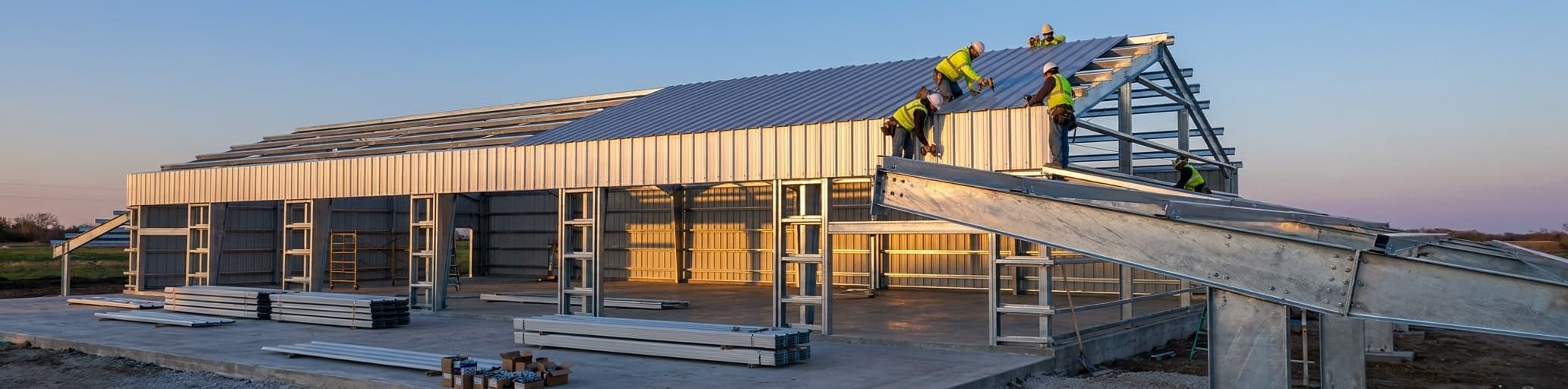

Metal garage kits arrive factory-fabricated with every structural component pre-engineered and labeled, letting you assemble a finished structure in days rather than months while cutting costs 30-40% below wood construction. We help you understand load paths, material grades, foundation requirements, and long-term maintenance so your kit performs reliably for 50-100 years with minimal upkeep.
What are metal garage kits and why they matter
Every piece of your steel garage kit arrives pre-fabricated and labeled to match engineered drawings, so nothing needs to be sourced locally or improvised on site.
Defining metal garage kits and core components
A metal garage kit is a pre-engineered steel building system delivered to your site as a complete, coordinated package — every structural member, panel, fastener, and accessory needed to raise a finished structure.[3] The industry defines a metal building system as "a complete integrated set of mutually dependent components and assemblies that form a building including primary and secondary framing, covering and accessories."[3] That coordination is the whole point: when you order steel garage kits, every piece arrives pre-fabricated, labeled with piece marks, and matched to engineered erection drawings, so nothing needs to be sourced locally or improvised on site.[2] The difference between a build that goes smoothly and one that stalls almost always comes down to whether the buyer understands what each component does and how it connects to the system around it.[2]
The kit breaks into five functional layers, each with a specific role in moving loads from roof to foundation:
- Primary framing — columns and rafters that form the main structural frame and carry all gravity and lateral loads down to the base plates and anchor bolts in your concrete foundation.[2]
- Secondary framing — purlins running horizontally across the roof and girts running horizontally along the walls, both supporting panels and distributing forces into the primary frame.[3]
- Bracing — rods, angles, or cables arranged in X-patterns across roof bays and wall bays to resist wind and seismic lateral loads and stabilize the frame during erection.[3]
- Cladding — roof and wall panels, ridge caps, flashings, closure strips, and trim that form the weather envelope and direct water away from the structure.[2]
- Connection hardware — base plates, anchor bolts, high-strength structural bolts, clip angles, gusset plates, and sealants that transfer forces between every layer.[2]
Load path is what ties all five layers together: forces travel from roof panels through purlins into rafters, down columns through base plates, and into the foundation.[2] A gap or mismatch anywhere in that chain — a missing trim piece, an incorrect bolt grade, a purlin with insufficient gauge — affects the entire system's strength, weather-tightness, and long-term maintenance costs.[2] That's why a well-specified kit lists not just steel tonnage, but member marks, quantities, coating specs, and a fastener schedule matched to each frame zone.[2]
Key advantages of metal garage kits over traditional construction
The most immediate difference you notice between a metal garage kit and stick-built wood construction is timeline. Building a wood garage is a construction project in the truest sense — blueprints, framing, roofing, siding, and weeks or even months of contractor labor, with weather delays that can blow your schedule and material cost spikes that can blow your budget.[5] A pre-engineered metal kit arrives factory-fabricated and can be installed on-site in less than a day.[4] That speed advantage translates directly to cost: steel garage kits start around $5 per square foot versus $7 and up for wood framing, and when total labor is factored in, prefab metal garages often cost half or less than a comparable stick-built structure.[4]
Durability is where the long-term math gets stark. Wood is organic — it expands, contracts, warps, and eventually rots when moisture works its way in.[5] Metal doesn't rot, doesn't warp in humidity, and gives termites, carpenter bees, and rodents nothing to work with.[4] A properly maintained steel structure can last well over 100 years without rust issues, and modern engineered metal buildings are frequently rated to withstand hurricane-force winds.[4][5] Steel also carries fire resistance that wood framing simply cannot match — a real advantage when you're protecting vehicles, equipment, or stored fuel.[5] If you want a deeper look at how steel structures hold up against wood over time, the long-term numbers consistently favor steel.
Once the build is done, the maintenance gap widens further. Wood garages demand repainting or restaining every few years, periodic shingle replacement, annual pest treatments, and winterization in cold climates — each one a recurring cost and time commitment.[5] A metal kit's factory finish is engineered to resist fading and chipping for decades; typical annual upkeep amounts to rinsing the panels with a garden hose.[5] Beyond maintenance, metal's clear-span framing removes interior support columns entirely, so you get unobstructed floor space — wide enough for a boat, tall enough for an RV, or fully open for workshop equipment — without the complex truss engineering that drives up cost in wood construction.[5] That combination of lower upfront cost, minimal maintenance, and maximized usable square footage is why property owners across commercial, agricultural, and industrial segments keep choosing metal garage kits over traditional builds.
Typical residential, commercial, and hobbyist applications for metal garage kits
The same kit platform that protects three sedans on a suburban lot can shelter a fleet of service vehicles at a commercial yard or house a combine harvester on a working farm. Understanding which use case matches yours is what drives every dimension and configuration decision. On the residential side, the primary variable is vehicle count and type: a standard car needs roughly 240 square feet of floor space with clearance for doors to open fully, while a medium-sized truck requires around 300 square feet; long-term storage without daily access drops those figures to 150 and 200 square feet respectively.[6] Eave height follows the same vehicle-first logic — 10'-12' handles passenger cars and pickup trucks, while oversized vehicles, trailers, and boats need 14'-18' of clearance.[6] Choosing a 12' eave also opens up space for a vehicle lift inside, a detail worth locking in during initial design rather than trying to accommodate later.[6]
Commercial operators use metal garage kits at larger scale but for many of the same structural reasons. Retail businesses build durable, high-traffic storefronts with metal structures that absorb daily customer volume without the repainting and repair cycle wood-framed spaces demand.[7] Manufacturers and small startups find the clear-span interior equally suited to production floors and warehousing, since column-free space adapts to equipment layouts and assembly configurations without load-bearing walls forcing compromises.[7] Agricultural steel buildings represent one of the most direct-value applications: farm operations use metal garage kits to store equipment, house livestock, and run working farm shops, with insulation and ventilation options sized around temperature control requirements for both animals and machinery.[7]
For hobbyists and hands-on builders, the kit format delivers a dedicated workspace configured around your workflow rather than a generic floor plan you adapt to. Roughly half of buyers erecting garages under 3,000 square feet choose to build the kit themselves, capturing 20-30% savings on total project cost with basic construction experience.[6] That same clear-span interior works as a home gym, a car restoration bay, a woodworking shop with overhead storage, or a dedicated space for any trade — without the interior framing complexity that inflates cost in stick-built alternatives.[7] The consistent thread across residential, commercial, agricultural, and hobbyist uses is that the kit's clear-span framing and configurable dimensions make it a starting point, not a constraint.
Designing Your Steel Building for Success
Your building's intended use and local geography determine every structural requirement, so getting these details right before requesting quotes keeps engineering accurate and pricing honest.
Assessing space, load requirements, and intended use
Intended use is the single variable that drives every dimension decision in a metal garage kit. Aircraft hangars, warehouses, and distribution centers need clear-span framing capable of delivering column-free interior widths up to 150 feet so large machinery and vehicles can maneuver without obstruction.[10] Your building's occupancy level — rated on a scale from 1 to 4 — directly affects snow load calculations, wind ratings, and required structural specs, so classifying occupancy before you request quotes keeps the engineering accurate and the pricing honest.[10] When finalizing footprint dimensions, going longer rather than wider saves real money: as width increases, heavier primary framing is required and cost climbs accordingly — a 40×60 layout costs less per square foot than a 60×40 layout with the same total area.[10] The dimensions you give a manufacturer represent outside measurements, not interior clear space, so factor in framing depth, girts, and purlins when planning usable floor area for vehicles, equipment, or workflow.[10] For agricultural and industrial buyers, a resource like farm equipment storage building dimensions shows exactly how getting those numbers right prevents daily maneuvering losses.
Geography sets your structural floor, and working below it creates liability. Metal garage roofs carry snow load ratings that typically run 30 to 60 psf, while commercial metal buildings must meet 50 to 100 psf depending on roof span and regional snowfall.[8] Wind speed ratings for metal garages range from 90 to 140 mph under standard conditions; hurricane-prone regions require 150 mph or higher, and commercial structures in high-risk zones are commonly engineered to 120-180 mph.[8] In seismically active areas — parts of California, Idaho, eastern Tennessee, and northeastern Arkansas — steel rod bracing replaces flexible cable bracing to add the rigidity those ground conditions demand.[10] Before requesting a single quote, check with your local permit office for the exact required loads at your installation site, then verify that every quote you compare reflects those loads in the price — the load drives the cost, and a number that omits it is not a valid comparison.[10]
Site conditions and future needs are where buyers most often leave money on the table. Poor drainage around a foundation accelerates rust and can compromise structural integrity over decades, so surveying the land and confirming water flows away from the building before the slab is poured is a step that protects the entire investment.[9] Specific soil conditions may require foundation adjustments to keep the structure level and stable over its lifespan.[9] For future-proofing, if you anticipate adding solar panels, a vehicle lift, mezzanine storage, or additional bays later, plan for the roof load capacity and wiring infrastructure now — retrofitting structural provisions after erection costs far more than designing for them from the start.[9] Sizing slightly larger than your current requirement is almost always the more cost-effective path than adding a structural extension once the building is occupied.[9]
Choosing roof styles, dimensions, and customization options
Roof style is the single design decision with the highest long-term consequence in a metal garage kit, because it determines how water, snow, and debris move off the structure every week — not just how the building looks from the street. Three styles dominate the market: regular, boxed eave, and vertical.[11] Regular roofs use rounded eaves with horizontal panels running side to side — the cheapest to produce, fastest to install, and perfectly adequate in mild climates with modest rainfall.[12] Boxed eave roofs keep horizontal panel direction but swap rounded eaves for straight, trimmed edges and an A-frame profile that reads as more finished when the structure sits beside a home or commercial storefront.[13] Vertical roofs run panels from ridge to eave, add hat channel framing underneath to support the orientation, and include a ridge cap — more steel, more labor, higher cost, but the best drainage performance of the three.[12]
Building length is what forces the roof decision for many buyers. Regular roofs are only appropriate on structures up to 35 feet long; beyond that, panel seam count rises and water infiltration at horizontal overlaps becomes a recurring problem rather than an edge case.[12] Vertical roofs are required on buildings longer than 35 feet and standard on widths over 30 feet, precisely because vertical panels shed standing water cleanly and freeze-thaw cycles don't exploit the joints the way horizontal overlaps fail in snow-prone regions.[12] Metal roofing materials also promote energy efficiency by reflecting heat in summer and insulating in winter, so the roof style you pick affects not just drainage but your seasonal operating costs too.[13] For a closer look at how panel selection and cost interact, the metal roof installation cost guide breaks down what drives pricing across gauge and finish options.
The comparison below maps each style to its practical fit so you can match your location and use case without second-guessing:
| Roof style | Panel direction | Eave shape | Suited for | Relative cost |
|---|---|---|---|---|
| Regular | Horizontal | Rounded | Mild climates, spans under 35 ft | Lowest |
| Boxed eave | Horizontal | Squared + trimmed | Aesthetic match to homes, moderate weather | Mid |
| Vertical | Vertical, ridge to eave | Squared + ridge cap | Heavy rain/snow, long buildings, RV storage | Highest |
The most consistent regret buyers report is choosing regular or boxed eave to save money, then living with drip lines along horizontal overlaps after the first hard storm season.[11] If you're sheltering an RV — a structure full of its own roof seams, slides, and penetrations — vertical is the correct choice regardless of building size, because the roof above it needs to shed water cleaner than anything horizontal can deliver.[11] Gutters are a useful addition to any of the three styles for directing runoff away from slabs, doorways, and adjacent landscaping, but gutters solve placement problems rather than panel-direction problems — wind-driven rain finding a horizontal overlap is a framing issue, not a drainage accessory issue.[11] Planning runoff direction before the slab is poured keeps water away from foundation edges, which protects the entire investment across decades of use.[11]
Integrating energy efficiency, smart technology, and code compliance
Energy code compliance is not optional — your metal garage kit cannot be permitted in most U.S. jurisdictions without satisfying the International Energy Conservation Code (IECC), which sets minimum requirements for the building envelope, insulation, air sealing, and mechanical systems.[14] Most commercial projects must meet IECC 2018, IECC 2021, or newer versions depending on location, with IECC 2021 significantly tightening roof-assembly requirements in Climate Zones 2-4.[14] Three compliance pathways exist: prescriptive (matching exact R-value minimums from IECC tables), performance (energy modeling against a baseline building), and COMcheck — the DOE's compliance software that most metal buildings use because it produces a permit-ready report while allowing limited trade-offs between envelope components.[14] Metal building systems can be engineered to comply with energy codes anywhere in North America, and industry bodies like the MBMA publish dedicated resources to help design professionals choose the right components for each climate zone.[15] Start COMcheck inputs before finalizing door and window specs — fenestration U-factors are required to run the calculations, and specifying them late is one of the most common causes of permit delays.[14]
The defining challenge steel introduces is thermal bridging, and it's more severe than most buyers anticipate. Steel's thermal conductivity is roughly 420 times that of wood, which means a girt running through a wall assembly acts as a near-zero R-value bypass that partially defeats whatever batt insulation you install between framing members.[16] A wall with R-19 batts between steel girts doesn't deliver R-19 — the effective assembly value can drop to R-5 or R-8 once bridging is fully accounted for.[16] The most reliable fix is continuous exterior insulation — typically XPS or polyiso rigid foam — installed on the outside of the girts to interrupt the steel-to-sheathing conduction path before it starts.[16] IECC requirements address this directly: insulation and thermal breaks must be part of the engineered assembly from the start, not retrofitted after materials are ordered.[14] For a detailed look at how wall and roof assembly U-factors interact in a real metal building, the insulated metal warehouse U-factor spec sheet shows how correct assembly selection changes both the compliance numbers and the long-term heating and cooling bills.
Air sealing compounds the energy picture in a way that insulation alone cannot fix. All joints, seams, penetrations, and openings in a metal envelope must be properly sealed — inadequate air sealing is one of the most frequently cited failure points during IECC inspections, and it's invisible until the inspector flags it.[14] Even a building classified as "unconditioned" needs to be reviewed carefully: installing any HVAC or mechanical ventilation can push the structure into a higher compliance category with stricter envelope requirements.[14] Cool metal roofs contribute on the other side of the energy ledger by reflecting solar heat in summer and adding insulation value in winter, which directly reduces seasonal HVAC demand.[15] The long-term sustainability case is equally solid — metal building systems carry Environmental Product Declarations (EPDs) validated to ISO standards and are recognized by above-code programs like LEED and Green Globes for their low-VOC profiles, recycled content, and full recyclability at end of life.[15] A correctly specified metal garage kit — continuous exterior insulation, engineered air sealing, and COMcheck-verified assemblies — passes inspection, costs less to condition year-round, and holds that performance across the full life of the structure.[14]
Materials, Quality Standards, and Installation Best Practices
Your frame choice determines span capacity, future expansion costs, and load ratings, so confirming whether you're getting rigid I-beam or C-channel before signing is essential.
Frame and panel options: I‑Beam, C‑Channel, gauge selection, and coatings
The frame system you choose sets the structural ceiling for everything else in your metal garage kit — span capacity, column-free clearance, load ratings, and the cost of any future expansion all trace back to this single decision. Two systems dominate the market: rigid I-beam frames and C-channel (cold-formed) frames.[18] Rigid I-beam frames, sometimes called hot-rolled or welded frames, deliver superior strength, stability, and design flexibility, making them the standard choice across commercial and industrial applications where spans are wide and loads are heavy.[18] C-channel frames are cold-formed — meaning steel coil is roll-pressed into a C-shaped profile without heat — which produces a lighter member suited to smaller-scale projects where design flexibility is less critical and cost efficiency is the primary driver.[18] The two systems are frequently confused in quotes, but they differ completely in structural design, scalability, and long-term performance, so confirming which system is in your package before signing is non-negotiable.[17]
Span and use case are the practical filters that separate the right frame from the wrong one. I-beam rigid frames carry all gravity and lateral loads through deep, welded web sections that can deliver clear-span widths well beyond what cold-formed profiles can achieve without intermediate columns — a real advantage for vehicle workshops, aviation hangars, and agricultural equipment bays where unobstructed floor space has direct operational value.[18] C-channel systems, by contrast, work efficiently on tighter footprints: a standard personal garage, a smaller farm storage bay, or a hobbyist workshop where the building width stays modest and the load demands are straightforward.[17] For buyers comparing cold-formed steel frame construction against hot-rolled alternatives, the key variable is always the span-to-load ratio — push either figure beyond what a cold-formed member is rated for and the frame either requires costly intermediate supports or must be re-specified as a rigid frame from the start.[19]
Gauge — the thickness of the steel used in panels and secondary framing members — is where most buyers absorb hidden cost without realizing it. Lower gauge numbers mean thicker steel: a 26-gauge panel is thinner and lighter than a 24-gauge panel, and the difference in dent resistance, spanning ability between purlins, and long-term fastener retention is significant under real service conditions.[19] DIY steel building kits on paper often appear far more affordable because they spec thinner gauges in the panels and secondary members, and most buyers don't catch the downgrade until they're comparing completed structures.[19] For panel cladding, 26-gauge is the common entry point on residential and light commercial structures; 24-gauge adds measurable rigidity and is the practical minimum for agricultural buildings, commercial facilities, and any structure in a high-wind or heavy-snow region where panels take sustained dynamic loading.
Coatings protect all of it. The steel substrate in a quality kit arrives either with a Galvalume finish — an aluminum-zinc alloy coating applied at the mill — or with a factory-applied Kynar/PVDF paint system over a zinc primer.[17] Galvalume delivers corrosion resistance by sacrificial protection: the zinc-aluminum layer oxidizes preferentially, leaving the base steel intact even when the surface is scratched.[17] A PVDF topcoat adds color retention, chalk resistance, and UV stability across decades of exposure — the factory finish on a properly specified panel should not require repainting within the building's service life under normal conditions.[18] When comparing quotes, ask for the explicit coating spec by name and mil thickness; a vague reference to a "painted" or "coated" panel tells you nothing about the system's actual field performance, and the difference between a bargain coating and an engineered one shows up in the maintenance column every year.
Fasteners, connectors, anchoring systems, certifications, and warranties
The fastener holding your roof panel in place does more work than most buyers realize — it's the final transfer point between the panel system and every load-bearing component behind it.
Quality metal garage kits supply self-drilling cast zinc fasteners matched specifically to Galvalume sheathing, with a lifetime warranty against red rust formation on the head.[20] Beneath each fastener sits an EPDM sealing washer that creates a waterproof seal resistant to ozone and UV degradation under continuous weather exposure.[20] Structural connections between primary and secondary framing — columns to base plates, rafters to clips, girts to frames — use high-strength bolts and nuts sized to the load at each joint, with clips pre-welded to frames at the factory so field drilling is eliminated and bolt patterns stay consistent with engineered drawings.[20] Waterproofing continuity depends on die-formed ridge caps that hold metal-to-metal contact at roof seams, plus foam rubber closure strips at eaves and base sealed with mastic and double-sided tape.[20] Every one of these components should arrive in the kit, documented on the bill of lading — anything sourced locally after delivery is a gap in the engineered system.
# Anchoring systems
How a metal garage kit connects to its foundation determines whether the structure stays put in a high-wind event.
The standard anchor for concrete installations is the post-installed wedge anchor, which expands under torque into cured concrete to resist uplift forces; the minimum spec is 1/2-inch diameter with at least 4 inches of embedment, stepping up to 5/8- or 3/4-inch for taller buildings or high-wind regions.[22] For installations on dirt or gravel, 30-inch helical mobile home anchors screw into the ground at every leg location — not every other — to replicate the uplift resistance concrete normally provides.[22] Paved surfaces use asphalt anchors with barbed or finned profiles that grip the paving material, effective in 3 or more inches of good-condition asphalt.[22] Tall structures and coastal builds add buried concrete tie-down blocks at each leg as a secondary uplift system — unnecessary in mild climates, essential near the Gulf or Atlantic coasts where sustained wind loads are a real design condition.[22] The anchor bolt plan on your engineered drawings reflects the specific wind and snow loads for your site; verify the required spec with your local permit office before the slab is poured, because changing anchor diameter after concrete cures means core-drilling and re-epoxying, which adds cost and delays inspection.
# Certifications and warranties
Metal building materials sit inside an extensive library of standards, and knowing which ones govern your kit is what separates a build that passes inspection from one that creates liability. The most common governing standards are ASTM standards for material composition and physical properties, and AISC standards for fabrication quality and structural performance — both of which a legitimate supplier can document for every component in your package.[21] For a deeper look at how structural steel components meet those standards in practice, the component-level breakdown shows exactly where each certification applies across a finished assembly. A complete kit includes three sets of engineer-stamped plans with a Letter of Certification signed by a professional engineer licensed in your state, confirming the design meets local wind, snow, and seismic requirements — the stamp is what your permit office requires before issuing approval.[20] On the warranty side, the steel substrate and finish carry separate coverage periods:
- Galvalume substrate: 25-year warranty against rust perforation.[22]
- Painted finish: 40-year film integrity, 30-year chalk and fade protection from the steel manufacturer.[22]
- 12-gauge structural framing: 20-year rust-through warranty from the building manufacturer.[22]
- 14-gauge structural framing: 10-year rust-through warranty.[22]
- Installation workmanship: 6 months from installation date, covering defects like missing fasteners or misaligned panels.[22]
Structural warranty coverage is voided by unauthorized modifications — cutting or welding framing members, drilling additional holes, or relocating the building all terminate manufacturer coverage.[22] When comparing supplier quotes, ask each one to provide warranty terms for the substrate, finish, framing, and workmanship as separate line items. A vague reference to a "covered" building tells you nothing actionable about which failure modes are actually protected.
Step‑by‑step installation workflow with safety tips and troubleshooting
Before a single column goes vertical, the work that determines your project's outcome is already finished — or not. Every permit check, foundation decision, and site condition review happens before the kit arrives, and errors at this stage cost far more to correct than they do to prevent.[23] Confirm your local building department's requirements for snow loads, wind ratings, setbacks, and anchor bolt specs before the slab is poured — changing anchor bolt diameter after concrete cures means core-drilling and epoxy injection, which delays inspection and adds avoidable cost.[23] A monolithic slab is the standard foundation choice for most residential and commercial metal garage kits: a single pour serves as both footing and floor on stable, level ground.[24] For uneven terrain or expansive soils, pier or perimeter wall foundations distribute loads at individual structural points instead.[24] The highest-risk detail in foundation work is anchor bolt placement — these J-shaped bolts must match your engineered drawings to the millimeter, because misaligned bolts mean columns that won't seat, and no amount of field adjustment fully resolves that problem once the concrete cures.[23]
Frame erection follows a specific sequence that keeps the structure stable at every stage:
- Unpack all components and verify each piece against the manufacturer's packing list before lifting anything.[23]
- Raise the first bay — two columns plus their connecting rafter — at one end of the building, and brace it plumb before moving to the next bay.[23]
- Connect each subsequent bay to the previous one with roof purlins and wall girts, building a chain of stability across the frame.[23]
- Keep all bolted connections slightly loose until a full section is assembled, squared, and verified plumb — only then torque bolts to the manufacturer's specification.[23]
- Install permanent X-bracing per your engineered drawings as soon as each section allows, replacing temporary cables that held the frame during assembly.[23]
Wall panels go on before roof panels, starting at a corner and working outward to establish a square, plumb baseline for everything that follows.[23] Roof panels run from eave to ridge, with every seam sealed — the most common leak source on completed metal garage kits is a roof screw that's either under-tightened, leaving the EPDM washer unsealed, or over-tightened, dimpling the panel and creating a small basin where water collects.[23] Trim is the final step: ridge caps, corner pieces, eave trim, and base flashing cover sharp panel edges, seal remaining gaps, and complete the weather envelope before your first inspection.[23]
Safety protocols govern every phase of the erection sequence. Every crew member needs hard hats, steel-toed boots, heavy-duty gloves, safety goggles, and a harness when working above ground level.[24] A site-specific erection plan that identifies hazards, assigns roles, and outlines fall protection systems — including Personal Fall Arrest Systems and perimeter safety cables — must be written before day one, not improvised on-site.[24] Nobody stands under a suspended load, and equipment operators handling forklifts, telehandlers, or cranes must hold current certifications before touching the controls.[23] For structures under 3,000 square feet, a DIY crew with solid construction experience can manage the full erection sequence; larger or more complex builds benefit from a vetted steel building erector who owns the equipment and reads erection drawings under real field conditions.[23]
Most troubleshooting problems trace back to pre-construction decisions, not errors made during erection itself. Insufficient planning, poor site assessment, and skipped permit review account for the majority of cost overruns and schedule slips on metal garage projects.[24] On-site, the two most common fixable errors are misaligned panels caused by a frame torqued down before it was fully squared, and fastener-driven leaks caused by incorrect screw depth — both of which inspection catches but field repair makes expensive.[23] Build a 10-15% contingency into your total project budget — not just the kit cost — to absorb unexpected soil conditions, material adjustments, or permit-required specification changes without halting the build mid-sequence.[23]
Cost, Financing, Maintenance, and Choosing National Steel Buildings
Request itemized quotes that break out steel, foundation, delivery, and labor separately to avoid the budget overruns that hide in the gap between kit cost and installed cost.
Transparent cost breakdown, financing programs, and tax incentives
Knowing where your money goes before you commit to a metal garage kit is what separates a budget that holds from one that surprises you at every milestone. Kit prices — the steel package alone — run $15 to $20 per square foot, translating to roughly $24,000 for a 35×40, $43,200 for a 45×60, and $75,000 for a 50×100.[25] Once you add the concrete slab, delivery, and construction labor, a fully installed turnkey price lands between $24 and $43 per square foot.[25] The gap between kit cost and installed cost is where most budget overruns hide, so request itemized quotes that break out each line — steel package, foundation, delivery, and erection — rather than a single turnkey number you can't audit.[25]
Financing is more accessible than most buyers expect. One of the most useful programs is PACE — Property Assessed Clean Energy — which lets residential and commercial property owners finance energy-efficiency upgrades and repay them over up to 20 years as a voluntary addition to their property tax bill.[27] Because the loan attaches to the property rather than the borrower, it transfers automatically if you sell before repayment is complete, and the interest may be tax-deductible.[27] For buyers adding insulation, solar, HVAC, or other qualifying systems to a steel garage kit, PACE can eliminate the upfront cost entirely while keeping monthly payments below the energy savings the upgrade generates.[27] For a detailed walkthrough of how financing structures interact with real project budgets, financing options for metal building projects shows how different programs close the gap between kit cost and total project spend.
The tax picture is where metal garage kits separate from almost every other construction investment. Commercial property owners can depreciate a metal building under MACRS — the IRS's Modified Accelerated Cost Recovery System — typically over a 39-year schedule for commercial structures, but provisions exist to accelerate that recovery significantly.[26] Section 179 of the tax code lets businesses deduct the full cost of qualifying property, including certain metal building systems, in the year the structure is placed into service, with a limit of up to $1,160,000 in 2024.[26] Bonus depreciation, introduced by the Tax Cuts and Jobs Act, allowed 100% first-year write-off on qualifying new structures — though the rate is phasing down at 20-percentage-point annual increments, so acting before each step-down preserves the larger deduction.[26] Beyond depreciation, metal buildings incorporating energy-efficient features such as high-performance insulation, reflective coatings, or solar panels may qualify for Section 45L tax credits and the Residential Energy Efficient Property Credit, which covers 30% of qualified solar, wind, and fuel cell installations connected to your property.[26][27] A steel garage also qualifies as a capital improvement, which can reduce taxable gain when you eventually sell.[27] Verify every provision with a tax professional before filing — deduction limits and phase-out thresholds update annually, and your building's classification as residential or commercial determines exactly which provisions apply.[26]
Calculating long‑term ROI, energy savings, and resale value
ROI on a metal garage kit doesn't come from one number — it comes from stacking five cost categories where steel outperforms wood every single year. Metal garages cost 30-40% less upfront than comparable wood structures, and that gap compounds across maintenance, insurance, pest control, and longevity.[28] Over a 30-year ownership period, a wood garage can cost two to three times more than a comparable steel structure when every dollar is counted — repainting cycles, shingle replacement, moisture remediation, annual pest treatments, and eventual partial rebuild.[28] A steel garage built with quality Galvalume components can realistically last 50 to 100 years, which cuts per-year ownership cost dramatically against a wood-framed alternative that typically requires major intervention well within that window.[29] Traditional garage maintenance runs three to eight times higher over a 10-year period than the near-zero upkeep a steel structure demands — a gap that grows every year you hold the property.[29]
| Cost category | Steel garage (30-year) | Wood garage (30-year) |
|---|---|---|
| Upfront kit + install | Lower by 30-40% | Higher baseline cost |
| Annual maintenance | Minimal (rinse, inspect) | Repainting, shingles, pest control |
| Pest & moisture damage | Near-zero risk | Recurring vulnerability |
| Structural lifespan | 50-100+ years | Requires rebuilds within window |
| Total ownership cost | Lower | 2-3x higher over 30 years |
Energy performance depends entirely on the insulation decisions you make at construction, not on the steel itself. Steel conducts heat roughly 420 times faster than wood, so an uninsulated metal garage runs hotter in summer and colder in winter — but a properly insulated steel structure performs on par with or better than a wood-framed alternative in the same climate.[29] The payback on quality continuous rigid foam or spray foam insulation is direct: every dollar spent at build time reduces HVAC operating cost across the full life of the structure. For property owners who condition the space for a workshop, gym, or aviation hangar, the energy-efficient metal buildings guide maps ASHRAE 90.1 compliance to real operating cost reductions — the same framework that qualifies your building for energy tax incentives.
On resale, both material types add to property value, but metal delivers a slightly better return — and in markets with severe weather exposure, high pest pressure, or elevated insurance costs, that gap widens further in steel's favor.[28] Appraisers are treating metal buildings as permanent structures with increasing consistency, and the durability of a steel garage is viewed favorably against an aging wood-framed alternative on the same parcel.[29] In rural, agricultural, and commercial markets where workshop and covered storage square footage directly drives land value, a well-finished metal garage kit often returns more per dollar invested than any other outbuilding improvement.[29] In regions with storm risk — Gulf Coast, Tornado Alley, Atlantic coastal markets — the ROI gap between steel and wood widens even further, because steel's engineered wind ratings mean buyers face lower post-storm repair liability and lower insurance premiums year over year.[28]
Service excellence: design tools, 3‑D visualizer, warranties, and customer success stories
The gap between "I have an idea" and "I have a permit-ready drawing" used to mean weeks of back-and-forth with an architect. Browser-based 3D design tools close that gap to minutes. Suppliers like Toro Steel Buildings and Norsteel both offer online 3D building designers where you dial in sizes, door placements, color selections, and layout options before a single quote is requested — giving your building consultant a concrete starting point rather than a verbal description to interpret.[31][32] Toro's tool requires no prior design experience and produces a visual model that shows your building from multiple angles, making it easier to spot layout conflicts or missing clearances before they become fabrication revision costs.[31] Norsteel's 3D Design Tool operates on the same principle: explore layouts, styles, and features until the model matches your actual needs, then submit it as the basis for engineering and pricing.[32] That sequence — visualize first, quote second — protects your budget because specification decisions surface before they trigger change orders. Understanding how that design-to-delivery timeline unfolds is worth mapping early, and the prefab building kits delivery timeline guide shows exactly what happens between order placement and components arriving on your slab.
Warranties translate material quality claims into contractual commitments, and the coverage structure in a well-specified kit breaks down by component rather than applying a single blanket term to the entire building. For straight-wall steel buildings, a 1-year limited warranty covers failures caused by faulty or substandard materials, while roof and wall paint warranties run 25 to 40 years depending on the panel and finish selected.[31] Arch-style buildings carry a 50-year limited warranty against rust perforation, a 30-year limited warranty on damage caused by snow or wind loads, and a 60-day warranty covering delivery shortages or defects in material or workmanship.[31] Norsteel backs its pre-engineered metal buildings with industry-leading warranties on structures designed, engineered, and fabricated in state-of-the-art manufacturing plants.[32] When comparing suppliers, ask for each warranty tier as a separate written document — substrate, finish, framing, and workmanship — so coverage gaps are visible before you sign, not after the first hard weather season.
What buyers actually experience after the kit arrives is where supplier promises get tested against real conditions. Norsteel customers consistently cite responsive engineering support as the deciding factor: one buyer noted the team "responded immediately" and "provided engineering that met and exceeded expectations," while another described the staff as "honest, down to earth and really know their stuff" across multiple projects spanning years.[32] Toro's customer base shows a parallel pattern — a buyer assembling a 30×40 steel building described the process as "excellent" and credited direct support from a named consultant for answering every question throughout the project.[31] First-time builders specifically call out clear assembly instructions as the difference between a smooth erection sequence and a costly stall: one owner over 60 completed a kit independently and ordered a second building immediately after.[31] A client experience documented by Worldwide Steel Buildings reinforces the same theme — a defined process with a real point of contact made a first-time steel building purchase manageable from design through delivery.[30] Those accounts reflect what happens when a supplier owns the process from engineering through fabrication: problems surface before components ship, accountability stays direct, and you're not left tracking down answers from a dealer who wasn't in the room when the building was designed.
- Metal garage kits arrive pre-fabricated with every component labeled and matched to engineered drawings, eliminating on-site sourcing and improvisation.
- Five functional layers–primary framing, secondary framing, bracing, cladding, and connection hardware–work together in a load path; gaps anywhere compromise the entire system.
- Metal garages cost 30-40% less upfront than wood and 2-3x less over 30 years when maintenance, pest control, and structural lifespan are factored in.
- Thermal bridging through steel is 420 times worse than wood; continuous exterior insulation is required to meet energy codes and avoid R-value collapse.
- Vertical roof panels are mandatory on buildings longer than 35 feet; horizontal overlaps fail in freeze-thaw cycles and create recurring water infiltration problems.
- Anchor bolt placement must match engineered drawings to the millimeter before concrete cures; misalignment after pour requires core-drilling and epoxy injection.
- Quality coatings, fasteners, and closure strips are non-negotiable; sourcing components locally after delivery creates gaps in the engineered system and voids warranties.
- https://buildway.com/metal-building-kit-contents-guide/
- https://www.ibeehivesteelstructures.com/blog/steel-structure-building-parts-explained/
- https://www.worldwidesteelbuildings.com/resources/glossary-of-terms/
- https://alansfactoryoutlet.com/metal-garage-vs-wood-garage/?srsltid=AfmBOoor6BW33raTGqR0AoWzt4fSa-dbi_BWRA1uS-8e9krnkPkiDgKg
- https://actionbuildings.com/blogs/storage-ideas/prefab-metal-garage-vs-wood-which-is-better?srsltid=AfmBOorCniXPkXw8TR0mbNCkwMtp4TrKIa7vdw3J2yjI7vNVWKmvUmhB
- https://www.buildingsguide.com/build/metal-garage-construction/?srsltid=AfmBOopCOamTWvpNXWSQK-lhATz6jIsmgXBY8_Q7fnEhdiqNpct-Jlin
- https://www.vikingsteelstructures.com/multi-use-metal-buildings?srsltid=AfmBOooANdOaQpBKz96IzYWLzo9KEYtDkfeXdR2KoRoX38v96ZeROrbe
- https://valuemetalbuildings.com/blog/snow-load-and-wind-speed-ratings
- https://www.eaglecarports.com/blog/designing-a-metal-building
- https://www.fortifybuildingsolutions.com/resources/blog/top-things-to-consider-when-buying-a-metal-building/
- https://www.aametalbuildings.com/blog/metal-carport-roof-styles-regular-vs-boxed-eave-vs-vertical?srsltid=AfmBOoqmG6mK3qJV2pj5Fo2hbOK0f6Ky9KYYJ728H8VIE5jqq6U5bgAd
- https://eversafebuildings.com/roof-types/?srsltid=AfmBOorpK9QiJtHyjkp_xIDVYQ-1Go7P8lJTjoZahGidj3-0RIbF_0JL
- https://titansteelstructures.com/metal-structure-tutorials/comparing-popular-prefab-metal-building-roof-styles/
- https://www.forgefabmb.com/iecc-compliance-for-metal-buildings-insulation-comcheck-and-envelope-design
- https://mbma.com/energy-sustainability
- https://www.greenbuildingadvisor.com/question/exterior-xps-layer-on-steel-building
- https://norsteelbuildings.com/us/steel-building-systems/cee-channel-vs-tube-steel-buildings-choosing-the-right-structure/
- https://steelcommandercorp.com/rigid-frame-vs-c-channel-steel-buildings/
- https://buildway.com/cold-formed-vs-i-beam-vs-quonset/
- https://www.rhinobldg.com/steel-building-features-and-options
- https://jagmetalsllc.com/blog/understanding-the-certifications-and-standards-in-metal-building-materials/
- https://metal-america.com/complete-guide-to-metal-buildings/
- https://iconsteelbuildings.com/how-to-erect-a-metal-building/
- https://www.hcsteelstructure.com/assemble-prefabricated-steel-building-kit-yourself-guide/
- https://www.buildingsguide.com/metal-building-prices/?srsltid=AfmBOor53t61UbhpsV7z57C0m9dOLuM0eNB0-p68f0MMmM1hkGtWMoQR
- https://www.paramountmetalsystems.com/tax-advantages-of-metal-building-systems-save-money-while-adding-value
- https://armstrongsteel.com/blog/what-are-the-tax-benefits-of-steel-buildings
- https://www.eaglecarports.com/blog/metal-garages-vs-wood-garages
- https://www.vikingsteelstructures.com/blog/steel-garage-vs-traditional-garage?srsltid=AfmBOordHkyJLY689GElEl77AklFKMCTU1nk-S0AjDCYl_IxQBQubjhI
- https://www.worldwidesteelbuildings.com/blog/steel-building-process-one-clients-real-life-experience/
- https://torosteelbuildings.com/
- https://norsteelbuildings.com/us/