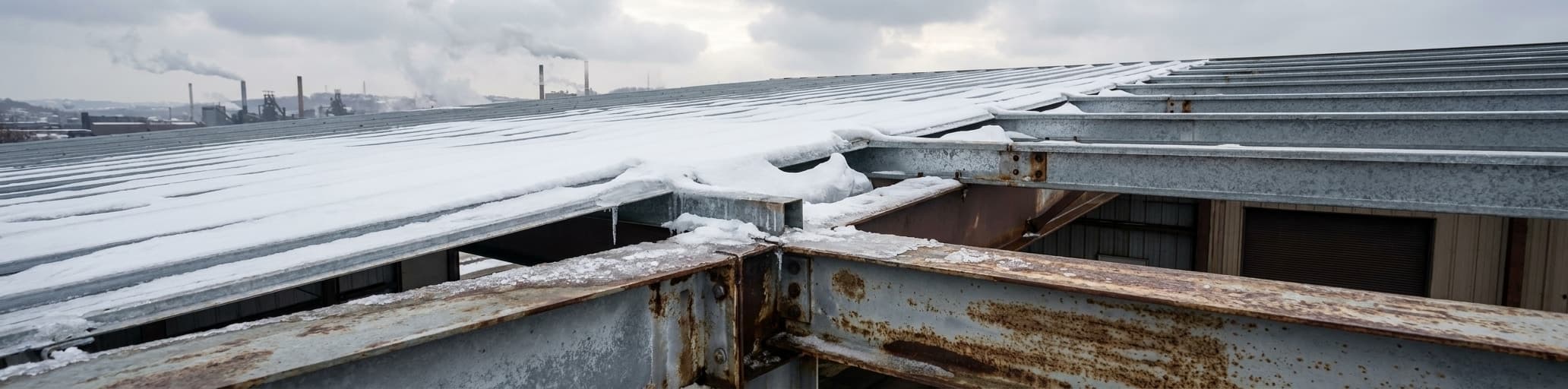

We help you engineer Pennsylvania steel buildings that withstand extreme snow loads up to 60 psf and humidity-driven corrosion through site-specific design and proper coating systems. Getting these climate specs right during design–not after construction–keeps your structure performing reliably across decades of freeze-thaw cycles and heavy winter accumulation.
Why Pittsburgh's Extreme Weather Demands Custom Steel Building Engineering
Pittsburgh's snow loads of 35-40 psf and freeze-thaw cycles demand engineered steel buildings with certified load ratings and corrosion protection.
Pittsburgh receives 41 inches of annual snowfall: what your roof load capacity must handle
Western Pennsylvania's snowfall creates a structural engineering problem, not just a seasonal maintenance task.
Ground snow loads across the state range from roughly 25 psf in southeastern Pennsylvania to 60 psf or higher in the lake-effect zones near Erie, and Pittsburgh's metro and Allegheny Plateau counties routinely require certified snow load ratings of 35 to 40 psf.[1] Those aren't worst-case projections — Pennsylvania winters have collapsed countless inadequately engineered structures under sustained loads that met or exceeded exactly those figures.[2] Under ASCE 7, engineers don't apply ground snow load (Pg) directly to roof design; they convert it into roof snow load using exposure, thermal, and importance factor adjustments, meaning your stamped roof capacity reflects a calculated chain of site-specific variables, not a raw measurement of snow depth.[1] Drift loads compound the problem further: parapet walls, roof transitions, and adjacent structures create localized surcharges that can substantially exceed uniform snow load, and failing to design for drift is a documented cause of partial roof collapse in urban settings like Pittsburgh.[1] Any steel building in Pennsylvania must include stamped calculations verifying ground snow load sourcing, the full ASCE 7 adjustment factors, and explicit drift load coverage before a permit will be issued — skipping any step exposes you to permit rejection and structural liability.[1]
Humidity and freeze-thaw cycles: the hidden threat to building longevity in western Pennsylvania
Snow load gets the attention, but moisture is what quietly degrades a building's service life.
Western Pennsylvania's combination of elevated annual humidity and repeated winter freeze-thaw cycles creates a sustained corrosion problem: moisture enters surface imperfections, freezes, expands, and widens those entry points with each cycle until unprotected steel begins losing section.[5] Carbon steel exposed to persistent moisture and chloride-bearing air is particularly vulnerable, with rust typically initiating at fastener pockets, unsealed base plates, and any gap in protective coating.[5] Water infiltration then cascades into secondary damage — corroding structural reinforcements, degrading insulation performance, and creating interior conditions that favor mold and mildew growth.[4] Pittsburgh's industrial legacy compounds the baseline risk: residual airborne particulates accelerate surface oxidation beyond what a generic mid-Atlantic corrosion benchmark anticipates, meaning buildings engineered to standard regional specs can still underperform specifically in Allegheny County conditions.[5] Pennsylvania properties on regular inspection schedules experience significantly fewer major structural failures than those without systematic protocols — making an annual check, plus additional inspections after severe winters, the lowest-cost intervention available.[5] The design-phase answers are zinc or epoxy coatings applied over properly prepared steel surfaces, sealed penetrations at every envelope entry point, and base connection geometry that prevents standing water from collecting; pairing those coating decisions with a well-specified vapor barrier and insulation system keeps condensation from becoming an interior corrosion accelerant that bypasses exterior protection entirely.[5]
How National Steel Buildings designs for Pennsylvania's specific climate zone requirements
Pennsylvania's IBC 2018 requires construction documents to explicitly record roof snow load data, wind design parameters, and each applicable load combination before a permit can move forward.[6] Those requirements reference ASCE 7 directly, which Pennsylvania adopts into its building code.[7] The 2022 edition of ASCE 7 made one change that affects every steel building in Pittsburgh and across western Pennsylvania: ground snow loads were recalculated using 30 years of additional data and shifted from a 50-year mean recurrence interval to reliability-targeted values, with the load factor on snow revised from 1.6 to 1.0 to reflect that updated basis.[8] For the Northeast — including Allegheny County — the winter wind parameter W2 runs 0.45 to 0.65, among the highest in the country, which amplifies drift surcharge calculations compared to calmer-wind regions and pushes local drift loads well beyond what earlier ASCE 7-16 designs anticipated.[8] Getting those numbers right means your stamped drawings document the exact ground snow load source, all ASCE 7-22 adjustment factors, and drift calculations tied to your site's specific W2 value — a package that satisfies Pennsylvania's Section 1603 documentation requirements and closes every permit gap before a single piece of steel ships.[6]
Snow Load Specifications for Steel Buildings in Pittsburgh and Western PA
Pittsburgh's 30 psf ground snow load baseline must be increased on the roof itself to account for drift, partial loading, and extreme accumulation events that simple calculations underestimate.
Ground snow load calculations: 20 psf baseline and why peak winter events demand 30+ psf roof design
Pittsburgh's municipal code directly amends the base standard: the City of Pittsburgh sets its required ground snow load (Pg) at 30 psf, which is the starting input for every roof calculation on a permitted structure in the city.[9] Applying the ASCE 7 flat roof formula — Pf = 0.7 x Ce x Ct x Is x Pg — with standard exposure, thermal, and importance factors all equal to 1.0 produces a flat roof snow load of roughly 21 psf.[9] Pennsylvania's IBC 2018 Section 1608 requires construction documents to record this ground snow load data explicitly, so that calculated value must appear in your stamped drawings before a permit moves forward.[6] But 21 psf is a floor, not a ceiling.
Partial loading, unbalanced roof snow loads, drifts on lower roofs, roof projections, parapets, and rain-on-snow surcharge can all push the actual design requirement well above that figure — and each of those effects must be addressed under ASCE 7 before your engineer signs off.[9] ASCE 7-22 reinforced this further: reliability-targeted analysis found that mid-latitude cities — including the Pittsburgh region — carry outsized risk from extreme short-duration accumulation events, precisely because mild winters create intervals of partial melt followed by sudden heavy accumulation that a simple 50-year recurrence interval underestimates.[10] The practical result is that a roof engineered to only the calculated flat-roof baseline will be under-specified for the conditions Pennsylvania winters actually produce; designing to 30 psf or above on the roof itself, before drift surcharges are added, is what keeps your structural steel components performing across the full range of load events your building will face over its service life.[10]
Roof pitch, truss spacing, and eave design: engineering decisions that prevent catastrophic snow load failure
Roof pitch is the first variable your engineer locks in when designing for Pennsylvania snow. At slopes between 1:12 and 3:12 — common on warehouse and agricultural steel buildings — snow compacts, lingers, and forms ice dams at the eaves, which compounds both load magnitude and load duration.[11] Moderate pitches in the 4:12 to 6:12 range give steel buildings in Pittsburgh the best balance: snow slides naturally once it warms or adds weight, reducing long-term accumulation without introducing the sliding-snow hazard that steeper pitches create at lower roofs, awnings, and adjacent structures.[11] The engineering standard for heavy-snow regions puts the optimal pitch at 5:12 to 8:12, where accumulation stays manageable and structural demand stays predictable season after season.[11]
Truss spacing is where a lot of owners expect a fixed rule — there isn't one. Modern computerized truss engineering sets spacing based on span, bay load, and site-specific design conditions rather than any prescriptive limit; properly designed steel trusses can be placed at 12-foot centers or beyond when purlins are oriented on edge and loads are fully verified.[12] That design flexibility is the performance advantage a steel truss system holds over conventional pole barn framing — you get the fewest members doing the most structural work, within safe engineering tolerances, rather than compensating for weaker material with tighter and costlier spacing.[12] What matters in every configuration is load path continuity: each pound of snow must transfer cleanly through the roof panel, into the purlin, down through the truss chord, and to the column without overstressing any single connection.[11]
Eave design ties both decisions together. At low-pitch eaves, interior heat migrates toward the colder roof edge, melts the underside of the snow layer, and refreezes into an ice dam that redirects meltwater under panel seams — exactly the infiltration pathway that initiates freeze-thaw corrosion and insulation degradation.[11] Properly detailed eave overhangs, combined with ventilation that equalizes roof surface temperature, prevent that cycle from starting. Wherever a lean-to, attached bay, or lower roof abuts the primary structure, drift surcharge at that junction can double or triple the local design load, and tighter truss spacing or heavier purlins at precisely those transition zones is the cost-effective answer — rather than upsizing the entire frame to compensate for one predictable geometry problem.[11]
National Steel Buildings's snow load Estimates: tool to spec your building's roof system for your exact location
Two free public tools cut the guesswork out of early-stage roof planning before your engineer runs the full ASCE 7-22 calculation chain.
The ASCE Hazard Tool at ascehazardtool.org delivers ground snow load values tied to both location and risk category — the exact input Pennsylvania's IBC 2018 Section 1603.1.3 requires your stamped construction documents to record before a permit moves forward.[6] SnowLoadByZip.com maps ASCE 7-22 ground snow load data to every US ZIP code, so you can pull a county-level psf figure for any Pennsylvania site in seconds.[14] What those lookups give you is pg — ground snow load — which is not the number your roof is engineered to carry.
Roof snow load (pf) runs 50 to 90 percent of pg depending on exposure, thermal conditions, and building importance, calculated through ASCE 7-22's formula pf = 0.7 x Ce x Ct x Is x pg.[14] One important flag: if your site returns a "Case Study" designation rather than a specific psf value, ASCE 7-22 has flagged that local elevation, terrain, or microclimate variation makes a county-level figure unreliable — and a licensed engineer must conduct a site-specific study using local weather station data before any roof spec can be stamped.[14] For most western Pennsylvania addresses, the lookup will return a concrete psf figure you can hand directly to your design team as the starting input, tightening your structural scope and keeping your project on schedule without waiting for preliminary engineering to confirm what the code map already shows.[13]
Humidity, Corrosion, and Coating Systems for Pennsylvania Steel Structures
Proper ventilation design–ridge vents, wall inlets, and exhaust fans–stops condensation before it damages steel panels and hidden cavities.
Condensation control and ventilation design: preventing interior moisture damage in agricultural, commercial, and industrial buildings Condensation in steel buildings forms when warm, moist interior air contacts cooler steel surfaces — a physics problem that Pennsylvania winters sharpen but that livestock respiration, wash-down operations, industrial machinery, and stored materials sustain independently of outdoor temperature.[20] Three factors drive every condensation event: temperature differential across the envelope, elevated interior humidity from occupancy or operations, and insufficient air exchange that allows moisture-laden air to stagnate at the panel surface.[21] Ventilation is the mechanical solution, and it works best when designed in from the start rather than retrofitted. Cross-ventilation — openings positioned on opposite walls — creates a pressure-driven exchange path; ridge and soffit vents pair with those wall openings to establish natural stack-effect airflow that continuously exhausts humid air before it reaches the dew point at roof panels; exhaust fans provide mechanical backup in high-humidity zones like workshops, livestock enclosures, and spray bays where passive airflow can't keep pace with moisture generation.[21] For agricultural and commercial buildings across western Pennsylvania where you can't practically run full HVAC 24 hours a day, a well-specified barn ventilation layout that integrates ridge vents with low-wall inlets solves the year-round moisture problem without ongoing energy cost.
The less visible threat is what building scientists call channel flow: air infiltrating through small gaps in the enclosure travels far enough through the wall or roof assembly to cool below its dew point, depositing concentrated moisture inside cavities rather than on interior surfaces where you'd notice it.[22] Air pressure differentials — driven by wind, stack effect, and HVAC fan pressure — move hundreds of times more water vapor through enclosure gaps than diffusion alone over the same period, which means even minor unsealed penetrations at conduit entries, fastener pockets, and wall-to-roof transitions can accumulate enough hidden moisture to corrode concealed steel framing and degrade insulation performance long before any interior damage becomes visible.[22] The design counter is a continuous air barrier system: a traceable airtight plane running through every wall assembly, roof section, foundation connection, and framing penetration, with flexible sealed joints at each transition point so thermal cycling doesn't reopen gaps over the building's service life.[22] Under ASHRAE 90.1 and the IECC — both referenced in Pennsylvania's energy code — air barrier materials must test at or below 0.02 L/s*m² at 75 Pa, and whole-building air leakage must not exceed 0.4 cfm/ft² when tested per ASTM E779.[22] For industrial warehouses, agricultural facilities, and commercial buildings where interior humidity is structurally driven by the operation itself, reaching those airtightness benchmarks is what keeps hidden corrosion and mold from shortening a building's service life well before its structural components have any reason to fail.
Designing Your Pittsburgh Steel Building: From Climate Specs to Final Erection
Pennsylvania warehouses, hangars, and agricultural buildings require snow-load engineering and factory-certified erection teams working under unified accountability.
Real-world Pennsylvania project examples: warehouse, hangar, and agricultural buildings engineered and erected by NSB for snow, humidity, and load requirements Warehouses built for Pennsylvania's climate carry a load specification problem that doesn't appear in standard national catalogs. A 100,000-square-foot distribution facility in Allegheny County operates under 30+ psf ground snow load, meaning every purlin, every connection, and every column base must be sized for sustained accumulation — not just a single-event peak.[26] Industrial and warehouse builds across Pennsylvania require full turnkey construction services with licensed, insured, and factory-certified erection crews, because the gap between a stamped drawing and a correctly installed drift-zone purlin is where under-engineered structures fail.[26] The practical answer for a warehouse in western Pennsylvania is a building system where structural framing, coating spec, and erection crew all operate under a single accountable scope — the same team that sized the snow drift surcharge is the team torquing the bolts.[26]
Airplane hangars present a separate engineering challenge in Pennsylvania: clear-span requirements for aircraft storage conflict directly with the heavier framing that high snow load demands.[27] A hangar designed for a mid-size aircraft needs unobstructed interior width — typically 40 to 80 feet or beyond — without interior columns, which means the primary frame must carry the full Pennsylvania snow load across that span without the load-path relief that intermediate columns provide.[27] Roof pitch selection matters more in hangar construction than most owners realize: a pitch too low accumulates ice at the eave, a pitch too steep creates sliding-snow liability at apron level where aircraft park, and the narrow band in between is exactly where Pennsylvania's freeze-thaw exposure makes the wrong choice expensive.[25]
Agricultural steel buildings in Pennsylvania face a combination of loads that no single-variable design handles well: grain storage adds significant dead load to a roof system already carrying snow, livestock facilities generate sustained interior humidity that attacks base connections from the inside out, and equestrian and riding arena structures span distances that amplify drift surcharges at every interior transition.[25] Steel agricultural builds in Lehigh County and across Pennsylvania's farming regions address those conflicts through G-90 galvanized secondary framing, sealed base plates, and ridge-vent layouts that exhaust moisture-laden air before it reaches its dew point on the roof panels — each decision a direct response to the C4 corrosivity environment and freeze-thaw cycling that define western Pennsylvania winters.[26] For owners comparing steel frame farm building systems against conventional construction, the performance gap shows up earliest at the base connections and coating interfaces — precisely where Pennsylvania's moisture and load profile is most aggressive.[26]
Next steps: getting a climate-optimized quote from National Steel Buildings's in-house engineering team
Before you request a quote, pull three pieces of information: your county name, your building's intended use (warehouse, agricultural, hangar, commercial), and your approximate footprint. Those three inputs let the engineering team confirm your ground snow load from the ASCE 7-22 data set, assign the correct corrosivity classification for your site, and size your primary frame before the first call ends.
Pennsylvania enforces its own Uniform Construction Code, and each municipality within the state may apply additional amendments on top of it — so the quote process starts with code verification, not a catalog price.[30] Every building system is certified against wind, snow, and seismic load requirements specific to your location, meaning the structural spec you receive reflects your county's actual conditions rather than a national average.[29] Steel trusses and framing components are engineered to handle the full range of load demands across Pennsylvania's climate zones, from the lake-effect corridors near Erie to Allegheny County's C4 corrosivity environment.[28] What you get at the end of that process is a prefab building kit delivery timeline and a stamped structural scope that satisfies Pennsylvania's Section 1603 documentation requirements — a package ready to move into permitting without redesign cycles or scope gaps. Call National Steel Buildings at 1-800-763-9631 to start the conversation; every step of the way, the same engineering team that sizes your snow drift surcharge is the team that ships your steel and coordinates your erection crew.
- Pittsburgh's ground snow load of 30 psf converts to 21 psf roof load, but drift surcharges and partial loading can double or triple actual design requirements.
- ASCE 7-22 shifted snow load calculations to reliability-targeted values, affecting every Pennsylvania steel building engineered after the 2022 update.
- Freeze-thaw cycles and airborne particulates create C4 corrosivity in western Pennsylvania, requiring G-90 galvanized framing and sealed base plates.
- Channel flow through enclosure gaps deposits hidden moisture inside wall cavities, corroding concealed steel long before interior damage becomes visible.
- Roof pitch between 4:12 and 6:12 balances snow accumulation and structural demand; eave design and drift surcharges at roof transitions demand localized reinforcement.
- Proper ventilation design–ridge vents, soffit inlets, and exhaust fans–prevents condensation from initiating corrosion inside agricultural and commercial buildings.
- Stamped construction documents must explicitly record ground snow load source, all ASCE 7-22 adjustment factors, and site-specific drift calculations before permit approval.
- https://gundersonengineering.com/snow-load-requirements-pennsylvania/
- https://carport1.com/states-service-area/pennsylvania-pa/
- https://swfunk.com/news/longevity-and-durability-of-concrete-and-steel-structures/
- https://titansteelstructures.com/steel-building-services/are-red-iron-buildings-resistant-to-rust-and-corrosion/
- https://www.reliablestructuralengineers.com/blog/the-role-of-structural-inspections-in-preventing-property-damage-in-pittsburgh-and-western-pennsylvania
- https://up.codes/viewer/pennsylvania/ibc-2018/chapter/16/structural-design
- https://www.asce.org/publications-and-news/codes-and-standards/asce-sei-7-22
- https://www.structuremag.org/article/snow-and-rain-loads-in-asce-7-22/
- https://www.pittdes.com/post/snow-loads-on-roofs
- https://www.structuremag.org/article/ground-snow-loads-for-asce-7-22/
- https://alldraft.com/snow-load-engineering-in-barndominiums-how-roof-pitch-material-and-frame-strength-prevent-collapse/
- https://www.hansenpolebuildings.com/2011/06/pole-barn-truss-spacing/?srsltid=AfmBOoqC1krSJGSFYLD_I0Ag1wmXqb-IrM0RlaEg7KOaSm1mkjZzF1FN
- https://www.structuremag.org/article/asce-7-22-flat-roof-snow-load-versus-minimum-snow-load/
- https://snowloadbyzip.com/
- https://pmc.ncbi.nlm.nih.gov/articles/PMC11679332/
- https://kta.com/iso-testing-specifications/
- https://galvanizeit.org/corrosion/corrosion-process/corrosion-rate
- https://www.alliedbuildings.com/coatings-and-finishes-of-steel-for-pembs/
- https://armstrongsteel.com/blog/steel-building-coatings-explained
- https://futurebuildings.com/blog/7-effective-ways-to-prevent-condensation-in-steel-buildings.html
- https://armstrongsteel.com/blog/7-proven-methods-to-prevent-condensation-in-steel-buildings
- https://www.wbdg.org/resources/air-barrier-systems-buildings
- https://marbuildingsolutions.com/7-benefits-of-design-build-construction/
- https://www.nucorbuildingsystems.com/about-us/metal-building-benefits/
- https://masonsteelcorp.com/steel-buildings-in-pennsylvania/
- https://ironbuiltbuildings.com/steel-buildings-pennsylvania-2/
- https://www.steelsmithinc.com/
- https://www.worldwidesteelbuildings.com/states/pennsylvania/
- https://www.americanmetalbuildings.com/pennsylvania-metal-buildings/?srsltid=AfmBOoq7NI7dP2TbgOmwIqTNiMTNSkjP_gK8DJvZ3u9hBW8B0SgrIMkq
- https://www.buildingsguide.com/build/building-codes-by-state/?srsltid=AfmBOoqNshUHyzq7TSVaZx8RD1IZBF2YJJUsV1dAPkr7BD0S0cyBuzot