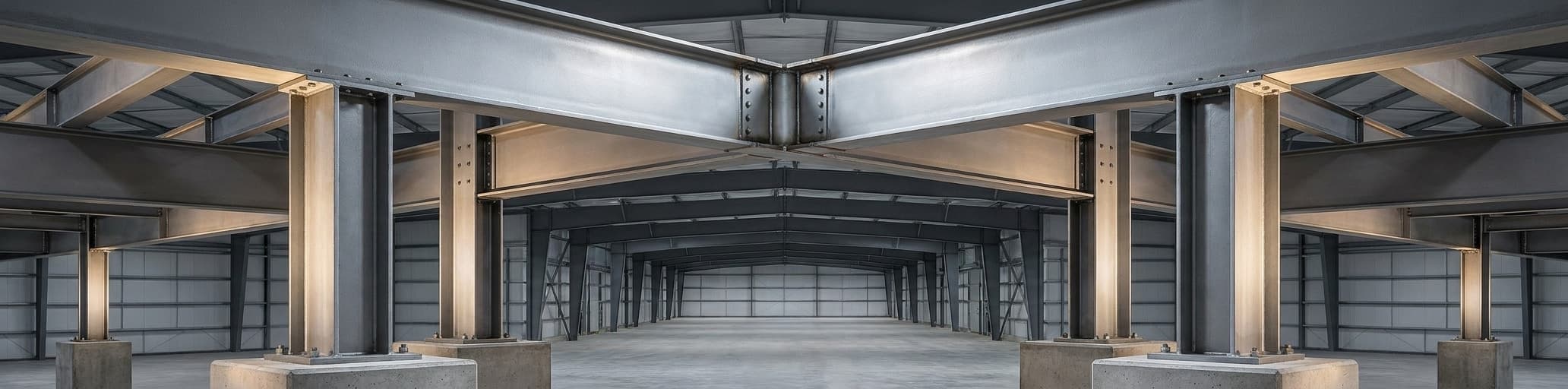

Steel frames rely on two essential components: columns that transfer loads vertically to foundations, and beams that span horizontally to collect roof and floor weights. We engineer these members together as an integrated system to deliver clear spans and structural reliability that wood or concrete simply cannot match at scale.
What Steel Frame Construction Is & Why It's the Reliable Choice
Hot-rolled steel handles primary structural loads with predictable welds and proven strength, while cold-formed steel delivers precision and corrosion resistance for secondary framing.
Steel Frame Defined: Hot-Formed vs. Cold-Formed in Plain Language The phrase "steel frame" covers two distinct manufacturing processes, and the difference matters long before your building goes up. Hot-rolled steel starts as a slab heated above 1,700 degreesF (926 degreesC), then passes through powerful rollers while still red-hot to form I-beams, columns, and structural channels.[2] Because the steel cools naturally after shaping, it carries minimal internal stress, welds predictably, and handles heavy loads without complaint–but expect dimensional variation of roughly +/-2-5% and a rough, scaled surface that needs prep before any coating goes on.[2] For the primary members of a structural steel frame–the pieces bearing roof weight, wind pressure, and snow accumulation–hot-rolled sections are the standard choice.
Cold-formed steel works the opposite way: flat sheet stock is pressed, stamped, or roll-formed into shape at room temperature.[1] That cold-working process actually work-hardens the steel, boosting its yield strength up to 20% over a comparable hot-rolled section.[2] The payoff is tighter tolerances (often within 1mm), cleaner edges, and lighter finished pieces.[3] You'll find cold-formed members handling secondary framing tasks–purlins, girts, wall studs, roof decking–where precision fit and reduced dead load matter more than the sheer tonnage a primary column must carry.[1] Cold-formed sections are also routinely pre-galvanized or zinc-coated at the mill, which gives them built-in corrosion resistance before they ever reach your site.[2] The practical takeaway: neither process is universally better. Hot-rolled steel dominates primary structural work because of its weldability and load capacity.[3] Cold-formed steel earns its place in secondary framing because of its strength-to-weight ratio and dimensional accuracy.[2] Most engineered steel frame buildings use both–heavy hot-rolled columns and rafters for the primary skeleton, cold-formed purlins and girts to tie the skin together.
Knowing which is which helps you ask the right questions when reviewing your building specs.
The Two Essential Parts Every Steel Frame Must Have
Every steel frame–whether it's a clear-span industrial warehouse or an aviation hangar–comes down to two members that do all the structural work: columns and beams.
Columns are vertical, built to absorb compressive forces from the floors and roof above and transfer them directly to the foundation.[4] Beams run horizontally between those columns, spanning open space while carrying roof weight, floor loads, and suspended equipment.[5] The two function as a system: beams gather distributed loads across a span and concentrate them at their connection points, then columns pick up those concentrated forces and drive them to the ground.[5] That complete load path–horizontal collection, vertical delivery–is what lets a steel frame achieve clear spans that wood or masonry simply can't match without a forest of intermediate supports.[6] Get the sizing of either member wrong for your specific span, snow accumulation, or wind exposure, and no amount of secondary framing corrects it.
Engineering columns and beams correctly for your site conditions is always the first step–everything else gets designed around them.
Why National Steel Buildings Prefers Welded, Hot-Formed Moment Frames
The connection type at each column-beam joint determines whether your primary frame behaves as a rigid, moment-resisting system or a pinned assembly that needs diagonal cross-bracing to stay stable.
Welded connections fuse two steel pieces into one continuous joint, distributing stress evenly across the entire bond rather than concentrating it at discrete bolt holes.[7] Under the dynamic loads your building faces over its life–wind uplift, seismic movement, suspended equipment vibration–that even distribution is what keeps a frame holding its geometry instead of fatiguing at connection points.[7] Bolted connections assemble faster in the field and allow future modification, but bolts can loosen under repeated vibration cycles, adding periodic re-torquing to your long-term maintenance schedule.[8] A hot-formed, welded moment frame sidesteps that maintenance loop entirely: the rigid welded joints resist lateral forces through frame stiffness alone, eliminating the knee braces and interior columns that would otherwise carve up your usable floor area.[9] For a clear-span prefab aviation hangar, wide-bay warehouse, or large retail center, that unobstructed interior isn't a design preference–it's the structural outcome you're paying for, and welded, hot-formed moment frames are the most direct path to delivering it within budget.
The Two Core Components: Columns & Beams
Wide-flange columns resist both compression and the bending forces that wind and crane loads introduce, letting you keep cross-sections slender while reducing your foundation concrete volume.
Columns: Vertical Strength That Keeps Your Building Standing Straight
Wide-flange W-shapes handle the primary column work in most steel frame construction because their two-axis flange geometry resists not only straight-down compression but also the bending that lateral forces introduce.[10] That distinction matters more than most property owners realize: wind pressure, crane swing loads, and corner-column geometry all push forces off-center, meaning your columns constantly manage combined axial and bending stress–not just dead weight from above.[11] Steel's high yield strength (typically 50 ksi for standard ASTM A992 structural grades) and elastic modulus allow engineers to keep column cross-sections relatively slender even under heavy loads, concentrating forces into a smaller base plate footprint and directly reducing the concrete volume your foundation requires.[10] Where tighter profiles suit the design–perimeter canopies, exposed architectural framing, or applications needing strong torsional resistance–hollow structural sections (HSS) in square, rectangular, or circular form step in without sacrificing load capacity.[10] For buildings with overhead crane service, column placement in a steel building becomes especially critical: a column's position and finished height set your usable hook clearance, and correcting that after fabrication is one of the most expensive structural changes in steel construction.
Beams: Horizontal Spans That Carry Roof, Snow, and Equipment Loads
Beams gather every load pressing down on your roof–steel panels, accumulated snow, suspended HVAC units, overhead crane rails–and concentrate those forces at the column connection points where they travel to the foundation.[12] That load-collection role makes beam sizing the most span-sensitive decision in your frame: the longer the clear span, the deeper the beam must be to resist bending without sagging, which is why a wide-bay 40×80 metal warehouse requires far heavier primary rafters than a compact agricultural bay.[13] W-beams dominate primary rafter work in pre-engineered steel frame construction because their parallel, relatively thick flanges resist bending stress more efficiently than older tapered-flange profiles–and they scale continuously from a W4x13 to a W44x335 to cover almost any span or load scenario.[13] The two-number designation tells you exactly what you're getting: nominal depth first, then weight per linear foot, so a W24x55 on your fabrication drawings carries no ambiguity.[13] Beyond gravity loads, beams also resist horizontal forces–seismic movement and wind pressure both create bending demands at the ridge and knee joints of a moment frame.[12] Your engineer sizes each beam against the full combined envelope of dead, live, snow, wind, and seismic loads, so a beam that looks overbuilt on a calm day is sized exactly right for the worst conditions your site will ever face.[13]
How Columns and Beams Work Together to Resist Wind, Quake, and Time
The column-beam joint is where gravity loads and lateral forces converge–and the connection type at that joint determines how your entire frame handles wind, earthquakes, and decades of accumulated stress.
Moment connections resist rotation at each joint, transferring both vertical loads and bending forces between members so the frame acts as one continuous system rather than a collection of independent pieces.[14] Without that rotational resistance, lateral forces from wind or seismic events would cause the frame to shift and deform; moment connections keep every member engaged, spreading demand across the full structure instead of letting it concentrate at a single weak point.[14] In high-seismic zones this matters most: steel moment frames are among the few lateral systems building codes permit without height restriction in the highest-risk seismic areas, precisely because beams and columns are proportioned and detailed to absorb earthquake energy through controlled inelastic behavior distributed across multiple stories.[15] That outcome depends on strong-column/weak-beam engineering–column flexural strength must exceed beam flexural strength at every joint so that plastic deformation occurs in the beams and spreads across the building's height rather than collapsing into a single catastrophic story mechanism.[15] For long-span applications like prefab retail buildings, wide-bay warehouses, or aviation facilities, this integrated column-beam behavior is what delivers the clear-span interior you need today and the structural reserve to handle the worst conditions your site will ever face over the building's lifetime.
Benefits & Trade-Offs You Should Know Up Front
Steel frame construction cuts on-site labor by 10-20% and delivers column-free interiors up to 300 feet wide, though you'll need to address thermal bridging in your design.
Speed, Strength, and Clear-Span Freedom–What You Gain
Pre-engineered steel frame construction delivers three concrete advantages over wood and concrete: faster erection, superior structural performance, and column-free interiors.
Because every component is fabricated off-site to exact tolerances–pre-punched, cut to length, and numbered to match assembly drawings–there's no waiting for concrete to cure and no temporary formwork to erect and dismantle.[17] That compression of site activity reduces on-site labor by 10-20% compared to traditional builds, which shortens your financing period and gets your building generating revenue sooner.[17] The strength case is equally direct: steel's high strength-to-weight ratio means a given cross-section carries far more load than the same dimensions in timber, so you get heavier load capacity with less material shipped, simpler foundation requirements, and a frame engineered to handle wind uplift, seismic movement, and snow accumulation without complaint.[17] Unlike wood, steel doesn't rot, crack, split, or attract termites–meaning the structural performance you pay for on day one is still intact decades later with minimal intervention.[17] The clear-span benefit is where steel frame construction separates itself most visibly from competing materials: steel beams carry loads across long distances without intermediate supports, giving you wide-bay interiors where no columns interrupt your floor plan–something wood and masonry simply can't replicate at scale.[16] Clear spans up to 300 feet wide are achievable, making steel the default structural choice for prefab building kits destined for aircraft hangars, distribution warehouses, retail centers, and agricultural facilities where every square foot of unobstructed space translates directly to operational efficiency.[16]
Thermal Bridging, Fireproofing, and Up-Front Cost–What to Plan For
Thermal bridging is the trade-off most steel frame construction buyers underestimate until their first heating bill arrives. Steel conducts heat far more readily than wood, so any column or beam that contacts or penetrates the building envelope creates a direct path for conditioned air to escape in winter and heat to pour in during summer.[18] The practical fix is keeping structural members inboard of your insulation layer–an approach building scientists call the "warm frame" principle–or installing load-bearing thermal break products at every point where steel must cross the envelope.[18] Tested systems from manufacturers including Schöck, Armatherm, and Marmox make this structurally reliable today, and your engineer can spec them into connection details without sacrificing load capacity.[18] Continuous insulation placed outboard of the framing is equally effective: the more insulation you run outside the studs, the less impact the steel framing has on overall thermal conductivity through the wall assembly.[18] Budget envelope detailing as a first-day design decision, not an afterthought–retrofitting thermal breaks after construction documents are locked costs significantly more than designing them in from the start.[18] Fireproofing is a mandatory cost line that won't appear in your steel kit quote but is non-negotiable for a code-compliant certificate of occupancy in most commercial, industrial, and aviation occupancies.
Structural steel holds its strength reliably at ambient temperatures but loses load capacity rapidly under sustained fire exposure, which is why the International Building Code requires applied fire protection on exposed primary members in most occupancy classifications.[18] Spray-applied cementitious coatings are the most common solution, and as the Hotel Marcel retrofit demonstrated, increasing application depth beyond code minimum lets the fireproofing layer double as thermal insulation–solving two problems with one material and one mobilization.[18] If your project involves steel building fire resistance as an insurance premium driver, that added protection depth can pay back faster than expected through lower annual policy costs. Get a fireproofing line item into your early budget; it's far easier to price it correctly upfront than to discover it during the permit review.
The up-front cost reality is direct: pre-engineered steel frame construction typically carries a higher initial price than wood framing at comparable floor areas, but the 20-year ownership math consistently favors steel for commercial and industrial owners who hold and operate their buildings.[19] Steel doesn't rot, warp, crack, or attract pests, so the structural performance you pay for on day one is still intact decades later with minimal intervention–eliminating the repainting, re-leveling, and pest-treatment cycles that inflate wood building operating costs over time.[19] For owners planning to keep a warehouse, hangar, retail center, or agricultural facility in service long-term, the lower maintenance burden and greater durability compress the real cost gap considerably compared to the raw contract price.[18] Front-loading three decisions in early planning–envelope insulation strategy, fireproofing specification, and thermal bridging details–keeps that up-front premium as tight as possible and avoids the costly change orders that follow late-stage design revisions.[18]
Environmental Edge: Recyclability and Reduced Waste on Site
The environmental case for steel frame construction starts with a number that no competing structural material can match: the average hot-rolled wide-flange beam or column entering your building already contains 92% recycled content, produced in an electric arc furnace that uses electricity to melt scrap cars, decommissioned bridges, and old appliances into new structural sections without any loss of material quality.[20] That same EAF process cuts CO₂ emissions by 75% compared to traditional blast-furnace steelmaking, and U.S. mills carry the lowest greenhouse gas intensity of any major steel-producing nation–a gap that will continue to widen as the American power grid shifts further away from fossil fuels.[20][21] When your building eventually comes down, 100% of the structural steel sections will be recovered from demolition–93% remelted into new steel and 7% reused directly in other structures–meaning the material you paid for today re-enters the supply chain rather than a landfill.[22] That closed loop is what makes steel a genuinely circular material: once iron ore becomes structural steel, it remains a permanent resource that cycles through buildings, infrastructure, and industry indefinitely without degrading in strength or quality.[22] Less obvious–but equally real for your project budget–is what steel's high strength-to-weight ratio does to on-site waste and foundation demand. A comparable office building framed in steel weighs roughly 32 metric tons of total material versus 55 metric tons for the equivalent concrete-framed structure, a 72% weight penalty that cascades into larger, deeper foundations and more concrete poured on site.[22] Fewer raw materials shipped, less concrete placed, and a lighter above-grade structure all mean less construction waste generated during your build.
Because pre-engineered steel components arrive pre-punched, pre-cut, and numbered to match assembly drawings, there is no field-cutting waste stream comparable to wood-framed or cast-in-place concrete construction. Steel's by-products don't go to waste either: the slag generated during steelmaking is routinely converted into cement, fertilizers, and asphalt, so the manufacturing process itself produces near-zero landfill output.[22] For owners building warehouses, hangars, agricultural facilities, or retail centers who face increasingly strict sustainability reporting requirements–or who simply want a building whose environmental footprint holds up to scrutiny–these credentials are documented in industry-wide Environmental Product Declarations covering more than 95% of domestic structural steel production, verified and published by AISC with no carbon sources excluded.[20]
Design, Engineering & Certification at National Steel Buildings
Documenting your specific operational needs before engineering begins eliminates the most common source of budget overruns in steel frame construction projects.
From Sketch to Stamp: Our 4-Step Engineering Workflow
Every project starts with a precise needs assessment–not a vague footprint request, but the specific operational answers that drive every downstream engineering decision: intended use, required clear span, crane service, door placement, and occupancy classification.[24] Skipping or rushing this step almost always produces costly change orders later, because a manufacturing facility with overhead crane service demands fundamentally different column heights, base plate sizing, and connection details than a climate-controlled distribution warehouse of identical square footage.[23] Get those answers documented before a single line is drawn, and you've eliminated the most common source of budget overruns in steel frame construction projects.
From there, your engineering team moves into site evaluation–translating your location's soil bearing capacity, wind exposure category, ground snow load, and zoning classification into the specific load parameters that will govern every member size in your frame.[24] A building in a high-wind coastal zone and an identical footprint in a low-seismic inland region carry completely different structural demands, and a successful modification of either follows a strict chronological workflow to ensure safety and constructability rather than retrofitting compliance after the fact.[25] Those site-specific loads feed directly into the design and engineering phase, where column sizing, rafter depth, and connection geometry are mathematically derived–not estimated–against the full combined envelope of dead, live, snow, wind, and seismic demands your site imposes.[23] As you work through how to build a metal airplane hangar or any other occupancy type, this calculation phase is the heart of the design: a mathematical certainty derived from tributary area, span, and code-prescribed load combinations–not a conservative guess.[25] The four-step workflow closes with a complete set of stamped engineering drawings: PE-certified documents that serve simultaneously as fabrication instructions for the production plant and the permit package your jurisdiction requires before a single anchor bolt is set.[23] Locking in door framing, thermal break details, and crane rail elevations at this stage–before the drawings are sealed–is the single most cost-effective decision you can make; changing any of those details after engineering is complete triggers a redesign cycle that adds weeks and budget to a project that was otherwise on schedule.[24]
Custom Framing Options for Hangars, Warehouses, and Retail Centers
Aviation hangars demand the widest single-span frames in commercial steel frame construction–clear spans of 80 to 200-plus feet are standard because the hangar door opening must cover the full aircraft wingspan, and any interior column that crosses that footprint makes the building operationally useless.[27] That span requirement drives every downstream framing decision: rafter depth scales up with span, eave height is set by the tallest tail fin plus door hardware clearance, and the moment frame is engineered specifically around those combined vertical and lateral door loads.[27] Warehouses operate on a different set of priorities: modern distribution facilities need clear heights of 28 to 36 feet–some reaching 40 feet or more–to accommodate multi-level pallet racking and automated storage systems, while column spacing is typically held to 24-30 feet to align with standard racking module widths so you don't lose floor area to structural interference.[27] For retail centers, multi-bay configurations are the practical solution: connecting several clear-span sections lets you cover large footprints while carving out distinct zones–showroom, stockroom, service–within one structure, and because pre-engineered components arrive pre-cut, pre-punched, and numbered to match assembly drawings, you avoid field-cutting waste and shorten the path from permit to opening day.[26] Across all three occupancy types, rigid frame systems–where columns and roof beams form strong, moment-resisting joints–handle vertical and lateral forces while using less material than post-and-beam or truss alternatives, which keeps your steel tonnage and kit cost as tight as possible without sacrificing clear span or structural reserve.[27] For a side-by-side look at how these framing configurations translate across different project types, metal prefab buildings in their proven commercial applications illustrate how one structural system adapts cleanly from a 60-foot hangar bay to a 200,000-square-foot distribution center.
Delivering Code-Compliant, Sealed Plans Ready for Your Permit
The PE stamp on your structural drawings is what converts an engineered design into a legally binding permit package.[28] That stamp–carrying the engineer's license number, signature, and official seal–tells your building department, your lender, and your insurer that a licensed Professional Engineer has reviewed the design against local codes and confirmed it meets every applicable safety requirement.[28] Building officials require this certification for three concrete reasons: it establishes legal accountability so a licensed professional is on record for the design's safety, it applies rigorous load calculations and structural integrity checks that protect occupants and neighboring properties, and it ensures compliance with local, state, and federal codes from day one–avoiding the costly rework that follows a failed review.[28] Once you submit those stamped drawings with your permit application, the building department typically completes its review within two to four weeks, checking for code compliance, zoning requirements, and safety standards; if reviewers flag any items, your PE revises and re-stamps before resubmission–no starting from scratch, just targeted corrections.[28] During construction, inspectors use those same stamped drawings as the on-site reference to verify that structural specifications, materials, and connection details match the approved plans, which is why drawing clarity directly determines how fast each inspection clears.[28] Not every structure requires this level of documentation–small personal-use sheds in rural counties often don't–but any commercial, industrial, agricultural, aviation, or retail occupancy that triggers a permit will need a site-specific stamped package covering the structural details inspectors actually look for.[29] Understanding what your contractor's engineering package includes before you sign is critical; knowing which questions to ask local prefab contractors upfront keeps your permit submission clean and your project on schedule from the first day to the last inspection.
- Steel frames use two distinct processes: hot-rolled steel for primary members like columns and beams, and cold-formed steel for secondary framing like purlins and girts.
- Columns and beams form the complete load path system, with beams collecting horizontal loads and columns transferring them vertically to foundations, enabling clear spans up to 300 feet.
- Welded moment connections distribute stress evenly across joints and eliminate the need for interior bracing columns, preserving unobstructed floor space in large buildings.
- Thermal bridging through steel members requires design solutions like thermal breaks or continuous outboard insulation to prevent energy loss through the building envelope.
- Fireproofing is a mandatory cost for code compliance in commercial and industrial buildings, as structural steel loses load capacity rapidly under sustained fire exposure.
- Pre-engineered steel components arrive pre-cut and pre-punched, reducing on-site labor by 10-20% compared to traditional construction and eliminating field-cutting waste.
- Structural steel contains 92% recycled content on average and achieves 100% recovery at demolition, creating a closed-loop circular material system without degradation.
- https://www.edconsteel.com.au/articles/steel-and-metal-articles/cold-formed-vs-hot-rolled-structural-steel/
- https://metalprobuildings.com/what-is-the-difference-between-hot-rolled-and-cold-formed-steel/
- https://buyabeam.com/blogs/steel-beams/hot-rolled-vs-cold-formed-steel-whats-the-difference/
- https://www.xometry.com/resources/machining/steel-framing/
- https://heldenfels.com/whats-the-difference-between-a-beam-vs-column/
- https://www.berryhomecenter.com/blog/structural-framing-components-methods/
- https://mahsteel.com/news/welded-vs-bolted-steel-connections/
- https://www.jswonemsme.com/blogs/blogs-articles/structural-steel-connections-bolted-vs-welded-joints-pros-cons-and?srsltid=AfmBOooq4zSt22TZEO6PMevfSfOw0oThBnR1axwYqFB40JO3IszVSL_5
- https://www.cecobuildings.com/blog/cold-formed-vs-rigid-frame-metal-buildings-choosing-the-right-system-for-your-project/
- https://www.buildtwin.com/blog/steel-columns-explained-types-design-essentials-bim-applications/
- https://civiltoday.com/construction/building/384-what-is-column-types-of-columns
- https://cbsmn.com/what-are-steel-beams/
- https://tampasteel.com/steel-beams-types-sizes-and-applications-guide/
- https://strucalc.com/blog/learning/moment-connection/
- https://constrofacilitator.com/seismic-design-of-buildings-with-steel-moment-frames/
- https://armstrongsteel.com/blog/exploring-metal-buildings-key-features-benefits-and-trends-in-modern-construction
- https://www.designingbuildings.co.uk/wiki/8_Reasons_Why_Structural_Steel_Frames_Are_Advantageous_For_Any_Building_Projects
- https://continuingeducation.bnpmedia.com/architect/courses/the-steel-institute-of-new-york/structural-steel-in-passive-house-construction
- https://www.ussteelbuildings.com/blog/steel-vs-wood-framed-buildings
- https://parallax.aisc.org/sustainability.aspx
- https://www.steel.org/sustainability/
- https://www.steelconstruction.info/Steel_and_the_circular_economy
- https://harrisconstructorsinc.com/building-steel-buildings/
- https://mbmisteelbuildings.com/blog/planning-a-commercial-steel-building/
- https://istaengineers.com/service/structural-modification-design/
- https://ecosteel.com/ecosteelprefab/the-definitive-guide-to-metal-building-construction-types-and-classifications/
- https://www.steelcobuildings.com/what-is-industrial-building-design-standards-layouts-and-structural-systems/
- https://consac.com/blogs/pe-stamped-structural-drawings-us-permitting-inspections
- https://www.bossbuildings.com/blog/when-do-you-need-stamped-engineer-drawings/?srsltid=AfmBOooGEQcWUgy_bUc8zOxJh_8eDixLMyPTWg227Nn-3W59Q2Q_v5cT