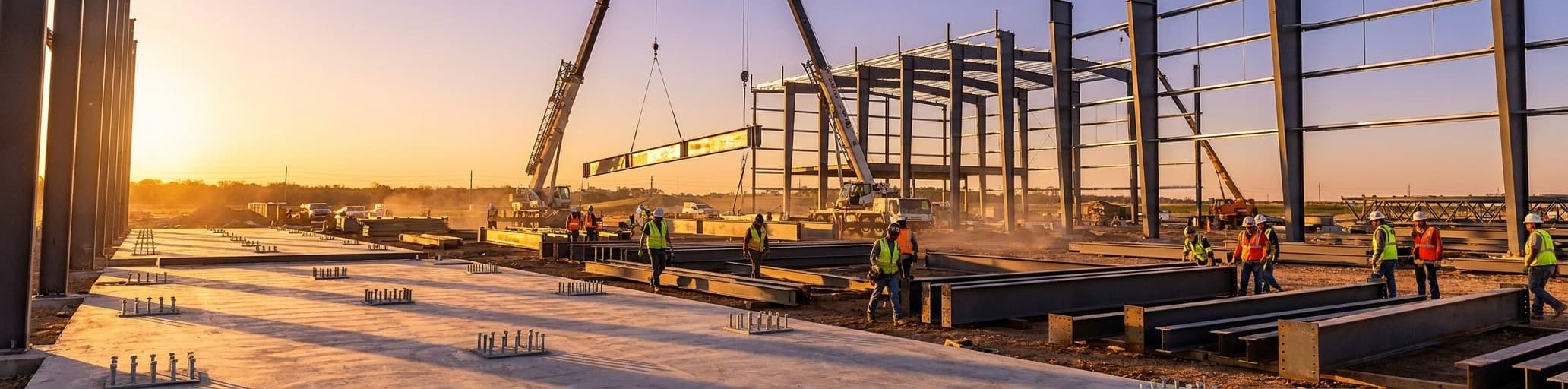

We help event planners meet fixed summer deadlines by compressing covered arena construction into 8-14 weeks through parallel-track fabrication and turnkey delivery. Pre-engineered steel eliminates traditional construction delays, locks pricing against cost inflation, and reduces long-term maintenance by 75% compared to wood or concrete structures.
Why Summer Event Venues Need Fast-Delivery Steel Structures
Pre-engineered steel buildings compress your timeline by running design, fabrication, and site work in parallel instead of waiting through the delays that stall conventional construction.
The seasonal deadline problem: Why traditional construction fails event planners
Summer event deadlines are binary: the venue is ready, or the season is lost. That pressure is exactly where traditional construction consistently fails event planners — and where covered arena construction fast delivery becomes the only viable path forward.
Nearly all construction projects in North America experience delays, often extending timelines by more than a third of the original schedule.[1] Permit review windows alone can consume weeks or months, since approval timelines are set by the jurisdiction rather than anything a general contractor can compress on their end.[3] Weather disruption affects roughly 45% of construction projects,[2] and persistent labor shortages leave critical trade positions unfilled long enough to cascade through every subsequent phase.[1] Material pricing adds a final layer of instability: construction costs rose approximately 20% in 2023, with supply chain disruptions forcing teams to revise budgets and schedules mid-build.[2] Stack those variables against a fixed June or July opening date and you're not managing a risk — you're absorbing a near-certainty of missing it. For event planners investing in steel riding arenas or large covered multi-use venues, the conventional stick-built process carries too many interdependent failure points to reliably survive a seasonal deadline.
How pre-engineered steel buildings compress timelines from months to weeks
The compression happens because pre-engineered steel buildings run design, fabrication, and site work on parallel tracks instead of sequential ones.
While your building's columns, beams, purlins, and wall panels are being pre-cut, pre-drilled, and precision-engineered in a factory, your crew is simultaneously grading the site, running utilities, and pouring the foundation.[4] That overlap alone eliminates the dead interval that stalls conventional builds between foundation cure and framing start.
Fabrication for a covered arena shell typically runs 3-6 weeks depending on size and customization level, and because site prep runs concurrently, steel arrives at a job-ready foundation with no idle time in between.[5] Erection then moves fast: a clear-span pre-engineered shell goes up in 1-3 weeks, compared to the 12-16 weeks a comparable stick-built or tilt-wall structure needs just for the structural frame.[4] Overall, installation runs 30-50% faster than traditional methods, and the full sequence from approved drawings to a standing building can compress into as few as 8 weeks when permits and site conditions align.[6] For event planners who need a prefab building delivered and erected on a fixed schedule, that parallel-track engineering model is the single biggest reason a summer opening date stays within reach rather than becoming a casualty of compounding delays.
National Steel Buildings's turnkey advantage for time-sensitive venue projects
The fragmented hand-off between designer, fabricator, and erector is where most covered arena construction fast delivery promises fall apart.
A turnkey project model eliminates that fragmentation by placing a single contractor in charge of every phase — engineering, material procurement, construction, and commissioning — so you have one point of accountability from signed contract to opening day.[7] That matters enormously on a summer deadline because there's no gap between parties to absorb blame when a schedule slips; the same team that engineered your building is the team standing on your site putting it up.
In a traditional multi-contractor setup, each trade has its own schedule, its own supply chain, and its own definition of "on time." A turnkey delivery model removes those coordination seams entirely, replacing them with a single fixed-price contract where the timeline, deliverables, and performance criteria are locked in writing before fabrication ever begins.[7] For event venue owners, that translates directly into a project that stays within budget and on schedule — not because nothing goes wrong, but because one accountable partner owns every variable and has already built contingencies into the plan rather than passing surprises down a chain of subcontractors.[8]
Covered Arena Construction: Design Options That Ship on Schedule
Match your arena footprint to one of three practical size bands–small, mid-size, or full competition–and pre-engineered steel components arrive pre-drilled and ready to bolt together on schedule.
Standard covered arena sizes and how National Steel Buildings pre-engineers them for rapid delivery
Covered arena sizes fall into three practical bands, and matching your footprint to the right band is what keeps fabrication on a tight schedule. Small private facilities run 60×120 to 80×160 feet — enough clear span for a full riding or event surface with safe side clearance.[9] Mid-size venues in the 80×160 to 100×200-foot range accommodate multiple simultaneous uses, attached support spaces, and viewing areas, which is why they're the most common footprint for summer event operators.[9] Full competition and multi-discipline event arenas start at 100×200 feet and scale up, with pre-engineered clear spans reaching 100, 150, or even 200 feet across — no interior columns anywhere in that footprint.[10] Eave height is just as critical as floor area: most covered arenas need a minimum 14-foot eave, while venues hosting jumping, large-scale events, or equipment movement require 16-20 feet for safe clearance and proper ventilation.[9] What makes covered arena construction fast delivery achievable across all three size tiers is how the components arrive at your site.
Primary I-beam frames — fabricated from 1/4-inch plate steel welded into structural members — along with secondary purlins, girts, and wall panels are precision-cut and pre-drilled at the factory before your foundation cure is even complete.[10] Every hole lines up, every connection is pre-fit, and your erection crew is bolting together a known system rather than field-cutting to compensate for dimensional drift. If you're weighing how arena sizing intersects with multi-use event programming, the recreational steel buildings sizing matrix is a useful reference for matching clear-span dimensions to specific activity requirements.
Customizing span, height, and open-side configurations without delaying fabrication
Customization sounds like a fabrication risk, but with pre-engineered steel the variables that actually extend lead time are narrow and predictable.
Span width is the most structurally significant dimension: widening a clear span requires heavier primary frame engineering, so moving from a 60-foot shell to an 80-foot shell is a more meaningful structural change than adding 40 feet of length.[11] Even so, clear spans from 60 to 150 feet sit within standard pre-engineered configurations, meaning the structural calculations are built into the system rather than requiring fully bespoke design from scratch.[11] Eave height works the same way — your eave should sit at least two feet above the tallest framed opening in the building, whether that's a high overhead entry door, a stage rigging clearance point, or a large ventilation louver.[12] Heights from 14 to 24 feet fall within standard fabrication parameters, and specifying 20 feet instead of 16 feet adds steel tonnage to the order but not weeks to the schedule.[12] Open-side and large-portal configurations are where decisions need to lock in early: a portal-frame opening — an endwall or sidewall removed for drive-through vendor access, outdoor stage integration, or unobstructed grandstand sightlines — requires columns placed precisely on each side of the opening, and that column placement must be fixed before factory cutting begins.[12] Change it after fabrication starts and you restart the cut sequence.[12] Pre-engineered components are pre-punched and numbered to correspond with assembly drawings, so every structural connection is already accounted for before a single piece ships — but only if the design is finalized first.[13] The practical rule: lock in your span, eave height, and any open-side requirements before approving drawings, and your custom configuration ships on the same 3-6 week fabrication schedule as a standard shell.[13]
Comparison table: Construction timeline and cost by arena size (40×80 through 150×250)
The numbers below give you a working budget framework before you commit to a site or a timeline. Kit pricing — meaning the steel shell including primary frames, purlins, girts, and wall panels — runs $15 to $20 per square foot for commercial-grade I-beam construction, while turnkey installed cost covering the kit, concrete slab, delivery, and erection runs $24 to $43 per square foot.[14] Cost per square foot drops as total footprint grows, so the jump from a 40×80 to a 100×200 costs significantly more in total but progressively less per square foot of enclosed space.[15] Fabrication lead times and erection windows scale with building size but remain compressed compared to conventional construction across every tier — locking your design before factory cutting begins is what keeps the smaller windows achievable. For a closer look at how arena-specific cost factors like eave height and span width interact with overall budget, the prefabricated steel riding arena cost guide breaks down the variables that move the number most.
| Arena Size | Sq Ft | Kit Price (shell only) | Turnkey Installed | Fabrication Lead | Erection Time | Total Build Window |
|---|---|---|---|---|---|---|
| 40×80 | 3,200 | $48K-$64K | $77K-$138K | 3-4 weeks | 1 week | 6-8 weeks |
| 60×120 | 7,200 | $108K-$144K | $173K-$310K | 3-5 weeks | 1-2 weeks | 7-10 weeks |
| 80×160 | 12,800 | $192K-$256K | $307K-$550K | 4-5 weeks | 1-2 weeks | 8-10 weeks |
| 100×200 | 20,000 | $300K-$400K | $480K-$860K | 4-6 weeks | 2-3 weeks | 9-12 weeks |
| 120×200 | 24,000 | $360K-$480K | $576K-$1.03M | 5-6 weeks | 2-3 weeks | 10-12 weeks |
| 150×250 | 37,500 | $563K-$750K | $900K-$1.61M | 5-6 weeks | 2-3 weeks | 10-14 weeks |
Two figures in the table matter most for summer deadline planning: the kit price and the total build window. The kit price sets your steel commitment — and unlike lumber, pre-engineered steel is quoted against a fixed-price contract, so the number you see doesn't drift upward once fabrication begins.[15] The total build window assumes permits are in hand and site prep runs concurrently with fabrication, which is the parallel-track model that makes covered arena construction fast delivery possible across every size tier.[14] Larger arenas don't require proportionally more time to erect — they require more crew and more steel tonnage, but the bolted-connection system keeps the erection sequence predictable regardless of footprint.[16]
From Permit to Opening Day: The Fast-Track Steel Building Erection Process
Eliminate contractor delays by partnering with the same team that engineered and fabricated your building through one contract and one point of accountability.
How National Steel Buildings's in-house erection division (ProTrades, LLC) eliminates contractor delaysThe typical covered arena project using a third-party steel erector creates a handoff problem: the fabricator ships components to a job site where a general contractor then schedules a separate erection crew that has never touched those specific pieces. That gap is where summer deadlines die.
In conventional phased construction, each trade works sequentially — while one subcontractor is on site, the others wait — and scheduling conflicts cascade through every subsequent phase.[19] Most general contractors don't carry the specialized knowledge required for steel erection either, meaning sourcing a qualified erector becomes a separate procurement task that adds time before a single bolt turns.[18] Managing the handoff between fabricator, GC, and erector introduces competing schedules, communication breakdowns, and conflicting definitions of "on time" that consistently slow projects down.[17] ProTrades, LLC — NSB's in-house erection division — removes every one of those variables. Because the team that engineered and fabricated your building is the same organization directing the crew on your site, there's no translation layer between design intent and field execution: every numbered piece, every pre-drilled connection, and every load-path detail arrives with people who already know the system.[17] If you're weighing how to vet a local prefab contractor against a turnkey model, the clearest differentiator is exactly this — one contract, one crew, one point of accountability from approved drawings to a standing venue, with no subcontractor handoffs left to absorb blame when a summer schedule gets tight.[19]
Parallel engineering and foundation prep: What happens while your building is being fabricated
The parallel-track model only delivers its schedule advantage if the foundation is engineered correctly before the concrete truck arrives.
While your building's primary frames, purlins, and wall panels are being cut and pre-punched in the factory, your site crew should be grading, running utilities, and pouring the slab — but that slab must be designed around the manufacturer's anchor bolt plan, not a generic specification.[20] The anchor bolt locations, footing depths, and slab thickness are all dictated by the specific loads your building places on each column base.
Skip that coordination step and your building arrives at a foundation it can't connect to, which stops erection cold.[20] Foundation installation and curing typically run 2-4 weeks — almost exactly the window that overlaps with early fabrication — so the two phases are designed to finish together.[21] Getting the manufacturer's foundation engineering drawings to your concrete contractor before ground breaks is the single coordination action that keeps the parallel tracks actually parallel rather than sequential.[20] Once the slab cures, every component that rolls off the truck is numbered and pre-punched to match an assembly drawing, so the erection crew bolts directly to anchor points that were placed to exact specification — no field drilling, no shimming, no idle time waiting for corrections.[21] If you're planning the slab side of your project, choosing the right concrete thickness for your steel building is a decision that needs to be made with your building's engineering drawings in hand, not after the fact.
Real-world timeline: What 3-6 week delivery actually means for your summer event schedule
The 3-6 week fabrication window describes one phase of your project, not the full calendar from contract to opening day. To use it for summer planning, you need to work backward from your target opening date through every dependent phase. Final inspection runs 1-2 weeks after erection completes, erection itself takes 1-3 weeks depending on arena size, and the foundation needs 1-4 weeks to pour and cure — phases that overlap with fabrication where the parallel-track model allows, but not with permit review, which must clear before factory cutting begins.[22] Permit timelines vary from as little as one week in smaller jurisdictions to several months in busy urban areas, and that variance is the single most unpredictable variable in your summer schedule.[22] Running the math conservatively — a 4-week permit window, a 5-week fabrication lead, a 2-week erection, and a 1-week inspection — puts your realistic project clock at roughly 12-14 weeks from contract signing to opening day for a mid-size covered arena.[22] To hit a June 15 opening, that traces back to a contract signing date no later than early March. A July 4 opening buys you until late March.
Two conditions determine whether your project lands inside or outside that window. First, permit speed: jurisdictions that turn commercial permits in 2-3 weeks allow a well-coordinated project to reach a standing building shell in as few as 8-10 weeks from contract signing.[4] Second, site readiness: a site that isn't graded and utility-ready when the concrete crew arrives adds days to the foundation phase that faster fabrication cannot recover, because components sitting at a job site waiting on a slab aren't compressing your schedule — they're costing you storage and pushing erection start back on the calendar.[4] Pre-engineered metal buildings cut total construction time by up to 30% versus conventional methods, but only when the foundation and permit tracks run in parallel with fabrication rather than sequentially in front of it.[4] If you want to understand how steel building project timelines map across smaller footprints as well as large arenas, the same phase-by-phase logic applies regardless of building size. The actionable number for your summer planning isn't the fabrication lead alone — it's the full project clock, and the date that clock starts is the day you approve your drawings and submit for permits, not the day steel ships. Cost-Effective Covered Arena Solutions for Event Venues Across the U.S.
2026 pricing guide: Covered arena costs by region and size (Northeast, Midwest, South, West)
Long-term ROI: Low-maintenance steel vs. traditional event venue infrastructure The annual maintenance gap is where steel event venues quietly recover their construction cost. Steel buildings require roughly 1% of initial cost in annual maintenance — around $1,500-$2,500 per year for a 10,000-square-foot facility.[26] Wood and concrete structures run 2-4% annually, which translates to $7,000-$20,000 per year for a comparable footprint — before accounting for unplanned events like termite damage, which can add $30,000 or more in a single repair on a wood-framed building.[26] For an event venue operator running a full summer season, that maintenance delta isn't just overhead — it's lost revenue days when your facility is closed for repairs rather than booked for events.
Energy performance adds another compounding advantage. Steel buildings with insulated metal panels save 10-20% on annual energy costs compared to wood or concrete structures — a difference of $2,000-$5,000 per year for a commercial event venue.[26] Beyond energy, steel's non-combustible framing typically earns lower insurance premiums than wood-framed structures, since insurers price fire risk directly into commercial property rates.[27] Neither of those savings lines appears in a steel kit quote, but both compound across every operating year.
Run the math across 20 years and the gap becomes the deciding number. A 10,000-square-foot pre-engineered steel facility — all operating and maintenance costs included — runs approximately $350,000 in total expenditure over two decades.[26] The same footprint in wood or concrete lands between $670,000 and $1.1 million over the same period, driven by higher maintenance frequency, remodeling costs, and greater energy consumption.[26] Steel structures also carry a resale premium: their modular design makes future expansion straightforward, pushing resale value up 20-30% over a 20-year horizon compared to the original build cost.[26] For event venue owners, the structure you build to capture this summer's bookings is an asset that appreciates — not a facility that consumes cash every season. If you want to see how the same 20-year math applies to smaller footprints, steel barn cost vs. wood barn comparisons run through the same variables at agricultural-scale dimensions, and the directional logic holds across every building type and use case.
Next steps: How to get a fast-delivery quote and timeline from National Steel Buildings
The quote conversation moves faster when you arrive with four pieces of information ready: your target opening date, your intended footprint and eave height, your site address and access conditions, and your current permit status. That combination lets NSB's team produce a fixed-price contract with a locked fabrication and delivery schedule rather than a range of estimates that shift after you commit.[28] Reaching out at least 6-12 weeks before your needed delivery date gives the project the buffer it requires — most covered arena shells land within that window under normal demand conditions, but spring and early summer are peak season for steel construction, and order backlogs during those months can push timelines out by 2-4 weeks.[30] If your opening date is fixed, contacting NSB before you finalize your permit submission is the right sequence: engineering drawings from NSB support your permit application, and starting the permit clock earlier — with stamped drawings already in hand — is the single move that keeps the full project schedule within reach.[29]
Design finalization controls every downstream phase. Changes to span, eave height, or portal-frame openings after fabrication begins require re-engineering and restart the cut sequence — meaning a mid-production adjustment can add weeks to a schedule with no slack to absorb them.[29] Submitting all your requirements in one complete round, rather than across multiple revision cycles, keeps your building in its original production slot and avoids the compounding delays that follow each change request.[28] Rush fabrication is available but carries a 15-25% price premium on top of the base kit cost — on a mid-size covered arena, that premium runs to tens of thousands of dollars that a well-timed order eliminates entirely.[29] For a detailed look at how building size and order timing interact with final installed price, the Prefab Buildings Cost & Speed: 2026 NSB Guide is useful context to review before your first call.
The fastest path to a locked schedule is straightforward: contact NSB with your opening date and footprint, confirm site conditions and permit jurisdiction, approve drawings in a single round, and let the parallel-track fabrication and site prep model compress the rest of your calendar. One contract, one crew, one point of accountability — within budget and on schedule, every step of the way.
- Pre-engineered steel buildings compress construction timelines to 8-12 weeks by running design, fabrication, and site work in parallel instead of sequentially.
- Summer event venues miss deadlines due to permit delays, weather disruption, labor shortages, and material costs–traditional construction fails 45% of projects.
- Turnkey delivery eliminates contractor handoffs by placing one accountable partner in charge of engineering, procurement, construction, and commissioning.
- Steel event venues cost 1% annually to maintain versus 2-4% for wood or concrete, recovering initial investment through 20-year operating savings of $320,000+.
- Locking design specifications (span, eave height, portal openings) before fabrication begins keeps custom arenas on the standard 3-6 week production schedule.
- Mid-size covered arenas (80×160 to 100×200 feet) range from $307K-$550K turnkey installed, with total build windows of 8-12 weeks from contract to opening.
- Permit approval is the single most unpredictable variable–contacting NSB before finalizing permit submission lets stamped drawings accelerate the approval clock.
- https://www.yourco.io/blog/construction-delays
- https://cmicglobal.com/resources/article/extreme-weather-the-construction-industry
- https://smartpm.com/blog/construction-timelines-explained
- https://www.tylerbuilding.com/post/speed-to-market-how-pre-engineered-metal-buildings-cut-construction-time-by-30
- https://metalprobuildings.com/pre-engineered-steel-building-timeline/
- https://www.alliedbuildings.com/time-savings-of-pre-engineered-metal-buildings/
- https://rdash.ai/blog/turnkey-projects-types-advantages-disadvantages/
- https://sanliansteelstructure.com/steel-warehouse-buildings-the-ultimate-guide-to-design-cost-and-construction/
- https://www.vikingbarns.com/metal-riding-arenas
- https://www.bucksteel.com/steel-riding-arenas/
- https://www.steelstructuresamerica.com/metal-building-sizes/
- https://www.buildingsguide.com/build/metal-building-planning/?srsltid=AfmBOorOYL1qnkm8JyiuwWhlPVRbYePRK-usH9xBigCvAkhGcTnRnbOz
- https://armstrongsteel.com/blog/custom-steel-structures-understanding-the-design-and-construction-process
- https://www.buildingsguide.com/metal-building-prices/?srsltid=AfmBOooiWqIqEmOtQ_aHJS_Vz6SmaIJDCYEoRykbd6JfhzEzPveWXh9l
- https://builtmammoth.com/how-much-does-a-steel-building-cost/
- https://americansteelinc.com/blog/steel-building-costs-prices-guide/
- https://successteamstrategies.com/home/how-steel-building-construction-saves-time-and-labor-costs/
- https://www.buildingsguide.com/build/metal-building-construction/?srsltid=AfmBOoo_gaAMCe3h59eN1B5Zhw7quYnHYAbizkUokmYuGbsOZbZqGb3T
- https://fse-ok.com/pemb_vs_conventional_construction/
- https://www.constructionowners.com/insights/how-prefabricated-steel-construction-is-reshaping-project-timelines-and-budgets-across-north-america
- https://www.buildingsguide.com/build/pre-engineered-metal-building/?srsltid=AfmBOoq6QWVkJMC24SVcw6tNFY3BKspU9j6bCvBU0SBaS5jLEaQUU5aU
- https://gravitycontractors.com/how-long-does-it-take-to-erect-a-steel-building/
- https://www.buildingsguide.com/metal-building-prices/?srsltid=AfmBOorIT3EIuRguyCayfg26B7LUDsIKxevDdMv1SS8TfP078CrORaUK
- https://torosteelbuildings.com/blog/steel-building-prices/
- http://www.247pro.com/blog/your-state-by-state-guide-to-construction-costs-and-calculations-in-the-us
- https://www.summitsteelbuildings.com/20-year-cost-comparison
- https://www.alliedbuildings.com/reliability-and-durability-of-preengineered-metal-buildings/
- https://www.vikingsteelstructures.com/metal-buildings-delivery-time-estimates?srsltid=AfmBOopGwNoi7kLOMKbjKfbOMkLi3VZETjzwhw4zXdWPjM7rjmo3kNCg
- https://www.factorysteeloverstock.com/steel-building-delivery-timelines-2/
- https://www.rhinobldg.com/blog/how-long-does-it-take-to-deliver-a-rhino-building