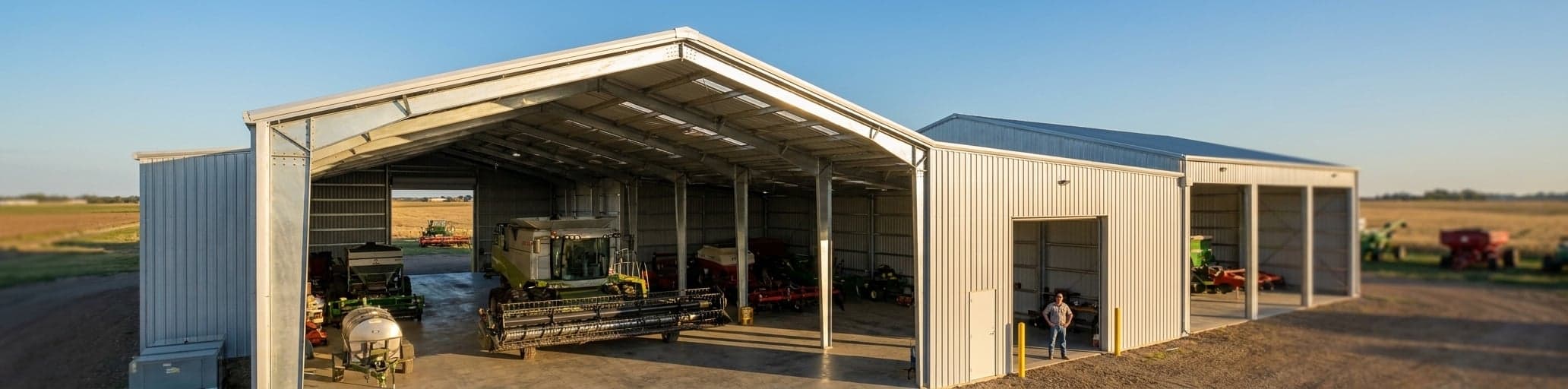

We help you right-size agricultural steel buildings and understand true installed costs, from 30×40 workshops through 50×100 grain facilities. Cold-formed steel delivers clear-span interiors, faster erection, and superior corrosion resistance at measurable cost savings compared to hot-rolled alternatives.
Right-Sizing Your Agricultural Steel Building
Choose from three proven footprints–30×40, 40×60, or 50×100–each engineered for your specific operational scale and workflow demands.
Standard farm building dimensions that balance cost and capacity
The three footprints that cover most agricultural steel buildings are the 30×40, 40×60, and 50×100–each mapped to a different operational scale.[1] A 30×40 (1,200 sq ft) handles small equipment storage and farm workshops; a 40×60 (2,400 sq ft) fits mid-size hay, implements, and confined livestock needs; a 50×100 (5,000 sq ft) anchors large-scale grain storage or multi-use production facilities.[1] Kit-only prices for those sizes run $24,000, $43,200, and $75,000 respectively, or $15 to $20 per square foot for the steel package alone, while turnkey installed cost–covering the slab, delivery, and construction–runs $24 to $43 per square foot.[1] Before committing to a footprint, check farm equipment storage building dimensions that affect daily workflow, because being 10 feet too narrow can cost you real time every single season.[2]
| Footprint | Square footage | Kit price | Installed range ($24-$43/sq ft) |
|---|---|---|---|
| 30×40 | 1,200 sq ft | $24,000 | $29K-$52K |
| 40×60 | 2,400 sq ft | $43,200 | $58K-$103K |
| 50×100 | 5,000 sq ft | $75,000 | $120K-$215K |
Cold-formed clear-span options: 30' to 150' widths without interior posts
A clear-span building carries its roof load through engineered walls and beams directly to the foundation–no interior columns anywhere on the floor.[4] For farm operations, that distinction is practical, not cosmetic: a combine, grain cart, or articulated tractor simply can't navigate around interior posts, and every column you work around costs you time on every pass.[4] Cold-formed steel reaches this column-free design across a wide range of widths, using precision-engineered trusses and roll-formed framing that bolt together on-site without welding, scaling from a 30-foot workshop all the way through spans where wood construction would need to add interior supports just to stay standing.[4] The economic case sharpens as width grows–once a pole barn's span pushes past 40 feet, its truss size and material costs climb steeply, often forcing builders to add interior columns anyway, while steel clear-span pricing per square foot holds or improves at larger widths.[4] So the buildings that demand the most unobstructed floor space–wide hay sheds, multi-implement storage, livestock arenas–are exactly where cold-formed clear-span steel becomes your most cost-effective option.[4]
Height, ventilation and access rules for livestock, machinery and crop storage
The height you need depends entirely on what goes inside. Machinery storage calls for eave heights of 16 to 23 feet; grain storage buildings typically push to 30 feet or higher to allow full stacking capacity.[6] If you're housing a combine harvester, door openings must clear at least 16 feet–and since farm equipment keeps getting larger, sizing for your next machine rather than your current one avoids a costly rebuild later.[5] Ventilation follows a straightforward design rule: a ridge height set at roughly 1.5 times the building's width generates enough natural airflow to prevent moisture buildup without mechanical systems.[5] That extra roof height also lets you stack hay bales higher, which directly multiplies usable storage per square foot of floor space.[6]
Access dimensions are where farms most commonly undersize. Loading bays need to be at least 15 feet wide and 16 feet high to clear most farm vehicles and delivery trucks.[5] For livestock, the space requirement is animal-specific–dairy cows need roughly 13.5 square feet per head for feeding space alone, while beef cattle require 27 to 32 square feet each, plus dedicated room for handling systems and the airflow corridors that protect animal productivity year-round.[5] Ventilation in livestock buildings deserves detailed upfront planning; the 40×80 metal barn ventilation guide shows how coordinated ridge and sidewall vents work together to cut heat gain and keep animals performing through summer.
Pricing Clarity for Every Farm Budget
Cold-formed steel frames cost $23 to $42 per square foot for agricultural buildings, while hot-rolled systems run $30 to $55, giving you a real price advantage at 30-to-80-foot widths.
Price-per-square-foot ranges for cold-formed vs. hot-rolled framesThe framing system you choose sets your cost floor before any other variable enters the equation. Cold-formed steel–the roll-formed, bolt-together framing used in light agricultural structures–sits at the lower end of the steel cost spectrum, with light steel structures for agricultural use typically ranging from $23 to $42 per square foot for the building shell.[8] Hot-rolled I-beam systems, fabricated from heavier steel sections and welded into primary frames, carry higher material and fabrication costs: structural steel framing for a mid-sized project adds roughly $20 to $40 per square foot for the framing alone, before cladding, doors, or foundation.[7] That overlap in the mid-range is where the decision gets practical–cold-formed systems reach that price point at larger footprints and wider spans, while hot-rolled I-beam frames are engineered with precision-fabricated members designed for maximum structural integrity across high-load agricultural environments.[9]
The table below puts both systems side by side on the metrics that matter most for farm budgets:
| Frame type | Shell cost range (per sq ft) | Structural steel framing add (installed) | Common agricultural use case |
|---|---|---|---|
| Cold-formed steel | $23-$42/sq ft | Included in shell range | Hay storage, workshops, equipment barns |
| Hot-rolled I-beam (PEMB) | $30-$55/sq ft | $20-$40/sq ft additional | Large clear-span machinery, livestock, grain facilities |
What that table doesn't show is how the gap closes at scale. Cold-formed clear-span pricing per square foot holds or improves as width increases, while hot-rolled systems deliver their strongest value when your load requirements–heavy snow, wide spans, or crane systems–exceed what lighter framing can handle.[8] For most agricultural steel buildings in the 30-to-80-foot-wide range, cold-formed steel delivers a measurable cost-per-square-foot advantage over hot-rolled frames without sacrificing the clear-span interior your equipment demands.[9] Hot-rolled I-beam systems earn their premium on the heaviest-duty projects–multi-span grain facilities, buildings with overhead crane loads, or structures where site-specific engineering pushes span requirements beyond 100 feet.[9]
What changes the quote–roof pitch, bay spacing, snow/wind loads
Three inputs shift your agricultural steel building quote more reliably than any other: roof pitch, bay spacing, and your site's design loads. Roof pitch is the most underappreciated cost lever–a straightforward 1:12 pitch on a farm workshop costs measurably less per square foot than a steeper profile on the same footprint, because it requires less steel across the truss span and produces a simpler structural solution.[10] Bay spacing–the distance between adjacent frame lines along the building's length–controls how many primary frames your building requires.[11] Compress that spacing and fabrication and erection workload climbs; push it too wide and secondary members get heavier to compensate, so the efficiency gain disappears.[11] The practical rule: bay spacing should align with how you'll actually use the floor–door positions, storage module layouts, and future expansion plans should all drive that number before the engineer sets it.[11]
Wind and snow loads are where geography hits your quote directly. The same 50×100 agricultural steel building designed for a sheltered Midwest site will require heavier framing, denser panel fixings, and more robust bracing if it's sited in a coastal zone or a northern region with significant snow accumulation.[11] Local code requirements–wind speed, terrain exposure category, snow ground load–set your structural minimum, and underestimating them produces an unsafe building while overestimating them adds steel you don't need.[10] Snow load also interacts with roof geometry: steeper pitches shed snow faster, which can reduce structural demand in heavy-snow regions–but that pitch premium must be weighed against the load reduction it actually buys you.[11] Getting your location data to your supplier early isn't a formality; it's the fastest way to get a quote that holds when the engineer stamps it. That's a lesson that applies directly to pre-engineered steel agricultural buildings, where accurate early inputs cut revision cycles and compress your project timeline.
| Variable | Cost direction | Farm-specific note |
|---|---|---|
| Roof pitch (steeper) | Higher | Offsets snow load in heavy-snow regions; adds steel cost elsewhere |
| Bay spacing (tighter) | Higher | More frames; may improve door and equipment-bay alignment |
| Bay spacing (wider) | Mixed | Fewer frames but heavier secondary members; net impact varies |
| Wind load (higher zone) | Higher | Coastal, open-plain, and storm-prone sites need stronger bracing |
| Snow load (heavier region) | Higher | Drives roof framing weight, purlin sizing, and slope decisions |
Financing, tax Section 179 and lease-to-own programs that improve cashflow
Section 179 turns a large capital outlay into an immediate tax deduction rather than a 20-year depreciation schedule. For 2025, the deduction limit sits at $2,500,000–reduced dollar-for-dollar only if your total qualifying purchases exceed $4,000,000–which means most farm operations capture the full benefit.[12] Single-purpose agricultural structures (livestock barns, dairy facilities, poultry houses) and grain storage bins qualify directly as Section 179 property under IRS rules, making them eligible for full first-year expensing instead of a 10- or 20-year write-down.[12] The Section 179 deduction allows you to immediately deduct the full cost of qualifying equipment purchases instead of depreciating them over several years, which means a $75,000 equipment barn placed in service this calendar year can generate an immediate six-figure deduction–keeping operating cash available through the very season the building goes up.[13]
Bonus depreciation adds another lever on top of Section 179. Congress restored the 100% special depreciation allowance for qualified property acquired and placed in service after January 19, 2025, so new agricultural steel building projects permitted and erected this year can access full first-year write-offs even when they fall outside the narrower single-purpose categories.[12] Buildings that don't qualify as single-purpose structures depreciate over 20 years under standard MACRS rules, while single-use agricultural enclosures carry a 10-year schedule–which means accurate classification at the permit stage directly determines your annual deduction and how quickly you recover the build cost.[14] Over 40% of farmers already claim depreciation on barns, making this one of the most widely used and least complicated farm tax tools available.[14]
For operations that want to preserve working capital rather than deploy it all upfront, lease-to-own financing can keep monthly payments deductible as rent on Schedule F–provided the agreement qualifies as a true operating lease rather than a conditional sales contract.[12] The IRS treats a lease as a conditional sale when payments build equity, a purchase option exists at a nominal price, or the agreement transfers title after a set number of payments; any of those features shifts the deduction from rent to capitalized cost requiring depreciation.[12] Structuring your financing agreement correctly from the outset is the difference between an immediate monthly write-off and a multi-year recovery schedule–and getting that distinction right before you sign keeps your cashflow math intact. You can review financing options that close the gap on larger builds before committing to a structure.
Cold-Formed Steel Advantages on the Farm
Cold-formed steel gains 20% strength through manufacturing, letting you build the same structural capacity with less material and faster assembly using standard crews instead of welders.
Lighter yet stronger: 25% less steel, 20% faster erection
Cold-formed steel gets stronger during manufacturing, not just shaped–the cold-working process work-hardens the material, boosting strength up to 20% above equivalent hot-rolled steel without adding mass.[15] That strength gain is structural, not cosmetic: a 2-ply web cold-formed member delivers greater load capacity than tubular steel or wood framing at the same thickness, which means your building's frame reaches the same structural numbers with less total steel.[16] On site, the weight difference is immediate. Cold-formed members don't need heavy cranes for erection, and the bolt-together assembly with pre-punched holes lets a smaller crew work through the frame using standard impact drivers rather than waiting on welders.[17] That's where faster erection comes from: no fire-watch protocols, no weld cure time, no specialized trade labor–just precision-engineered components that arrive labeled, palletized, and ready to fit together with millimetric accuracy.[17] For farm operations running against a planting or harvest deadline, reviewing prefab building kit delivery and erection timelines shows exactly how much schedule compression is possible when the frame goes up without the bottlenecks welded construction creates.
| Performance factor | Cold-formed steel | Hot-rolled steel |
|---|---|---|
| Strength vs. weight | Work-hardens ~20% above equivalent hot-rolled[15] | High absolute strength; heavier per member |
| On-site equipment | Standard forklifts and impact drivers[17] | Heavy cranes typically required |
| Connection method | Mechanical fasteners; no welding[17] | Field welding common; fire-watch required |
| Dimensional precision | Tight tolerance; consistent across every piece[17] | +/-2-5% variance from heat expansion[15] |
| Crew size needed | Smaller crews; no specialized weld trade[17] | Larger crews; certified welders required |
Galvanized protection against moisture, chemicals and pests
Farm environments are uniquely corrosive. Ammonia from livestock waste, uric acid from manure, chemical fertilizers, and constant moisture from wash-downs all attack structural materials simultaneously–and wood or uncoated steel simply can't keep pace.[18] Galvanized steel–coated with 100% zinc–forms a protective barrier that resists these chemical reactions directly, making it the proven standard for barns, stalls, livestock parlors, feed troughs, pipe rails, and ventilation structures across agricultural operations of every scale.[19] Zinc's sacrificial protection mechanism is what sets it apart from other coatings: even when the surface is scratched, the surrounding zinc continues to shield the steel beneath, maintaining structural integrity without any intervention needed.[20] That self-protecting chemistry matters most in applications like dairy facilities, where regular wash-downs, acidic waste, and persistent humidity combine to create the harshest possible conditions for any coating that relies on an intact film to function.[20]
Not all coatings perform equally in these conditions, and the choice between galvanized and Galvalume matters more in agricultural settings than almost anywhere else. Galvalume–coated with 55% aluminum, 43% zinc, and 2% silicon–excels in dry, non-corrosive environments like residential roofing or industrial warehouses, but is not recommended where it contacts animal waste, fertilizers, or manure gases.[20] The aluminum component reacts with ammonia and organic acids, causing accelerated coating failure and early rust–exactly the failure mode your livestock barn or grain facility can't afford.[20] A galvanized frame sidesteps that vulnerability entirely, and when you add an anti-corrosion topcoat every 10 to 15 years, the structure's service life extends into multiple decades even in coastal or high-humidity regions.[18] Agricultural structures are also regularly exposed to saline conditions in coastal areas and the full range of chemical fertilizers used in modern production cycles–all environments where galvanized cold-formed steel frames, coated or treated, consistently resist rust, rot, pests, and fire without demanding unscheduled repairs.[19] If keeping your agricultural steel building maintenance predictable and minimal is a priority, getting the coating specification right at the design stage is the single decision that determines whether you're scheduling routine checks or responding to structural surprises five years in.
100% recyclable frame that meets expanding environmental standards
Environmental compliance is moving from optional to required across U.S. agricultural permitting, and your building material choice now directly affects whether your project qualifies for green incentives or faces future regulatory friction.
Cold-formed steel frames are 100% recyclable–every damaged or end-of-life panel can be melted down and reformed into new structural members without any loss of material quality.[21] Most steel structures are also engineered with recycled steel content from the outset, so the environmental case starts before the first bolt is tightened.[21] The fabrication process compounds that advantage: roll forming produces steel framing waste of less than 1%, a sharp contrast to the offcuts and material overages typical of wood or concrete construction.[22] Less waste on site means less soil disruption, fewer debris loads, and a smaller overall construction footprint–which matters when your farm operation can't afford to have a construction crew tearing up access routes or compacting field margins for weeks.[21] On the regulatory side, steel buildings comply with the LEED Energy and Atmosphere category through expert air sealing, and because framing members are shop-painted rather than field-coated, no VOCs are released into the building interior over time–a factor the U.S. Green Building Council scores directly in its LEEDv4 certification framework.[21] For farm owners tracking the 20-year cost math of steel versus wood construction, the sustainability advantage reinforces what the numbers already show: a material that stays structurally intact for decades, requires no chemical preservatives, and exits the building's service life as a fully recoverable resource carries a lifecycle footprint that wood simply can't match.[23]
Customize, Expand and Service Your Building
Mechanical fasteners let you add doors, partitions, insulation, and mezzanines to your building without field welds, so reconfiguring your space stays simple and budget-friendly.
Add doors, partitions, insulation and mezzanines without welding
The bolt-together nature of cold-formed steel means every interior upgrade–doors, partitions, insulation, mezzanines–attaches with mechanical fasteners, not field welds, so you can add or reconfigure any of them without burning a single bead of weld on your existing frame.
Door selection starts at the order stage: sectional and roll-up overhead options both integrate cleanly, with framed openings engineered into the primary frame so the structural steel arrives ready for hardware installation without any on-site cutting.[24] Interior partitions follow standard new construction practice–steel studs or conventional 2×4 framing, either method–which means your local subcontractors can handle the work without specialized trade credentials.[24] Insulation installs as a separate finishing step, and most farm building owners choose spray foam or fiberglass blankets; both options reduce condensation on steel panels and dampen interior noise that an uninsulated metal shell amplifies.[24] After final touches like insulation and interior partitions are complete, the space is ready for occupation.[25] If your operation needs overhead storage, a farm office, or dedicated feed prep space on a second level, a mezzanine delivers that square footage without expanding your footprint–but it requires committing to a 20- to 22-foot eave height at the order stage so both floors retain usable clearance.[24] For a detailed breakdown of how loft additions change the cost-per-square-foot equation on agricultural builds, the steel buildings with lofts guide works through the numbers directly.
The single rule that keeps all of these upgrades on budget: lock in every add-on before fabrication begins, because changing plans after steel delivery pushes your timeline and adds cost that early decisions eliminate entirely.[25]
Future bay extensions that match the original profile and warranty
Farm operations rarely stay the same size–and the value of planning for that reality at the order stage, not after the fact, is what separates a building that expands cleanly from one that requires a partial tear-down to grow.
Pre-engineered steel buildings are a flexible solution for growing operations, with future expansion built into the structural logic from the start.[26] That flexibility shows up most clearly in bay extensions: because the primary frame lines run perpendicular to the building's length, adding bays means bolting new frame lines onto existing endwalls using the same connection geometry already embedded in the original engineering.[26] The panel profiles, rib spacing, and eave trim that defined your first build are on record–so matching panels ordered years later arrive with identical profiles rather than forcing you to over-clad or fill the transition with custom flashing that draws attention to the seam.[27] For operations that want to upgrade existing structures rather than start over, over-cladding with new metal and replacing deteriorated trims can extend building life without major structural changes–and steel frame farm building systems designed with expansion in mind make that process far simpler than retrofitting a wood or pole-built structure.[27] Warranty continuity depends on one discipline: any extension must use the same coating system, panel gauge, and fastener specification as the original build.[27] Closeout documentation–finish color references, hardware schedules, and warranty certificates–gives you the exact spec data needed to order matching components years later and keep the manufacturer's warranty intact across both the original structure and the new bays.[27]
National Steel Buildings' lifetime structural support and parts promise
A structural warranty is only useful if the company behind it is still there when you need it–and if the parts it covers are actually available decades later. Industry-leading agricultural steel building warranties cover the primary frame for the lifetime of the structure, guaranteeing that framing meets or exceeds all applicable local building codes and load requirements for as long as the building stands.[29] Panel warranties follow a tiered structure: Galvalume panels typically carry a 25-year coating warranty, while painted panels qualify for a lifetime warranty–a distinction that reinforces the case for specifying finish coatings at the order stage rather than treating them as an afterthought.[30] What separates a manufacturer-direct relationship from a broker model is accountability: when you purchase directly from the manufacturer, any warranty claim or parts request goes straight to the team that engineered and fabricated your building–no intermediary, no redirection, no ambiguity about who owns the problem.[30] That accountability extends to replacement components.
Because every primary frame, panel profile, and connection detail is on record from the original engineering package, matching parts ordered years after initial construction arrive with identical specifications–which is how a building designed for expansion actually delivers on that promise without forcing you to over-clad seams or source custom trim to hide the mismatch.[29] For farm operations that want to vet exactly what service continuity looks like before signing, the full-service agricultural building contractor checklist walks through the specific questions that separate a supplier with genuine post-delivery support from one that hands you a warranty card and disappears. A lifetime structural promise paired with on-record engineering data is the difference between a building that remains a documented, serviceable asset for the next operator of your land–and one that outlives its paper trail.
- Cold-formed steel buildings cost $23-$42 per sq ft for shell, while hot-rolled systems run $30-$55 per sq ft plus additional framing costs.
- Clear-span designs with no interior columns become more cost-effective than pole barns once spans exceed 40 feet in width.
- Section 179 tax deductions allow immediate full-year write-offs for qualifying agricultural structures, preserving working capital during construction.
- Cold-formed steel is 20% stronger than equivalent hot-rolled steel due to work-hardening, enabling lighter frames with equal load capacity.
- Galvanized coatings with zinc protection resist ammonia, uric acid, and fertilizer chemicals far better than Galvalume in livestock environments.
- Bolt-together construction with pre-punched holes enables faster erection without welders, specialized crews, or fire-watch protocols.
- Bay extensions on pre-engineered buildings use identical panel profiles and connection geometry, allowing seamless future expansion without custom flashing.
- https://www.buildingsguide.com/metal-building-prices/?srsltid=AfmBOop1s4jE98jFtJ9xB4mdzoNPvGFCW4W_M-ncY2jP3BI3Mf8BzGQS
- https://buildway.com/agricultural-steel-buildings-real-farm-comparison/
- https://armstrongsteel.com/blog/a-quick-guide-clearspan-metal-buildings
- https://metalmax.com/building-systems/cold-formed-steel-buildings/
- https://www.robinsons-group.com/finding-the-perfect-size-for-your-agricultural-steel-building/?srsltid=AfmBOoqo6CjgFf5navAokVu49h8PWsBSkCFbZg_LMIiEKvisfDQP3AmK
- https://pebsteel.com/en/farm-shed-size-guide/
- https://metalprobuildings.com/building-steels-cost-guide-average-prices-cost-per-square-foot/
- https://www.meichensteel.com/a/news/steel-structure-factory-price.html
- https://armstrongsteel.com/blog/using-light-steel-structures-in-agriculture-an-overview
- https://gensteel.com/building-faqs/steel-building-prices/building-costs-per-square-foot/
- https://vizsteel.com/prefabricated-steel-building-design-guide/
- https://www.irs.gov/publications/p225
- https://unclekam.com/tax-strategy-blog/section-179-deduction-2025-guide/
- https://prestigesteelstructures.com/metal-barn-tax-deductions-everything-you-need-to-know/?srsltid=AfmBOorCEWKZJFw3X4NVbZ_fUXICPkMFb-4WxUbMkBC0YQU_kDGt3XcC
- https://metalprobuildings.com/what-is-the-difference-between-hot-rolled-and-cold-formed-steel/
- https://titansteelstructures.com/steel-building-services/how-cold-form-buildings-compare-to-wood-construction/
- https://www.showhoobuilding.com/how-to-build-cost-effective-facilities-with-cold-formed-steel-buildings/
- https://xtdsteel.com/blogs/steel-framed-agricultural-buildings/
- https://havitsteelstructure.com/light-steel-structure-for-agricultural-use/
- https://www.metroll.us/blog-main/tag/Learning+Center
- https://www.libertymetalstructures.com/sustainable-spectacular-metal-buildings
- https://www.scottsdalesteelframes.com/operations/a-better-path-toward-sustainability-with-roll-forming-technology
- https://velent.com/cold-formed-steel-vs-traditional-building-materials-a-comparative-analysis/
- https://www.buildingsguide.com/build/how-to-build-a-shop/?srsltid=AfmBOoos0hiJgQ9_X2xGBe94nN5zTFsdXpO-qeO2OXx284IOw4dFIWrz
- https://metalprobuildings.com/pre-engineered-steel-building-timeline/
- https://www.buildingsguide.com/products/standard-size/60x40x16-metal-building/?srsltid=AfmBOorXY1zoSoCkiR8RWBfQ5Ix-L-b_i_LpPgmx_Ldij8AyPXlMrjjo
- https://completecustommetals.com/faq/
- https://miracletruss.com/portfolio-items/agricultural-steel-buildings/
- https://www.rhinobldg.com/agricultural-steel-buildings
- https://www.worldwidesteelbuildings.com/resources/faqs/