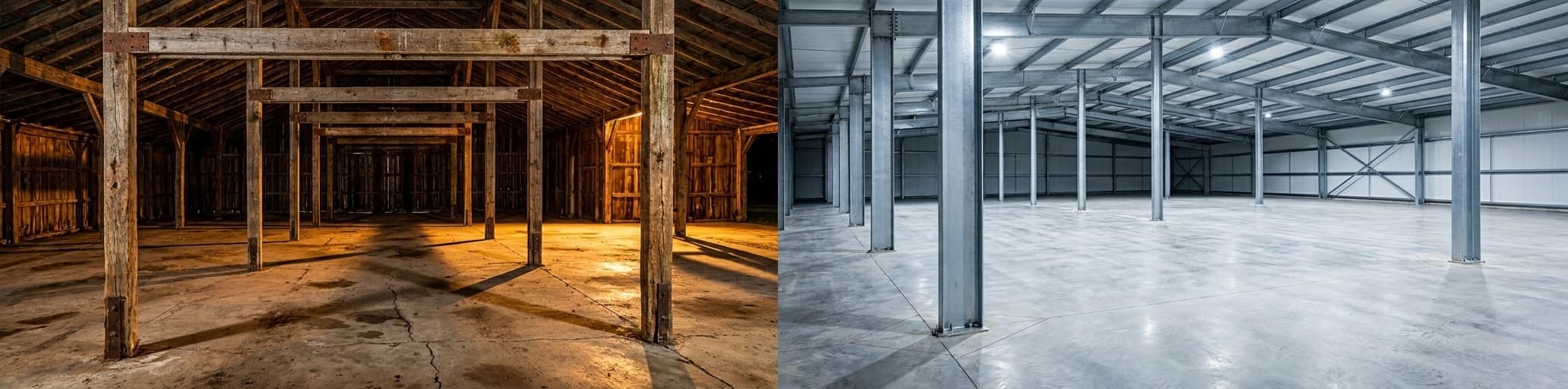

Steel buildings outperform pole barns across five critical dimensions: engineered foundations that resist frost heave and settlement, column-free interiors that maximize usable space, superior durability requiring minimal maintenance, commercial code compliance with stamped documentation, and lower total cost of ownership over 20+ years.
Difference 1: Foundation Requirements and Long-Term Site Stability
Frost heave pressure exceeding 30,000 pounds on buried posts causes incremental degradation over 2 to 3 winter cycles, while steel buildings engineered to local loads eliminate this variable entirely.
Pole barns rely on buried posts; steel buildings use concrete footings and grade beams
Pole barn posts are buried 4 to 6 feet into the ground as the primary vertical support, with columns spaced 8 to 12 feet apart along the building perimeter.[10] When those posts do sit on concrete footings — which the IBC requires to prevent settling under combined structural and live loads — code mandates a footing diameter of at least 18 inches for even a modest-span building.[9] The code requirement doesn't stop there: any wood contacting concrete must be pressure-preservative treated to UC-4B (IBC Section 1807.3), yet most pressure-treated posts sold at lumber yards carry only a UC-4A rating — one grade short of what the code actually requires.[9] Steel buildings bypass all of that by anchoring precision-engineered I-beam columns directly to a poured concrete slab or pier-and-beam foundation, with column spacing of 20 to 30 feet.[9] Every steel footing is engineered to local wind, snow, and seismic loads, so there's no guesswork about whether the anchor system meets code before you submit for permits.[9] A side-by-side look at pole barn vs. metal building foundations makes this structural gap visible immediately: one system buries wood in soil and hopes the chemistry holds; the other bolts steel to concrete and engineers out the variables from day one.[9]
How frost heave and soil settling affect each structure over 20+ years
Frost heave is the slow structural threat most pole barn buyers never see coming. Measured field data shows that frozen ground exerts upward pressure exceeding 30,000 lbs on a single buried post, with heaving pressure at the frost line ranging from 7 to 12 psi depending on soil moisture and temperature.[11] That force doesn't destroy a pole barn in one winter — it degrades it incrementally.
Repeated freeze-thaw cycles push buried columns upward over 2 to 3 winter cycles, loosening the soil-to-post contact until visible lean, racked door frames, and roof-line distortion force costly re-setting.[12] In northern states, post holes must reach at least 6 inches below the local frost line to resist heave at all — in Minnesota, that means excavating 78 inches or more for a standard installation.[12] Even properly set posts face a compounding problem: expansive clay soils common across Texas, Colorado, and the Dakotas shift 2 to 4 inches seasonally as the ground wets and dries, widening the gap between a settled post and its original bearing point year after year.[12] Steel buildings sidestep all of this. Precision-engineered anchor bolts connect I-beam columns directly to concrete footings sized and positioned to extend below the local frost line, so frozen ground moves around the foundation rather than lifting it.[11] Over a 20-plus-year commercial hold, those accumulated millimeter movements in a pole barn translate to purlins pulling away from posts, anchor connections loosening at every fastener, and door headers that no longer close square — expenses that never appear in a kit quote but do appear in your operating budget.
As the 30×40 metal building with slab cost guide notes, frost line depth varies dramatically by region, and engineering your foundation to that local reality is what keeps a steel building stable for decades — not just for the first few winters.
Why commercial buildings in harsh climates favor steel foundations
Climate zone is where the foundation decision stops being theoretical and starts costing real money. A steel building foundation accomplishes three non-negotiable functions regardless of location: it distributes the building's weight to prevent settling, resists uplift forces from wind and seismic activity, and maintains level support to preserve structural integrity.[13] What changes by region is how aggressively each function is engineered.
In hurricane-prone Gulf Coast and Atlantic states, foundations must be designed for substantial uplift resistance — the force trying to peel the roof off the slab during high winds.[14] In seismic zones across California, the Pacific Northwest, and parts of the Intermountain West, anchor bolt specs include additional provisions that standard pole barn posts simply can't replicate, because a buried post has no bolt pattern to upgrade.[14] Snow-belt states add another layer: deeper footers are required to carry the additional roof load that accumulates during winter months, and concrete strength requirements of 3,000 to 4,000 PSI are specified in the engineering drawings to ensure the anchor system doesn't degrade under repeated load cycles.[14] Pole barn construction doesn't deliver any of this climate-specific engineering by default — a lumber yard doesn't issue a stamped anchor bolt plan calibrated to your zip code's wind speed map, seismic design category, or ground snow load. A steel building does, because the manufacturer's engineering package is built around your specific site conditions from day one.[13] For commercial owners in coastal markets like Florida, seismic corridors like the Pacific Coast, or heavy snow regions like the Upper Midwest and mountain states, that precision is what separates a building that performs through 40 winters from one that needs remediation after the fifth.
If you're building in a region where the weather regularly tests structures, this regional guide to metal buildings with concrete foundations shows exactly how climate-driven engineering translates into lower repair exposure and stronger long-term asset value.[14]
Difference 2: Interior Space Utilization and Column-Free Design
Steel's rigid-frame design eliminates interior columns entirely, giving you 100 percent of your floor space to reconfigure as your business needs change.
Pole barns require interior support posts; steel trusses eliminate obstruction
The 40-foot mark is where pole barn interior design starts working against you.
Below that span, pole barns typically don't need interior columns.[15] Push past 40 feet — which virtually every commercial building does — and the structural math changes: wooden trusses grow larger and more expensive, and the cost-effective workaround becomes adding interior support posts rather than scaling up the truss system.[15] Steel sidesteps this entirely.
Rigid-frame haunch connections transfer roof loads laterally to the wall columns and down to the foundation, so the roof is supported by the walls rather than by posts running through the floor.[15] Steel trusses can be engineered and shaped into structural efficiencies that wood can't replicate, producing clear-span interiors with zero columns interrupting the floor plate.[15] Hybrid steel truss systems take the same principle further — using pre-engineered steel web trusses for the primary structural span while keeping wood secondaries for easier interior finishing — specifically because steel achieves the clear-span geometry that wood framing cannot reliably deliver at commercial widths.[17]
How open floor plans increase usable square footage and rental value
Interior columns don't just look inconvenient — they physically constrain every layout decision made afterward.
A post set every 8 to 12 feet forces equipment placement, shelving runs, partition walls, and door openings to work around fixed obstructions rather than around actual operational needs.[15] Steel's clear-span geometry puts 100% of the building's footprint to work, which matters directly when your business changes: adding mezzanines, repositioning loading doors, or subdividing bays all become straightforward decisions instead of exercises in working around a post that anchors every option in place.[16] Wood trusses can technically clearspan up to 100 feet, but the cost premium climbs steeply and wide clearspans come at a significant price increase — a tradeoff steel rigid frames avoid by design.[16]
Commercial applications where unobstructed space matters most
Three commercial uses expose the column problem immediately.
Warehouse operators running forklift aisles and pallet-rack systems need uninterrupted grid layouts — a post in the wrong bay blocks an entire racking column and wastes the square footage on both sides.[15] Aviation hangars require not just wide clear spans but full unobstructed floor-to-ceiling height for aircraft maneuvering and door swing, making any interior post a direct operational liability; prefab steel aviation hangars achieve 40- to 60-foot clear spans at commercial eave heights because steel trusses make that geometry cost-effective at scale.[15] Retail and showroom operators need reconfigurable floor plans to respond to seasonal merchandising changes, and a fixed column grid becomes a permanent constraint on sales-floor productivity.[15] In all three cases, clear span isn't a preference — it's an operational requirement that pole barn post spacing can't meet once the building exceeds 40 feet.[15]
How open floor plans increase usable square footage and rental value
The connection between column placement and rental income is direct and measurable.
Floor plate efficiency–the ratio of usable tenant area to total gross floor area–determines how much of your building a tenant can actually occupy and pay rent on.[19] Commercial spaces where columns appear frequently across the floor plan create dead zones in the usable areas, pushing the efficiency ratio below 70%, which commercial real estate benchmarks classify as poor.[19] Buildings with wide, unobstructed spans achieve efficiency ratios of 80% to 90%–the range where tenants fit more workstations, equipment runs, or inventory aisles into the same leased square footage without wasting square footage around fixed obstructions.[19] Steel's long-span structural system delivers that efficiency as a baseline: load transfers through the rigid frame rather than through interior posts, producing a flat, obstruction-free floor plate where all interior walls can be repositioned to suit whatever tenant occupies the space next.[18] That reconfigurability is what commercial property professionals call "loose fit" construction–the structural flexibility to accommodate a wide range of tenant layouts without costly modifications–and it's precisely what steel long-span design produces as a standard outcome rather than an expensive add-on.[18] For warehouse operators, the same principle applies directly to square footage utilization: column-free construction makes the layout flexible by design, so every square foot of floor space generates productive use rather than housing structural obstructions.[20]
Commercial applications where unobstructed space matters most (warehouses, hangars, retail)
The span requirements vary significantly by commercial use — and matching frame type to application is what separates a building that works from one that merely fits on the site. Steel clear span buildings eliminate interior columns across spans up to 300 feet, with most commercial applications falling between 40 and 100 feet.[21] For warehouse and distribution operators, tapered column multi-span frames deliver the high eave heights and extensive square footage that racking systems demand, while still allowing interior partition walls for finishing office space or dedicated receiving areas.[21] Straight single-slope frames serve retail and shopping center applications where one-way drainage and uniform façade height matter — specifically free-standing retail, convenience stores, and shopping malls where structural consistency ties directly to exterior presentation and drainage control.[21] For prefab warehouse construction, the rigid frame geometry means every square foot of floor space stays productive — no column footprint eating into a racking bay, no post interrupting a forklift aisle.
Aviation hangars set the hardest clear-span requirements of any commercial building type. Single-engine aircraft require 40 to 60 feet of unobstructed interior width; twin-engine and turboprop aircraft push that to 60 to 80 feet; corporate jets need 80 to 120-plus feet; and multi-aircraft FBO facilities run 120 to 200-plus feet of clear span.[22] Steel rigid frames achieve clear spans exceeding 200 feet without interior columns — a structural non-negotiable for aircraft maneuvering, maintenance access, and door swing geometry that pole barn post spacing cannot replicate at any price.[22] The demand pressure behind those requirements is only growing: the global general aviation market was valued at $31.9 billion in 2024 and is projected to expand at a 6.1% compound annual growth rate through 2034, with over 200,000 active general aviation aircraft in the United States alone creating persistent backlog for purpose-built hangar space.[22] In all three commercial categories — warehouse, hangar, and retail — the operational constraint isn't aesthetic preference for open space. It's that the building's structural system either supports the use case from day one, or forces workarounds that cost money every day of operation.
Difference 3: Durability, Maintenance, and Material Lifespan
Moisture, pests, and weather degradation combine to generate cumulative repair costs over 20-30 years that routinely exceed your initial pole barn savings.
Wood rot, termite damage, and weather deterioration in pole barn construction
Moisture is the most aggressive threat to pole barn framing, and its damage accumulates silently long before it's visible.[23] Even treated wood posts in persistent soil contact eventually lose their decay resistance, and minor water intrusion at fastener points is enough to trigger structural rot that demands full replacement rather than surface repair.[24] Termites and carpenter ants compound that risk: both insects target wooden structural members, and active infestations often stay invisible until hollow-sounding wood or sawdust accumulations at column bases reveal that load-bearing capacity is already compromised.[23] Catching the problem early requires scheduled inspections, annual insecticide applications, and physical termite shields at column transitions — none of which appear in a kit quote but all of which recur year after year.[23] Weather adds a third degradation pathway independent of biology: UV radiation breaks down protective coatings, persistent rain saturates exposed grain at cuts and connections, and freeze-thaw cycling forces dimensional movement that works fasteners loose at every joint across successive winters.[24] The visible symptom is a repainting or staining cycle required every few years; the less visible cost is progressive structural loosening no exterior coat addresses.[25] Over a 20-to-30-year commercial ownership period, those three failure modes — moisture rot, pest damage, and weather deterioration — generate cumulative repair costs that routinely exceed the initial savings a pole barn offered at purchase.[24] The steel farm buildings vs. pole barns 20-year maintenance cost breakdown puts specific dollar figures on each failure mode, replacing the upfront price comparison with the total-cost picture that matters for any long-term commercial asset decision.
Steel's noncombustible, rust-resistant properties and minimal maintenance demands
Cost of ownership over 30 years: pole barn repairs vs. steel building longevity Pole barns typically need major repairs or component replacement within 20 to 30 years — not because of poor construction, but because wood framing degrades on a fixed biological timeline regardless of how diligently the building was maintained.[30] Steel delivers 50 or more years of service without structural intervention beyond periodic inspections and surface touch-ups.[29] That lifespan gap closes the final argument for pole barns on a long commercial hold: when your steel building still has 20-plus productive years ahead, a comparable pole barn is entering its most expensive window — partial rebuilds, post replacements, and structural remediation that no maintenance schedule prevents, only delays.[30] The asset value implications are equally direct.
Buyers and investors price maintenance history into commercial acquisitions, and a steel building with documented low upkeep signals structural integrity during due diligence, while a wood-frame property with accumulated repair records generates questions that discount offers before negotiations open.[24] Over a three-decade commercial hold, the long-term cost gap between steel and pole barn construction removes any ambiguity: the recurring repair costs wood structures accumulate across that ownership period routinely exceed whatever upfront savings the pole barn offered at purchase — making steel the more predictable, lower-risk investment for any owner financing a long-term asset.[24]
Difference 4: Building Codes, Permits, and Commercial Compliance
Engineer-stamped structural drawings on steel buildings satisfy commercial permit reviewers immediately, while pole barns designed to agricultural standards require costly modifications after plan review rejection.
Why municipalities classify pole barns and steel buildings differently for zoning
The classification gap starts with zoning, not building codes. Municipalities assign land a use category — agricultural, residential, commercial, or industrial — and each category determines which building types are permitted outright, which require a conditional use permit, and which are blocked entirely.[31] Pole barns occupy an ambiguous position in this framework: many jurisdictions treat them as agricultural structures and extend permit exemptions for basic storage or equipment buildings on farmland, but those exemptions disappear the moment the intended use shifts to commercial operations.[31] A pole barn planned for commercially zoned land faces the same IBC scrutiny as any other structure, but without engineer-stamped drawings, plan reviewers have no certified baseline to approve — which stalls or blocks permitting in stricter jurisdictions.[32] Occupancy classification compounds the problem.
A building where employees work regularly triggers fire separation, egress, and energy code requirements that a basic storage structure doesn't carry; a pole barn designed to the lower agricultural standard won't pass commercial occupancy review without modifications that add cost and time after the fact.[31] Steel buildings are engineered around your occupancy classification from day one. Pre-engineered steel packages include stamped structural drawings calibrated to your site's specific wind, snow, and seismic load values — exactly what plan reviewers need to issue a commercial permit without requesting revisions.[32] If you're navigating a commercial permit in a state with detailed IBC enforcement, a Pennsylvania commercial steel building code checklist shows precisely how stamped engineering documentation maps to each plan review checkpoint — the same process that keeps steel projects on schedule while pole barn submissions cycle through additional review rounds.[32]
Fire ratings, wind load ratings, and seismic compliance advantages of steel
Fire rating classification is where the code gap between pole barns and steel buildings becomes legally significant. Under the International Building Code, steel structures qualify as Type II noncombustible construction, while wood-frame pole barns fall under Type V — the lowest fire-resistance classification the IBC recognizes.[33] That gap isn't cosmetic. Type II classification determines fire separation distances, sprinkler system requirements, and egress provisions for commercial occupancies.[33] A pole barn built to agricultural standards won't satisfy those provisions on a commercial permit review without costly structural modifications added after the fact — modifications that close the original price gap fast.[33]
Wind load compliance operates on an equally precise framework that pole barn construction can't replicate by default. The IBC and ASCE 7 classify every building site by wind exposure category — B, C, or D — based on surrounding terrain, site position, and building enclosure conditions, with each category producing different required design pressures.[35] A steel manufacturer applies those site-specific values to every column, connection, and anchor bolt before a single component ships, producing engineer-stamped drawings that document exactly how the structure resists wind from any direction.[35] Without that documentation, a plan reviewer has no certified basis to approve wind load compliance — and a lumber yard supplying pole barn materials doesn't generate it.[34] In hurricane-prone coastal states or open-exposure agricultural sites rated Exposure C or D, that absence of stamped wind engineering is what stalls or blocks commercial permits entirely.[34]
Seismic compliance adds the third layer, and it's the one that eliminates pole barn construction entirely in moderate-to-high risk zones. The IBC and ASCE 7 assign every U.S. location a Seismic Design Category — SDC A through F — based on seismic hazard, soil conditions, and building occupancy, with SDC A representing the lowest risk and F the highest.[35] Buildings in elevated SDC categories must meet progressively stricter structural connection requirements to maintain integrity during ground movement.[35] A steel building's bolted rigid-frame system can be engineered to meet any SDC from the start — the manufacturer calculates site-specific spectral acceleration values and designs anchor bolt patterns and frame connections accordingly.[35] A buried wood post offers none of that engineered certifiability; there's no bolt pattern to upgrade and no stamped connection detail to submit.[34] The result is that pole barn construction in SDC C, D, or higher zones faces a structural compliance ceiling that steel sidesteps entirely by design. For property owners whose sites sit in seismically active corridors — California, the Pacific Northwest, or the Intermountain West — understanding how structural steel components translate into disaster-resistant infrastructure is what separates a building that meets code on first submission from one that cycles through multiple revision rounds.[35]
How custom engineering from National Steel Buildings ensures code approval on first submission
The most common cause of permit revision cycles isn't code complexity — it's submitting drawings that weren't calibrated to your site's actual load requirements from the start.[36] Pre-engineered steel building manufacturers produce engineer-stamped drawings as part of the building package, generated by a licensed structural engineer and specific to your building's dimensions, local load requirements, and foundation design.[32] Those drawings arrive at your building department already mapped to your jurisdiction's IBC edition, local wind speed values, ground snow load, and seismic design category — the complete documentation plan reviewers need to issue a commercial permit without sending you back for revisions.[36] Some lower-cost package providers ship generic drawings that still need state engineering review after delivery, adding both cost and weeks to your schedule before a permit is even in hand.[32] A building engineered for lower loads than your site actually experiences is a structural problem waiting to happen — and a permit application with under-specified drawings triggers exactly the revision cycle that delays occupancy and erodes the project timeline you budgeted around.[32] The permit processing clock also runs longer when submitters arrive without complete documentation and must keep returning with additional submittals, a delay pattern that's fully avoidable when the engineering package is site-specific on first submission.[36] Working with a steel building partner who knows your jurisdiction's specific requirements, understands which local IBC amendments apply, and builds those values into your prefab building kit's engineering package from day one is what separates a project that moves fast and smooth through plan review from one that stalls in revision cycles while a pole barn applicant down the street is already pouring concrete.[32] Difference 5: True Total Cost of Ownership–Initial Price vs. 20-Year Expenses
Pole barn initial cost advantage: 10-15% cheaper upfront, but with hidden long-term costs
The 10-15% upfront savings a pole barn offers over comparable steel construction comes from simpler framing, fewer materials, and shorter labor hours — not from stronger engineering.[37] That discount starts eroding the moment you account for what pole barn ownership actually costs year over year.
Maintenance obligations alone shift the math: pole barns require regular painting or staining, scheduled pest treatment, and recurring moisture inspections that steel buildings simply don't generate.[29] Wood framing is susceptible to rot and insect damage, and those failure modes require ongoing attention across the full ownership period — costs that never appear in a kit quote but do appear in your operating budget.[37] Insurance compounds the gap further: steel's noncombustible framing consistently earns premium reductions of 30% or more compared to wood-frame structures, savings that recur every policy renewal rather than landing once at closing.[37] Resale value closes the argument: metal buildings carry higher resale value than pole barns, which means the upfront discount reappears as a discount again when you exit the asset.[37] A detailed 30×40 pole barn price comparison across three states shows precisely how regional material and labor costs affect that initial price gap — and how quickly recurring ownership expenses close it once the building is in service.
Steel building cost breakdown: higher initial investment offset by zero-maintenance durability
Steel building materials for commercial applications run $10 to $25 per square foot, with installation adding another $10 to $20 per square foot — putting a typical 10,000-square-foot facility between $120,000 and $250,000 in total initial investment.[38] Wood construction for an equivalent footprint lands between $350,000 and $500,000, and concrete can reach $500,000 to $700,000, so steel's upfront cost isn't actually the premium it's often assumed to be.[38] Where steel separates itself decisively is in what you spend after the building goes up. Annual maintenance for a steel structure averages roughly 1% of initial building value — around $1,500 to $2,500 per year for a 10,000-square-foot building — compared to 2 to 4% for wood, which produces $7,000 to $20,000 in annual upkeep once painting, pest treatment, rot repair, and recurring weather damage are factored in.[38] That gap compounds every year of ownership, and it doesn't include unplanned events: wood-framed buildings in humid climates routinely absorb $30,000 or more in a single termite remediation event that never appears in any maintenance forecast.[38]
| Cost category | Steel (10,000 sq ft) | Wood (10,000 sq ft) |
|---|---|---|
| Initial investment | $120,000-$250,000 | $350,000-$500,000 |
| Annual maintenance | 1% of value ($1,500-$2,500/yr) | 2-4% of value ($7,000-$20,000/yr) |
| Annual energy savings | 10-20% on energy bills | Lower efficiency baseline |
| Projected 20-year total cost | ~$350,000 | $670,000-$1,100,000 |
| Resale value change over 20 years | +20-30% | Lower ROI due to repair/remodel costs |
The lifespan math anchors all of it. According to the Metal Building Manufacturers Association, metal buildings last six decades or more — and many pre-engineered structures remain fully operational past the century mark when a basic maintenance program is followed.[39] Wood-frame buildings, by comparison, typically show serious structural wear within 20 to 40 years, requiring significant renovation or partial rebuilds before the ownership period most commercial owners are financing is even complete.[39] Steel doesn't rot, warp, split, or attract termites — the four biological failure modes that drive wood's higher maintenance burden — and hot-dip galvanized steel coatings in suburban environments carry a time-to-first-maintenance of 97 years according to the American Galvanizers Association, meaning the protective coating outlasts most buildings built around it.[39] The ongoing maintenance a steel building actually demands is straightforward: biannual visual inspections, gutter clearing, sealant checks around penetrations, and prompt touch-up paint on any scratched panels — tasks measured in hours per year, not days.[39] For commercial owners who have reviewed the steel barn cost vs. wood barn 20-year math, the same arithmetic applies at every commercial scale: the maintenance savings and longer service life steel delivers consistently convert the higher upfront cost into the lower total cost of ownership across any hold period longer than a decade.[24]
Cost comparison tool: calculate your break-even point by building type and region
The break-even point — where steel's lower running costs fully cancel its higher purchase price — is not fixed. It moves based on how hard your region works against wood framing.[30] Pole barns cost less upfront because they use simpler design and fewer materials, but that savings gap shrinks year over year as maintenance obligations accumulate.[29] Wood posts are vulnerable to moisture and termites regardless of treatment grade, and even a well-maintained pole barn typically reaches a window of major structural repairs within 20 to 30 years — before most commercial financing periods are even complete.[30] Steel buildings resist rot, pests, and weather damage by design, which means lower upkeep spend recurs every year of ownership rather than landing once at closing.[30] In humid Gulf Coast and Southeast markets, termite pressure and persistent moisture exposure accelerate wood degradation and pull the break-even point earlier than the national average.[29] In northern snow-belt states, freeze-thaw cycling and frost heave on buried posts generate recurring re-setting and straightening costs that compound annually and close the gap faster than any maintenance schedule prevents.[30] Arid western climates offer the mildest advantage for pole barns — UV degradation and seasonal dryness still work fasteners loose and crack coatings, but the pace is slower than in moisture-heavy regions.[29] The table below maps the primary cost drivers by region so you can estimate where your own break-even falls before committing to either building type.
| Cost factor | Humid South and Gulf Coast | Northern Snow Belt | Arid West and Southwest |
|---|---|---|---|
| Primary wood threat | Moisture and termites | Frost heave and rot | UV degradation and dry cracking |
| Pole barn maintenance intensity | High | High | Moderate |
| Steel break-even speed | Fast | Fast | Moderate |
| Long-term steel cost advantage | High | High | Moderate |
| Typical pole barn major repair window | 20-25 years | 20-30 years | 25-30 years |
| Steel building service life | 50+ years | 50+ years | 50+ years |
Across every region, the underlying arithmetic holds: pole barns offer a faster start, steel offers a longer and cheaper run.[30] For commercial owners financing a 20-year or longer hold, the question is never whether steel's total cost of ownership advantage appears — it's only how quickly it appears given your specific climate, insurance market, and maintenance exposure.[29]
How National Steel Buildings Delivers Single-Source Commercial Solutions
In-house erection crews resolve field questions in minutes rather than cycling delays through separate contractors, keeping your project on schedule and reducing costs.
From design and permitting through erection: one partner, one timeline, one guarantee
Why ProTrades in-house erection division eliminates contractor coordination headaches Separate supply and erection contracts are one of the most reliable ways to add weeks to a commercial steel project without adding a single square foot of building.
When two or more independent delay events hit simultaneously — a shop drawing revision from the supplier overlapping with a crew scheduling gap from a separate erection contractor — accountability blurs, and timeline recovery becomes a contract dispute rather than a field decision.[45] Concurrent delays of that kind rarely resolve quickly; they require formal cause analysis, contract review, and assigned responsibility before corrective action moves forward, all while your occupancy date slips further.[45] The ProTrades in-house erection division removes that gap entirely.
In-house crews answer to the same project managers who own the design and the schedule, so field questions resolve in minutes rather than cycling through an RFI log between two organizations whose contracts point at each other.[44] That direct supervision chain also eliminates the markup subcontractors layer onto labor and materials, reducing your project cost while improving schedule control through tighter sequencing of each construction phase.[44] When unexpected site conditions surface — and on commercial projects they do — an in-house crew adapts immediately rather than escalating to a separate contract party whose pricing and availability aren't aligned with your timeline.[44] For owners who want to understand what separates a reliable erection partner from a kit-only supplier before signing anything, this guide to vetting local prefab contractors covers the five questions that reveal scope gaps before they become change orders.
Real-world examples: commercial, aviation, and industrial clients who chose steel and why
Distribution and logistics operators were among the earliest commercial adopters of steel framing for one straightforward reason: clear span up to 300 feet eliminates the interior columns that destroy racking efficiency, and rental income is priced by the square foot — every column that interrupts a racking bay is dead space your tenant isn't paying for.[46] Northern Logistics built their steel distribution center in Clare, Michigan to provide transportation, supply chain, and pallet management services, specifying multiple 14-foot roll-up doors for simultaneous loading access and horizontal windows across the wall line for natural interior light without sacrificing panel strength.[46] The erection speed was equally decisive: a standard crew assembles 1,000 to 1,500 square feet of steel framing per day, meaning a 10,000-square-foot facility reaches weatherproof shell in roughly 10 working days — a timeline that lets distribution operators get to revenue before a wood-frame competitor even finishes framing.[46] For owners reviewing prefabricated industrial steel building options, the combination of column-free floor plates and fast erection is what makes steel the default choice for warehouse and logistics applications at any scale.
Aviation clients face the hardest structural requirements of any commercial building category, and three distinct operator types have each landed on steel for the same core reason: only rigid-frame steel achieves the column-free spans aircraft operations demand without prohibitive cost increases.[47] A commercial airline operator needed a 55-meter clear-span maintenance hangar accommodating narrow-body aircraft, specifying bi-fold doors, heavy-duty aircraft-rated flooring, and integrated MRO workstations — all completed within a compressed project schedule that concrete construction couldn't have matched.[47] A military aviation command deployed a modular steel hangar to a remote location requiring fast assembly, reinforced frames engineered for extreme wind loads, and sandstorm-resistant envelope systems — structural performance a pole barn post pattern cannot certify for any seismic or wind exposure category.[47] A private aviation operator chose a 30-meter clear-span steel hangar with sliding doors and basic HVAC, delivered and erected in under two months — a speed-to-occupancy result that matters directly when an aircraft owner is paying tie-down fees while their permanent hangar is still under construction.[47] In every case, the column-free interior wasn't a preference; it was a non-negotiable operational requirement that pole barn spacing cannot meet once aircraft size, door swing geometry, or maintenance workflow is factored into the floor plan.[47]
Commercial property owners across retail, industrial, and mixed-use categories consistently cite three business-level factors when explaining why they chose steel over pole barn construction: long-term asset value, lower annual insurance cost, and minimal maintenance burden.[37] Steel's noncombustible framing earns insurance premium reductions of 30% or more compared to wood-frame structures — savings that recur every policy renewal rather than landing once at closing.[37] On the maintenance side, steel requires no painting cycles, no pest treatments, and no post-straightening; the recurring upkeep is periodic inspection and surface touch-up, measured in hours per year.[37] Resale compounds the advantage further: metal buildings carry higher resale value than pole barns, which means the upfront price premium converts into a premium again at exit — the initial cost gap doesn't disappear, it reverses.[37] For commercial owners financing a 10-year or longer hold, those three compounding factors are what move the decision from pole barn to steel before the first permit application is filed.[37]
Next Steps: Determine Whether Pole Barn or Steel Is Right for Your Commercial Project
Answer these twelve questions in order to convert structural differences into a defensible go-or-no-go decision backed by numbers.
Decision Essentials: 12 questions to ask before choosing your building type
Before you request a single quote, these twelve questions convert the five structural differences above into a go/no-go decision you can defend with numbers. Work through them in order — each answer narrows your field before the next question matters.
- What clear span does your operation actually require? Pole barns become structurally complex and cost-inefficient beyond 60 to 80 feet of clear span and 20 feet of eave height; steel imposes no comparable ceiling.[6]
- How many years are you financing or holding this asset? Metal buildings consistently deliver lower long-term costs, and the ownership-period advantage grows wider the longer you hold.[6]
- What climate zone is your site in? Wood posts are more susceptible to weather damage from heavy winds and rain, while steel withstands harsh conditions including high winds, heavy rain, and snow without structural degradation.[6]
- Are there zoning or permitting restrictions on pole barns in your jurisdiction? Some areas impose permitting and zoning restrictions that prevent pole barn construction for specific commercial purposes — a friction point steel's engineer-stamped packages sidestep by design.[4]
- What occupancy classification will your building carry? Commercial occupancies trigger egress, fire separation, and energy code requirements that a basic agricultural pole barn design won't satisfy without costly post-permit modifications.[4]
- Will the building be heated or climate-controlled? When heating is required for a pole barn, an attic space must be constructed and sealed to accommodate insulation — an additional construction step steel buildings eliminate entirely because insulation installs with the roof panel in one operation.[6]
- How much interior layout flexibility do you need now and in five years? Steel frames span 20 to 30 feet on center and produce a fully reconfigurable floor plate; pole barn posts at 6 to 8 feet create fixed obstructions that constrain every layout decision from day one.[6]
- What is your annual maintenance budget? Wood structures require more ongoing attention than metal buildings — especially inspection for rot, pest damage, and weather wear — costs that steel buildings simply don't generate.[6]
- What are your fire risk exposure and insurance requirements? Metal buildings are resistant to fire, termites, and rot, and typically drive lower insurance premiums than pole buildings — a recurring annual saving, not a one-time benefit.[6]
- Do you need engineer-stamped drawings to pass commercial plan review? Steel buildings are pre-engineered with all components fabricated to exact dimensions, producing the certified documentation plan reviewers require; a lumber yard supplying pole barn materials generates none of it.[6]
- Are you planning to expand the footprint or add specialized features later? Steel accommodates wider clear spans, taller eave heights, longer lengths, and large specialty doors at any scale, while pole barn construction grows more complex and expensive as project size increases beyond modest dimensions.[6]
- What is your exit or resale strategy? Metal buildings often increase property value more than pole barns due to longevity and lower maintenance burden, while accumulated repair records on wood-frame properties tend to discount acquisition offers before negotiations open.[6]
If your answers to questions 1, 4, 5, 9, 10, or 12 point toward steel, the remaining questions are largely confirmatory — the structural and compliance case is already made. If you're still comparing contractor proposals at that point, a steel building contractors vetting guide covers the five scope questions that reveal hidden cost gaps before you sign anything.
How to request a free design consultation and cost estimate from National Steel Buildings
The consultation process works best when you arrive with three things ready: your approximate building dimensions (or a rough square footage), the address or zip code of the site, and your intended occupancy use.[50] That address-level detail isn't a formality — every pre-engineered steel building is engineered to your specific location's wind speed map, ground snow load, and seismic design category, so two buildings with identical footprints carry different structural specs depending on whether they're going up in Los Angeles or Miami.[50] A quote generated without your site address is a ballpark, not a budget.
Before the consultation call, also check with your local building authority to confirm your parcel's zoning classification and any use-specific restrictions — that information lets the engineering team calibrate your package to local IBC amendments from day one rather than discovering conflicts after plan submittal.[50] The consultation itself moves through five decisions in order: end use and operational requirements, site load conditions, clear-span and layout needs, component selections such as doors and insulation, and foundation scope.[49] Working through those points in sequence produces a complete project specification rather than a kit-only price — which is what separates a number you can build a real budget around from one that generates add-on surprises after you've committed.[48] When you're ready to compare what a full scope quote actually includes versus what a kit price leaves out, the 40×80 metal building kit pricing breakdown shows exactly which line items are optional at quote and which become non-negotiable before occupancy — so you can walk into your consultation with the right questions already in hand.
Common misconceptions about steel buildings that keep commercial owners from exploring the option
Several misconceptions about steel buildings circulate widely enough that commercial owners dismiss the option before comparing actual specifications — and most of them collapse quickly under scrutiny.[51] The rust concern is the most persistent: the assumption is that exposed steel corrodes rapidly in humid or coastal environments and becomes a structural liability within a decade.[52] In practice, galvanization applies a zinc coating to the steel framing during manufacturing that blocks oxidation at the surface level, requiring minimal maintenance and eliminating rust as a structural threat for decades — a protection mechanism the wood post sitting in soil contact doesn't have a comparable answer to.[52]
Lightning and Wi-Fi concerns stop more commercial owners than they should. The assumption that metal structures attract and concentrate lightning strike energy is a common scare, but structurally it works in reverse: a steel building transfers electrical energy directly into the ground rather than releasing it destructively through the frame the way a wood structure does, making the interior safer during electrical storms, not more dangerous.[52] Wireless signal performance raises similar unfounded concerns — radio, cellular, and Wi-Fi waves diffract around steel as efficiently as around any other building material, so steel framing produces no signal degradation compared to wood or concrete construction.[52]
Two flexibility misconceptions keep commercial owners from modeling steel accurately in their build planning. The first is that steel buildings are permanent and rigid once constructed — in reality, steel structures are easier and faster to expand or modify than either wood or concrete, with new bays and structural additions bolted into the existing frame rather than cut and reframed.[52] The second is that steel buildings perform poorly on energy efficiency; a steel building with a properly specified insulation system reduces heat loss and cuts HVAC operating costs consistently, and unlike a pole barn where insulating an attic space requires a separate construction step, steel panel systems install insulation in a single operation during the building envelope phase.[52] For owners exploring energy-efficient metal buildings that meet ASHRAE 90.1 standards, the insulation performance of modern steel panel assemblies is what makes that compliance achievable without expensive mechanical system upgrades.[53]
Weather performance rounds out the list of misconceptions that cost commercial owners real money when left unchallenged. Steel framed buildings are engineered to meet strict building codes for structural integrity under high winds, heavy rain, and snow — the same load conditions that cause progressive deterioration in pole barn framing through frost heave, moisture intrusion, and fastener loosening.[53] Steel does not warp, rot, or attract termites, which means the four biological failure modes that drive wood's maintenance burden simply don't apply; with periodic inspections and basic upkeep, a steel building stays in serviceable condition for decades without the component replacement cycles that define pole barn ownership past the 20-year mark.[53]
- Steel buildings achieve clear spans up to 300 feet with zero interior columns; pole barns become structurally complex beyond 40-60 feet.
- Frost heave and expansive soils exert 30,000+ lbs upward force on buried pole barn posts, causing progressive structural degradation over 2-3 winters.
- Steel buildings require only 1% annual maintenance ($1,500-$2,500/year); pole barns demand 2-4% ($7,000-$20,000/year) for painting, pest treatment, and rot repair.
- Over 20 years, steel total cost averages $350,000 while comparable pole barns reach $670,000-$1,100,000 including accumulated maintenance and repairs.
- Steel qualifies as Type II noncombustible construction, earning 30%+ insurance premium reductions; pole barns fall under Type V with higher fire-risk classification.
- Pre-engineered steel drawings arrive site-specific and code-ready; pole barn submissions routinely cycle through multiple permit revisions before approval.
- https://www.buildingsguide.com/build/pole-barn-vs-metal-building/?srsltid=AfmBOoo8b5ooa8oRMI7B46HMX_SuIR8-7LkAc7RHj3e_637h4u387nCj
- https://www.rhinobldg.com/metal-pole-barns-vs-rhino-steel-buildings
- https://www.acebuildingservice.com/blog/metal-building-vs-pole-barn
- https://armstrongsteel.com/blog/steel-buildings-vs-pole-barns-choose-the-right-structure-for-your-needs
- https://alansfactoryoutlet.com/blog/metal-building-vs-pole-barn/?srsltid=AfmBOoolNLDd0jey1DF9SzaqBXx2tIMg-AbVQ21pKYK3tCX2PmKRGA_D
- https://themetalshopllc.com/what-is-better-a-pole-barn-or-metal-building/
- https://info.fbibuildings.com/blog/post-frame-vs-steel-frame-buildings
- https://www.qmmetalbuildings.com/steel-vs-post-frame-buildings/
- https://www.hansenpolebuildings.com/2013/03/footing-2/?srsltid=AfmBOopWO8ofDtrlhEJxE7sheTm9ytT93RbCUXYVLUdmkyis2Qo_XazC
- https://www.concretepiersystem.com/post/why-build-a-pole-barn-or-why-post-frame-construction-is-better/
- https://inspectapedia.com/structure/Frost_Heave_Expansive_Soil_Damage.php
- https://nmifence.com/blog/fence-post-depth
- https://buildway.com/steel-building-foundation-slab-pier-footer-guide/
- https://mbmisteelbuildings.com/blog/steel-building-foundation/
- https://armstrongsteel.com/blog/whole-darn-pole-barn-truth
- https://www.hansenpolebuildings.com/2016/02/busting-more-all-steel-building-myths/?srsltid=AfmBOop47Zn1UhFeRY8_xuDuURWGMmYjFg3N8SpPze37BaCe_uYj1lrQ
- https://miracletruss.com/steel-truss-pole-barn-kits-vs-traditional-framing/
- https://steelconstruction.info/Multi-storey_office_buildings
- https://www.brigadegroup.com/blog/commercial/floor-plate-efficiency-in-office-spaces
- https://gensteel.com/resources/case-studies/how-to-start-a-warehouse-business/
- https://www.alliedbuildings.com/open-span-steel-buildings/
- https://www.steelcobuildings.com/metal-aircraft-hangars-design-advantages-and-structural-options/
- https://www.diypolebarns.com/learn/how-long-do-pole-barns-last/
- https://americansteelinc.com/blog/steel-building-vs-wood-concrete/
- https://www.peakbuildingsystems.com/post/steel_vs_wood_a_deep_look_at_the_pros_and_cons
- https://metal-america.com/steel-commercial-buildings-beat-wood-every-time/
- https://metalcontractors.com/metal-vs-wood-buildings-cost-and-safety-insights-for-buyers/
- https://systemswestinc.com/steel-frame-vs-wood-frame-commercial-buildings/
- https://www.omni-builders.com/home-tips/pole-barn-vs-metal-building-cost-maintenance-longevity-compared
- https://themetalshopllc.com/which-is-better-steel-building-or-pole-barn/
- https://www.steelstructuresamerica.com/pole-barn-permits/
- https://www.steelstructuresamerica.com/metal-building-permits-codes-and-engineering-requirements-what-you-need-to-know/
- https://www.arcosteel.com/what-permits-and-codes-are-required-for-steel-buildings/
- https://www.buildingsguide.com/build/metal-building-codes-permits/?srsltid=AfmBOorPEIv9Y4pQKC5qlZpyM-6oS9zMHnIlDIjSlD6fwC5k7fBL-V-1
- https://norsteelbuildings.com/building-codes-permits/steel-building-codes-loads/
- https://www.buildingsguide.com/build/metal-building-codes-permits/?srsltid=AfmBOoo7UIu52NsyUrjchGXnBtiYnRTki0nNmdEd2cqpLWuYC3Z4WVUL
- https://www.steelcobuildings.com/pole-barn-vs-metal-building/
- https://www.summitsteelbuildings.com/20-year-cost-comparison
- https://www.steelcobuildings.com/steel-building-lifespan-how-long-do-metal-buildings-really-last/
- https://bargainmetalbuildings.com/pole-barn-vs-metal-building/
- https://m2steel.com/
- https://www.doubleblackconstruction.com/best-to-use-one-turnkey-provider
- https://www.steelstructuresamerica.com/pre-engineered-vs-custom-metal-buildings/
- https://www.raecobuilders.com/blog/2025/1/13/3-advantages-of-self-performing-construction
- https://www.projectmanager.com/blog/concurrent-delay-construction
- https://gensteel.com/resources/case-studies/steel-buildings-for-distribution-centers/
- https://xtdsteel.com/blogs/steel-hangar-building/
- https://www.gramsconstruction.com/step-by-step-guide-to-the-steel-building-construction-process
- https://mbmisteelbuildings.com/blog/planning-a-commercial-steel-building/
- https://armstrongsteel.com/blog/steel-building-quotes-prices-estimates
- https://www.calahan.com/debunking-common-misconceptions-about-commercial-steel-buildings/
- https://swantonweld.com/debunking-structural-steel-building-myths/
- https://www.gjelgarconstruction.co.uk/blog/steel-framed-buildings-myths-vs-reality