
We help you understand how structural steel sections, connections, labor rates, and regional factors stack into a reliable total cost before fabrication begins. Steel frame construction runs $24-$43 per square foot installed in 2025, with proper planning cutting your total ownership cost by $40,000-$100,000 over two decades compared to wood or concrete.
Understanding Steel Frame Construction Cost Basics
Your choice of structural steel section type — universal beams, columns, or hollow sections — is the first cost lever you control before fabrication even begins.
What defines a structural steel frame and its core components
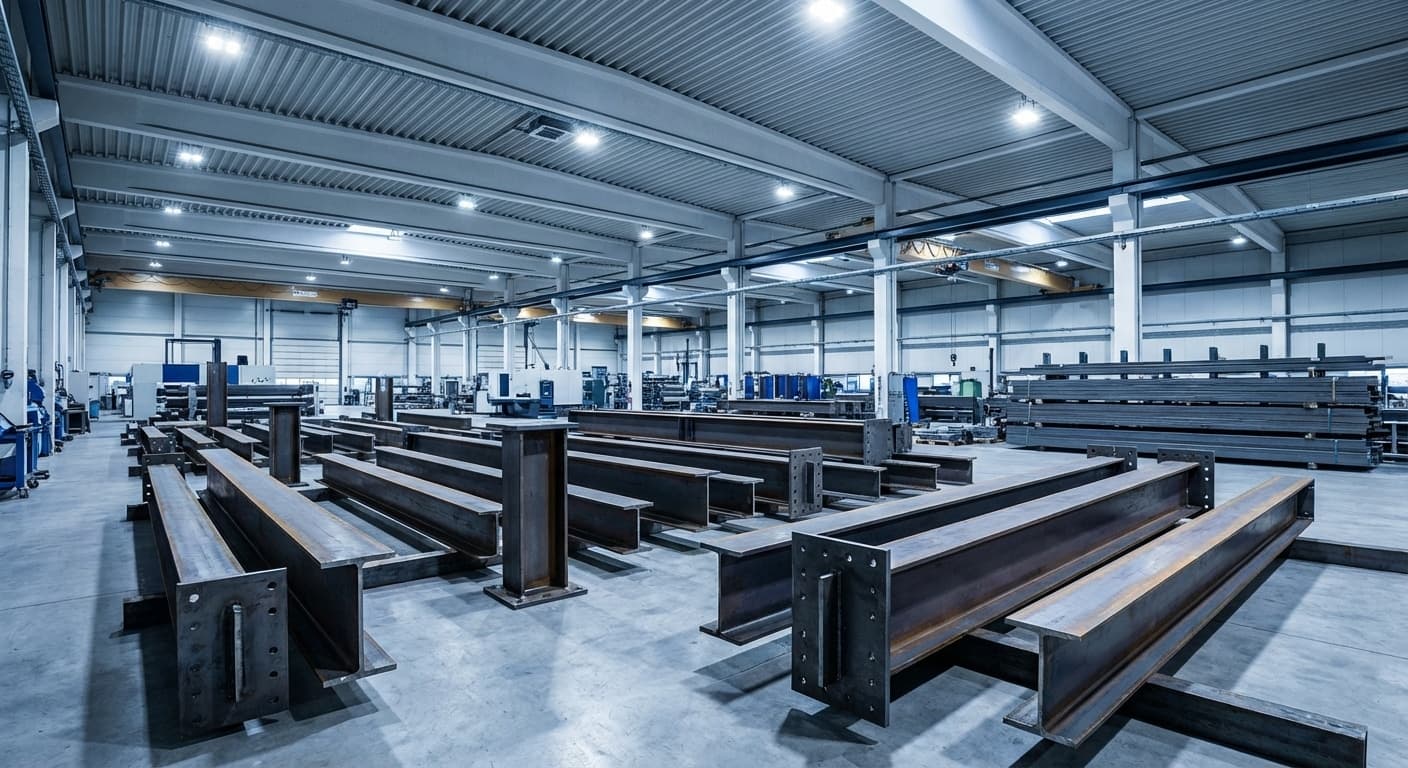
A structural steel frame is a load-bearing network of interconnected members — columns, beams, rafters, purlins, bracing, and connection plates — engineered to transfer dead loads, live loads, wind, and seismic forces safely to your foundation.[3] Columns and beams handle the core work: columns carry vertical compression (and bending moments in moment-resisting frames), while beams resist horizontal bending and shear along their span.[2] Primary beams run between columns; secondary beams span between primary beams and carry the floor slab directly.[1] Hot-rolled sections — universal beams (UB), universal columns (UC), structural hollow sections (SHS), and parallel flange channels — form the primary frame, while cold-formed sections handle secondary framing like purlins and girts.[3] Understanding which section type each part of your building requires is one of the first cost levers you control, and a closer look at how each of these structural steel components fits into a complete system shows why section selection shapes your steel frame construction cost well before fabrication begins.
Connections bind the whole frame together: bolted field connections allow faster erection and future modifications, while factory-welded connections deliver the tighter tolerances needed for complex fabricated assemblies.[1] Your framing system — braced frame, rigid frame, or portal frame — determines engineering complexity, connection counts, and steel tonnage before a fabricator opens your drawings, which is exactly why frame-type selection belongs at the top of any cost conversation.[1]
How steel frame construction cost compares to traditional methods in 2025
The numbers favor steel from the first invoice. Fully installed steel frame construction costs $24-$43 per square foot in 2025, while wood-frame construction runs $35-$65 per square foot and concrete or masonry pushes $45-$85 per square foot.[4] That upfront gap widens considerably at scale: a 10,000-square-foot steel building runs $120,000-$250,000 all-in, compared with $350,000-$500,000 for equivalent wood construction and $500,000-$700,000 for concrete.[6] Prefabricated steel components–manufactured off-site to exact specifications–account for much of that saving, because pre-drilled, pre-assembled members require smaller crews and shorter erection windows, trimming labor costs while cutting timelines 30-50% versus traditional on-site builds.[5]
| Construction method | Installed cost per sq ft | Approx. total for 10,000 sq ft |
|---|---|---|
| Pre-engineered steel | $24-$43 | $120,000-$250,000 |
| Wood frame | $35-$65 | $350,000-$500,000 |
| Concrete / masonry | $45-$85 | $500,000-$700,000 |
The long-term math is where steel separates itself further. Annual maintenance on a steel structure averages 1% of initial cost–roughly $1,500-$2,500 per year for a 10,000-square-foot building–while wood and concrete demand 2-4% annually, or $7,000-$20,000, because wood invites rot, warping, and termite damage while concrete requires regular patching.[6] Stack in insurance premiums up to 40% lower than wood-frame equivalents, energy bills that run 30% better thanks to insulated metal panels, and a resale value increase of 20-30% over 20 years, and projected lifetime savings reach $40,000-$100,000 over two decades.[4] Steel prices have stabilized heading into 2025, with global supply-chain normalization making project budgets more predictable than at any point in recent years.[4] For a closer look at how structural performance drives those insurance and financing advantages, the steel frame structure vs. wood frame comparison covers the load-path and fire-rating differences that underpin every number above.
Typical cost ranges per square foot and influencing factors
The number in any quote depends entirely on what that quote covers — and confusing the tiers is where most first-time builders blow their budgets.
Kit-only packages (steel framing and panels, no site work or finishes) run $15-$20 per square foot.[8] Add the concrete slab, delivery, and erection labor and you land in the $24-$43 per square foot installed range.[8] Build out the full project — site prep, interior finishes, utilities, permitting, and parking — and total costs climb to $100-$300 per square foot depending on use case and finish level.[7] Five variables drive most of that spread: total building size (larger footprints pull the per-square-foot figure down), local climate and building-code requirements like wind and snow loads, the degree of architectural customization you add beyond a standard shell, soil conditions and grading complexity at your specific site, and regional labor rates.[7] Utilities, paving, and landscaping are the line items most owners underestimate because steel manufacturers typically quote the steel package alone — those costs rarely appear in a supplier's number but always appear on your final invoice.[7] For a clearer picture of how scale shifts per-square-foot math on larger projects, the industrial warehouse cost breakdown by size walks through the same pricing tiers at warehouse-class footprints.
Primary Cost Drivers and 2025 Market Trends
Steel tariffs doubled to 50% in June 2025, creating a pricing floor that makes your current project budget window narrower than mill indices alone suggest.
Current steel material prices and global market outlook
Structural steel sat at $2,343.93 per ton in January 2026, down 7.18% year-over-year after a slide that has trimmed more than 16.5% from the 2021 peak.[9] Prices had briefly recovered through mid-2025 — hitting $2,653.03 per ton in July before pulling back — and specific products moved sharply within that trend: open web joists spiked 12% nationally even as overall indices softened.[9] That downward arc is real, but one policy move complicates any assumption that lower mill prices translate directly into lower building quotes. Section 232 steel tariffs doubled from 25% to 50% on June 4, 2025, embedding a permanent floor under domestic pricing and keeping U.S. hot-rolled coil range-bound in the low-to-mid $800s per short ton through summer 2025.[11] The BLS Steel Mill Products PPI registered 308.1 that July, and steel futures are trending upward through spring 2026, when seasonal Q4 order volume typically tightens supply and pushes delivered costs higher.[11] For anyone budgeting a steel frame construction project, the window of current pricing is narrower than the mill indices suggest.
The global backdrop reinforces that caution. Chinese steel exports hit a record 118 million tonnes in 2024, prompting 81 antidumping investigations worldwide — a five-fold increase from 2023 — as governments responded to low-priced material disrupting domestic markets.[10] Planned global steelmaking capacity is set to expand by up to 6.7%, or 165 million metric tonnes, between 2025 and 2027, with Asian economies accounting for 58% of that growth.[10] The OECD projects capacity utilization could fall toward 70% under sluggish demand, yet China's subsidization rate remains ten times that of OECD countries, sustaining the structural imbalance that keeps trade tensions — and tariffs — firmly in place.[10] World steel demand is forecast to grow just 0.7% per year through 2030, with OECD-area consumption remaining flat.[10] For U.S. buyers, that combination — domestic prices near a cyclical floor, tariff support baked into every quote, and futures pointing higher into spring 2026 — means the risk of waiting for a better market outweighs any near-term savings on raw material.
Design complexity, engineering requirements, and BIM impact
The simplest rectangle costs the least — that principle holds across every steel frame construction cost conversation. Add curved roofs, skylights, mezzanine floors, cantilevered elements, or non-orthogonal plans and each feature multiplies engineering time, fabrication hours, and connection counts.[12] Non-standard bolts, custom fasteners, and unique connection details compound the problem: they add procurement lead time on top of fabrication cost, and those delays ultimately raise your total erection bill as much as the extra steel does.[12] The effect runs all the way through the supply chain — unique façades and irregular framing geometries extend factory schedules and shrink your window to lock pricing before the next tariff cycle.[13] Choosing standard bay spacings and rectangular footprints consistently delivers the best balance of structural performance and cost control, while still leaving room for the custom doors, clearance heights, and roof pitches your operation actually needs. For a closer look at how frame geometry shapes those trade-offs, the types of steel frame structures in buildings guide walks through braced, rigid, and portal options with direct cost implications.
Engineering fees typically run 5-15% of total construction cost, covering structural calculations, shop drawings, environmental assessments, and professional stamping.[13] That range moves with complexity: a standard clear-span warehouse sits at the low end, while a multi-story commercial or industrial facility with moment-resisting frames, fire-rated assemblies, and seismic detailing pushes toward the ceiling.[12] Highly complex facilities — aviation hangars with wide clear spans, agricultural buildings carrying heavy snow loads, or churches with custom roof geometries — can exceed that band when third-party peer review, specialty MEP coordination, or jurisdictional variance filings are required.[13] Paying for thorough engineering upfront consistently costs less than redesigning mid-fabrication, where a single connection change can trigger shop drawing revisions, re-orders, and schedule compression fees across multiple trades.
BIM fundamentally changes the accuracy equation for anyone managing a project at this level of complexity. Research comparing BIM-based quantity take-off against manual methods found BIM achieves 95% accuracy versus less than 89% for manual approaches, with overall cost estimation accuracy improving approximately 15% through automated real-time data updates that eliminate transcription errors and omission risks.[14] For steel specifically, tools like Autodesk Revit extract section schedules, connection counts, and steel tonnage directly from the 3D model — the same model your fabricator uses — so your estimator and your shop are always working from identical geometry.[14] The return on that investment is documented: two independent case studies recorded BIM ROI ranging from 16% to 1,654%, with most of the gain coming from reduced change orders and fewer schedule overruns on complex projects.[14] The barriers are real — high initial implementation costs, software interoperability issues between platforms, and the training curve for staff — but on any project with significant custom engineering, BIM pays for itself before a single column arrives on site.[14]
Labor rates, construction timelines, and productivity trends
Labor is the most volatile line item in any steel frame construction cost estimate — and the market heading into 2026 makes that volatility harder to manage. Structural ironworkers earned a median $62,700 annually as of May 2024, while reinforcing iron and rebar workers earned $59,280.[15] Construction wages have climbed 4.2% year-over-year as of August 2025, compressing contractor margins on every fixed-price bid you negotiate.[17] The BLS projects ironworker employment to grow 4% from 2024 to 2034 — roughly average for all occupations — yet that steady demand forecast masks a sharper supply-side problem: the industry must attract 499,000 new workers by 2026, 41% of the current construction workforce is expected to retire by 2031, and only 10% of today's workers are under age 25.[17] That demographic squeeze means tighter crew availability, longer scheduling lead times, and sustained upward wage pressure on every project you put out to bid.
The practical benchmark contractors use is man-hours per ton. A straightforward warehouse typically runs 4-4.5 man-hours per ton, while a multi-story commercial facility with complex connections and greater height pushes closer to 6 man-hours per ton.[16] At a blended labor rate of $60 per hour, a 1,000-ton project costs anywhere from $240,000 to $360,000 in labor alone — a $120,000 swing driven entirely by frame complexity and site conditions.[16] Tracking a contractor's historical man-hours per ton by building type is the fastest way to stress-test any labor quote you receive. Project height, site access, weather exposure, and the ratio of field welding to bolted connections all shift that figure, so a quote built on tonnage alone without adjusting for those variables should be treated as a floor, not a ceiling.[16]
The broader industry backdrop reinforces the urgency of early planning. Project abandonment activity jumped 88.2% year-over-year as of August 2025, as labor shortages and tariff-driven cost increases pushed projects past owner budgets.[17] A potential shortage of more than two million skilled craft professionals by 2028 will further tighten erection crew availability — particularly for welders and specialty structural workers being drawn toward higher-paying data center and energy infrastructure projects.[17] For owners budgeting a steel building today, locking in an erection crew early is as important as locking in steel pricing before the next tariff cycle. Reviewing your options with a vetted steel building contractor before your preferred crews fill their calendars keeps your timeline and your steel frame construction cost within budget from the start.
Site preparation, foundation choices, and permitting costs
The foundation is the one line item that steel kit suppliers almost never include in their quote — yet it represents 15-25% of your total project cost and directly controls whether your manufacturer's structural warranty stays valid.[19] Three foundation types cover the vast majority of steel building applications, and choosing between them starts with soil conditions and site geometry, not budget preferences.[19]
Concrete slabs are the standard choice for most commercial, agricultural, and industrial applications because a monolithic pour combines the footer and floor into a single installation, running $4-$8 per square foot in straightforward soil conditions.[19] A 60×80 building carries a slab bill of $19,200-$38,400 before upgrades like radiant heat or perimeter insulation.[19] Slab thickness runs 4-6 inches for most applications, with the perimeter edge thickening to 12-18 inches to distribute column loads — and anchor bolts embedded in that perimeter are the detail that determines everything downstream.[19] A one-inch positioning error on anchor bolt placement can prevent proper building alignment during erection or create stress concentrations that void the structural warranty.[19] Pier and beam foundations solve problems a slab can't: individual piers run $200-$600 each including excavation, forms, concrete, and rebar, so a 20-pier project costs $4,000-$12,000 in pier work alone — and adding a separate floor system pushes total foundation costs 30-50% above an equivalent slab.[19] The premium makes sense on sloped terrain, expansive clay soils, or high-water-table sites where slabs would crack or heave.[19] Stem wall foundations split the difference, costing 25-40% more than a simple slab while handling moderate frost concerns and grade changes that a monolithic pour can't accommodate.[19] For a detailed look at how slab thickness decisions interact with intended use and load requirements, the 30×40 concrete slab cost breakdown walks through those decisions at a common project footprint.
| Foundation type | Typical cost range | Best for |
|---|---|---|
| Concrete slab | $4-$8 per sq ft | Stable soils, level sites, most commercial and agricultural uses |
| Pier and beam | $200-$600 per pier + floor system | Sloped sites, expansive clay, high water tables |
| Stem wall | 25-40% above slab cost | Moderate frost zones, slight grade changes, wet climates |
Before any concrete is ordered, allocate $500-$1,500 for professional soil testing.[19] Soil bearing capacity, expansion potential, and frost depth all determine whether your planned foundation type will perform — conditions that look identical from the surface can behave completely differently under load.[19] Northern climates with 40-48 inches of frost penetration demand footer depths that a southern builder would never specify, and expansive clay requires pier systems or soil stabilization that a standard slab quote won't cover.[19] Skipping that test to save a few hundred dollars is the most common and most expensive mistake in steel building foundation work.[19] Site preparation — clearing vegetation and topsoil, rough grading to establish drainage patterns, and compacting the gravel base to at least 95% of maximum density in 4-6 inch lifts — happens before any concrete work and varies widely by soil conditions and terrain.[19] None of those costs typically appear in a steel kit supplier's quote, but every one of them appears on your final invoice.[18]
Permitting adds another layer that owners routinely underestimate until it delays their erection schedule. Engineering fees for stamped foundation plans run $500-$2,000 depending on project complexity, and building permits generally cost 1-3% of construction value — with urban jurisdictions at the high end and rural municipalities at the low end.[19] Plan review alone can take anywhere from a few days to several weeks depending on department workload, and foundation inspections occur at two mandatory stages: excavation and formwork before the pour, then the completed foundation before erection begins.[19] Both inspections must clear before you proceed, which means permit timing is a direct schedule constraint, not just a paperwork cost.[19] Municipalities generally require permits and zoning approvals before any construction starts, and requirements vary by building size, intended use, and local land considerations — so starting the permit application the same week you finalize your foundation design, not after, keeps your steel frame construction cost on schedule and within budget.[18]
Modern Estimation Methods and Digital Tools
Digital takeoff tools convert your drawings into structured quantities before pricing, ensuring that the discipline you apply to scope directly determines your estimate's reliability.
Using specialized cost Estimates and online estimators for steel frame projects
Every steel frame construction cost estimate starts with the same question: what does the project require, in measurable terms? Digital estimating tools answer that question by converting drawings into structured quantities before a dollar figure ever appears. The workflow runs in sequence — PDF drawings or CAD files are imported, a digital takeoff captures lengths, areas, volumes, and connection counts directly from those drawings, and a cost database then applies pricing to each line item.[20] For structural steel specifically, dedicated takeoff tools identify beams, columns, connections, and steel components directly from plan sets, extracting the section schedules and tonnage that drive your fabricator's quote.[22] Keeping the quantity takeoff and the pricing layer separate matters in practice: a quantity takeoff captures net, in-place quantities from the drawings, while a material takeoff converts those net quantities into what you actually need to purchase — accounting for waste, packaging, and constructability — and errors introduced at the takeoff stage compound through every downstream number.[20] Industry research consistently finds that 90% of estimating errors trace back to scope, not pricing, which means the discipline you apply to the takeoff directly determines how reliable your final steel frame construction cost figure will be.[21]
Cost databases are what separate a credible estimate from a placeholder number. Platforms integrated with published data sources like RSMeans apply localized, current pricing to each line item — material costs, labor rates, and equipment costs that reflect your region and the current market, not last cycle's figures.[20] When a design change arrives and a bay spacing shifts, software built on live-linked data recalculates material needs, labor hours, and equipment requirements automatically, eliminating the manual re-entry that turns late-stage changes into budget surprises.[20] Indirect costs — taxes, insurance, bonding, overhead, and profit margins — layer in on top of direct costs through rules-based engines that apply consistent financial standards across every bid.[20] Every estimate should then be validated against your own historical project data: cost per square foot, unit counts, and productivity rates benchmarked against past jobs are what turn institutional experience into a quality-control step rather than a gut-feel check before a bid goes out.[20] Accuracy, as RSMeans frames it, is a system property — the software aids calculations and tabulations, but the estimator's understanding of construction conditions determines what goes into it.[21]
AI-powered takeoff tools have shifted what's practical within a single estimating day. Platforms like Beam AI automate quantity extraction from uploaded drawings, reading through specs, notes, and legends to identify structural steel components — beams, columns, connections — without manual tracing.[22] Contractors using AI-assisted workflows report cutting takeoff time by up to 90% per project and submitting three to four times as many bids without adding headcount.[22] Cloud deployment now accounts for roughly 68.7% of construction estimating software market revenue, driven by real-time collaboration needs and automatic cost database updates that desktop tools cannot match.[20] That accessibility matters for steel projects specifically, because late-arriving shop drawing revisions, tariff-driven material repricing, and addenda require the estimate to update quickly without rebuilding from scratch. The estimator's judgment stays in the workflow — AI handles pattern recognition on clean drawings, while the estimator validates output, catches site-specific anomalies, and applies the project knowledge that no algorithm carries.[20] For owners budgeting a steel frame project, the right combination of specialized structural steel estimating software and a fabricator who works from the same drawing set closes the gap between your budget model and your final invoice.
Integrating BIM and 5D modeling for precise quantity take‑offs
5D BIM adds cost as the fifth dimension to your 3D geometry model and 4D construction schedule, so every structural element — columns, beams, connections, cladding — simultaneously carries measurable quantities, material costs, labor rates, and equipment costs.[24] Penn State University defines 5D BIM as a process where the model assists in generating accurate quantity take-offs throughout the project lifecycle, letting your team see the cost effect of design decisions at every phase before fabrication locks those decisions in.[25] For steel frame work specifically, that matters because a single bay-spacing change cascades through section weights, connection counts, anchor bolt layouts, and erection labor — a chain reaction that a live cost model catches instantly while a spreadsheet catches days later, if at all.[24]
The practical question is which workflow gets you there. Five implementation paths exist, and each trades tooling complexity against update speed.
- IFC extraction via Navisworks — export an IFC from your authoring software, import into Navisworks, apply quantity rules and calculation logic, then push line items to a cost database; every model update triggers a resync rather than a rebuild.[25]
- Direct extraction from the authoring model — use Dynamo scripts or DiRoots add-ins inside Revit to organize and filter steel quantities before export; more control over section-level detail, but scripts are model-specific and require adjustment for each new project.[25]
- Dynamic budgeting — compositions and unit costs are entered directly into the authoring model, linked to each object, and synchronized to a cost server in real time, so any geometry change produces an immediate budget update with no extraction step.[25]
- IFC import with external 4D — cost data is assigned inside specialized estimating software after IFC import, then an enriched IFC or XLS is fed into Navisworks for 4D scheduling with costs attached to construction phases.[25]
- IFC import with internal 4D — the same process, but scheduling and costing happen inside a single unified platform, reducing hand-offs while accepting that some teams already have mature Navisworks or SYNCHRO workflows they won't abandon.[25]
Quantity surveyors gain the most leverage from 5D BIM in the early project stages, where approximate quantities extracted from competing 3D scheme models feed directly into the 4D schedule to produce a 5D cost budget — turning what used to be a late-stage estimate into a design-phase decision tool.[23] On steel frame projects with complex framing geometry, that early-stage cost visibility is what keeps your budget on track: scenario modeling lets you compare a braced-frame option against a moment-resisting frame — factoring steel tonnage, connection counts, and erection hours simultaneously — before a single shop drawing is issued.[24] The platforms that support this workflow include Revit paired with CostX or Navisworks for quantity extraction, Vico Office for model-based cost planning and cash flow forecasting, and SYNCHRO for infrastructure-scale projects where schedule integration and cost tracking must run in parallel.[24] Selecting the right combination depends on your existing technology stack, your fabricator's preferred file formats, and the learning curve your estimating team can absorb without adding schedule risk to a project that's already moving.
Best practices for quantity surveying and professional cost reviews
Connection hardware is the line item quantity surveyors undercount most consistently on steel frame projects — and the cost consequence is significant. Bolts, welds, plates, and stiffeners rarely appear explicitly on structural drawings, yet they can represent 20-30% of total steel costs on complex structures.[27] Waste factors compound the problem: straightforward rectangular buildings lose 2-5% of material to fabrication, transportation, and field trimming, while complex projects with heavy cutting and fitting requirements can exceed 10%.[27] Your quantity surveyor must work from complete, current drawings — incomplete or outdated plans are the primary source of steel estimating errors, and any scope gap at the takeoff stage multiplies through every downstream cost figure.[27] Maintaining strict drawing revision tracking, where every takeoff references the latest issued revision and any superseded sheets are clearly flagged, keeps your quantity data accurate from the first line item to the last.[26]
A formal peer review on every major steel frame bid is the most reliable quality-control step available to your estimating team. Research from the Association for the Advancement of Cost Engineering shows a 5-10% miss on quantities or unit rates is enough to push project costs outside acceptable ranges — and case studies across structural steel projects show cost model errors typically range from -1.7% to +7.3%, a variance that erases an intended 10-15% margin entirely.[28] Two reviewers working from the same drawing set catch section misidentifications, undercounted connections, and scope omissions that a single estimator will miss, especially on connection details where geometric constraints affect both fabrication complexity and bolt grade selection.[27] For owners comparing quotes on a steel frame project, asking contractors whether their estimates went through peer review before submission is one of the fastest ways to separate rigorous bids from placeholder numbers — the total project cost breakdown for a 30×40 steel building shows exactly how many distinct line items a thorough review must validate.
Historical benchmarking converts past project data into a real-time quality-control tool. Tracking estimated versus actual performance on completed jobs — material costs, labor hours, and productivity rates by building type — gives your team a reference database to validate new estimates before they go out.[28] On a 200-ton industrial frame with standard connections, knowing from past projects that shop labor should run 3,500-4,000 hours means any estimate outside that range triggers review rather than automatic acceptance.[28] Contingency allowances of 3-5% cover scrap, revision rounding, and minor scope adjustments on straightforward steel packages.[26] Complex structures with seismic detailing, fire-rated assemblies, or custom geometries warrant quantified risk analysis rather than a flat percentage — common risk factors include design changes, unforeseen site conditions, material price escalation, and schedule delays, all of which must be individually assessed and priced before a bid goes out.[27]
Common estimation pitfalls and how to avoid them
The most damaging pitfalls in steel frame construction cost estimation share a common thread: they involve assumptions that looked safe at the desk and proved wrong on site. Blueprint misinterpretation is where estimates break down first — missing a beam-to-column connection symbol, misreading a section callout, or overlooking a weld specification generates wrong material quantities before a single price is applied.[29] The fix is non-negotiable: issue RFIs on every ambiguous drawing detail before completing your takeoff, not after, because a scope clarification that takes 20 minutes at bid stage costs weeks and real budget at fabrication stage.[29] Underestimating fabrication complexity is the next silent budget-killer — too many estimators focus exclusively on steel tonnage while ignoring shop labor, equipment costs, and the extended lead times that custom connections or non-standard fasteners introduce, and that gap between material cost and total fabrication cost doesn't show up until the invoice arrives.[29]
Regional pricing is where even experienced estimators leave money on the table. Steel pricing shifts daily by region, supplier, and project size — relying on national averages or rates from a previous bid cycle embeds errors that careful arithmetic cannot fix downstream.[29] Update your supplier rates every quarter at minimum, and get current delivered-price quotes for your specific project location before any bid goes out.[29] Location-specific labor productivity factors matter as much as wage rates: a labor cost built on national averages rather than local market conditions understates your true exposure on every line item.[29] The least visible version of this problem is failing to adjust for material price volatility — steel prices moved more than 16.5% off their 2021 peak and then spiked again on tariff changes in mid-2025, meaning an estimate built six months earlier can be structurally wrong before the project breaks ground.[31] For a detailed look at how these pricing layers stack from kit cost through full installed cost, the 40×80 metal building cost breakdown shows exactly where each gap typically opens.
A poorly structured Bill of Quantities amplifies every other error in the estimate. When BOQ line items are incomplete, misaligned with contract scope, or not updated with each design revision, vendors underquote, field crews misinterpret scope, and change orders follow — and by the time the discrepancy surfaces, the budget damage is already done.[29] The practical fix is to use standardized BOQ templates calibrated to your specific project type, keep the document live through every design revision, and cross-check it against your contract scope milestones before submission.[29] Stakeholder communication gaps close the loop on how estimates go wrong: when design teams don't relay changes to estimating, and estimating doesn't communicate assumptions back to procurement, the estimate and the actual project diverge quietly until a change order makes the gap impossible to ignore.[30] Every major scope change — a bay-spacing shift, a door addition, a clearance height adjustment — should trigger a formal estimate update, not a mental note, because construction projects are won or lost on the details that never made it into the formal record.[30]
Regional Influences and Site‑Specific Adjustments
Your location's wind speed and snow load requirements directly determine steel tonnage and frame costs, often varying dramatically within fifty miles.
How climate, seismic and snow load requirements affect cost
Your zip code sets your engineering floor before a fabricator opens your drawings. ASCE 7-22 wind and load provisions are more granular than earlier editions, applying different roof and wall pressures by zone — corners, edges, and localized roof areas can drive heavier attachments and secondary steel even when the overall footprint stays the same.[32] For Risk Category III and IV buildings in tornado-prone regions, ASCE 7-22 adds tornado load provisions that introduce structural checks beyond conventional wind analysis, meaning schools, emergency facilities, and certain public buildings face real weight increases as a result.[32] The practical cost gap between an inland site and a coastal one is significant: inland East Texas typically engineers for 115-120 mph ultimate wind speeds, while the Gulf Coast demands 140-160+ mph design parameters, triggering hurricane-prone-region rules, wind-borne debris requirements on exterior openings, and compliance documentation steps that simply don't exist for projects fifty miles inland.[32] Harsh climate areas generally require reinforcement steel, special bracing, and upgraded fasteners that raise total steel frame construction cost well beyond what a simple square-foot figure captures.[33]
Snow load is the variable owners outside the Mountain West consistently underestimate. The difference between a 20 psf and a 50 psf ground snow load isn't a rounding error — it changes purlin spacing, purlin gauge, bridging requirements, and frame deflection control across the entire roof system.[32] Because snow loads are highly location-dependent and jump sharply with elevation and latitude, two sites fifty miles apart in Arkansas or Oklahoma can carry meaningfully different design requirements and therefore meaningfully different steel tonnage.[32] For agricultural buildings, warehouses, and hangars in northern climates, that tonnage difference compounds further when code requires footer depths that a southern builder would never specify — costs that never appear in a kit supplier's quote but always appear on your invoice.[32]
Seismic criteria are the quietest cost variable in the climate equation. Eastern Arkansas sits within the New Madrid Seismic Zone, and Oklahoma has faced elevated seismic scrutiny over the past decade — including induced seismicity considerations — pushing both states into design requirements that exceed what their geography suggests to first-time buyers.[32] Seismic detailing changes bracing strategy, diaphragm design, and connection counts across the entire frame, adding engineering hours and fabrication complexity that a standard warehouse quote won't reflect.[32] For any facility in a seismically active zone, verifying the actual seismic design category for your specific site — not just a state-level average — before finalizing scope is the single step that keeps your steel frame construction cost from expanding mid-fabrication when a connection redesign triggers shop drawing revisions across multiple trades.
The table below summarizes how these variables stack by region, so you can anticipate the cost premium before requesting your first quote.
| Location | Design wind speed | Ground snow load | Primary cost driver |
|---|---|---|---|
| Texas Gulf Coast | 140-160+ mph | 10-20 psf | Hurricane provisions, debris protection, coastal compliance steps |
| Texas inland | 115-120 mph | 10-30 psf | Standard wind engineering; lower premium than coastal sites |
| Arkansas / Oklahoma | 115-130 mph | 20-50 psf (location-dependent) | Snow drives purlin gauge and spacing; New Madrid / induced seismicity adds bracing and diaphragm detailing |
| Louisiana | 115-150+ mph (coast higher) | Minimal | Soft soils and high water tables can push foundations from slab-on-grade to deep pile systems, making foundations the largest budget variable [32] |
Regional steel price fluctuations and supply‑chain considerations
The mill price your fabricator quotes and the delivered price you actually pay are two different numbers — and the gap between them is almost entirely regional. Hot-rolled coil steel crossed $1,000 per ton in 2026, but what that means for your steel frame construction cost depends on where your project sits relative to service centers, rail lines, and port facilities.[34] Regional market conditions — energy prices, local construction demand, and freight routes — shape delivered costs independent of what's happening at the national mill level.[34] Service centers across the country are running leaner inventories than in previous cycles, so any regional demand spike in commercial construction, industrial expansion, or energy infrastructure translates to faster price hikes than buyers saw even five years ago.[36] For owners building in areas with active manufacturing or data center construction — markets competing for the same structural steel supply — that thin inventory buffer is a direct schedule and budget risk.
The tariff environment compounds regional sourcing constraints in a concrete way. From 2015 to 2023, U.S. import penetration remained above 23% throughout the period — and even in years where domestic production rose, imports were necessary to fill the gap between supply and demand.[35] The construction sector accounts for 47% of total U.S. steel consumption, absorbing roughly one ton of steel per 200 square feet of building area on average — a ratio that climbs sharply for industrial and agricultural applications.[35] With Section 232 tariffs at 50% narrowing the import channel, buyers in regions historically served by foreign-sourced steel through Gulf or East Coast ports face both higher base costs and fewer alternative suppliers when domestic mills are allocated.[34] U.S. crude steel production did grow 3.1% in 2025, but that output increase hasn't fully offset the regional gaps created by reduced import volumes.[34] The Federal Reserve's April 2026 Beige Book confirmed manufacturers were reporting rising costs from steel and aluminum tariffs alongside higher fuel-related shipping expenses — a combination that hits fabricators in freight-intensive regions hardest.[34]
The practical response is procurement timing and site-selection discipline. Lead time is as important as unit price: a lower-cost steel package with a 12-week delivery window often costs more in total than a premium-priced package with 2-week availability, once labor standby costs and schedule compression are factored in.[36] For projects where site location is still flexible, targeting regions with lower energy costs, favorable tax environments, or proximity to domestic mill capacity can meaningfully offset steel price pressure — though rural areas with those advantages often come with tighter labor markets that create their own cost exposure.[35] Regional warehouse cost analysis consistently shows location-specific factors driving double-digit swings in total project cost, which means regional supply-chain planning belongs in your budget model at the same time as your steel tonnage estimate, not after. Manufacturing construction spending still ran at a seasonally adjusted annual rate of $196.2 billion in January 2026 despite a 15% year-over-year pullback, confirming that the market continues moving forward — the owners succeeding are the ones reducing procurement uncertainty early rather than waiting for conditions to improve.[34]
Local labor market conditions and permitting fee variations
Labor rates are the single largest regional variable in your steel frame construction cost — and the range is wider than most owners expect when they first request quotes. Across the U.S., labor costs for steel building assembly can vary by as much as 60% depending on your location, with a project in rural Tennessee carrying meaningfully lower erection costs than the same structure in coastal Florida or a major metropolitan market.[38] That gap runs through every trade on the job, not just ironworkers: skilled trade shortages in high-growth markets push wages well above the national average, while union prevalence in the Northeast and parts of the West adds mandatory wage floors and benefit contributions that non-union Southern and Midwest markets don't carry.[39] Certified erection crews typically charge $5-$12 per square foot to assemble a base steel kit, and if you hire a general contractor to manage the full job, expect an additional 10-20% on top of your total project cost.[38] With roughly 94% of contractors currently struggling to fill open positions, markets with concentrated construction activity — data centers, logistics hubs, energy infrastructure — are pulling skilled crews away from steel building erection and toward higher-paying specialty work, which means selective bidding and longer scheduling lead times in those corridors.[38] The practical response is to secure your erection crew as early as you lock in steel pricing, not after, because crew availability in active markets tightens faster than material lead times.
Permitting is where regional cost variation catches owners off guard because the numbers spread much wider than most budget models assume. Permit fees average $550-$2,000 for straightforward projects, but jump to $7,500 or higher in larger cities with complex review processes.[38] Beyond the fee itself, regulatory environments vary significantly by jurisdiction: some municipalities run streamlined processes with standard requirements and predictable timelines, while others impose multi-stage review procedures, specialized compliance documentation, and extended department queues that add weeks to your schedule without adding a single steel member to your frame.[39] Building codes layer further cost onto permitting in ways that only appear in itemized proposals — jurisdictions that have adopted the 2024 IBC carry tornado provisions for certain Risk Category buildings, coastal municipalities add wind-borne debris compliance steps, and seismically active counties require peer-reviewed structural calculations before a permit is issued.[38] Understanding which code edition your jurisdiction enforces before you finalize scope is the step that keeps your steel frame construction cost on schedule; a state-by-state permit approval roadmap gives you a starting point for the jurisdictional research your project demands. Local economic conditions compound all of this: markets with rapid growth see both contractor capacity constraints and permit department backlogs simultaneously, inflating soft costs at the same time labor premiums rise — which is precisely why your budget model needs location-specific labor and permitting inputs, not national averages.[39]
Case studies: cost differences across major U.S. regions
Real completed-project data from the Pacific Northwest and Intermountain West illustrates how location reshapes the same steel frame construction cost equation you'd see in other parts of the country. In Idaho, Washington, Oregon, Colorado, and Montana, a 30×40 metal building with a concrete slab and standard doors lands at a median of $70,000 all-in — roughly $58 per square foot — while a 40×60 comes in at $120,000 and a 50×100 reaches $235,000 at the median.[40] Those figures reflect turnkey installed costs with concrete, not kit-only quotes, which is the distinction that catches most first-time buyers off guard when comparing regional bids.[40] Snow and wind load engineering alone adds $5,000-$20,000 to a mid-size building in Idaho, Montana, or the mountain corridors of Colorado compared to an equivalent structure in a lower-load area — and that cost is non-negotiable because the framing, connections, and bracing all have to meet the actual loads your site carries.[40]
The gap between the least and most expensive U.S. markets is wider than most owners budget for. RSMeans data shows location alone can drive as much as 70% of the cost difference for a single-story commercial building, with New York consistently ranking as the most expensive market across all building types in the country.[41] New York City construction runs approximately 22% higher than Los Angeles on a per-square-foot basis, and suburban markets north of Manhattan still carry a meaningful premium over mid-country and Southern benchmarks.[41] Industrial buildings in Austin, Texas come in around $100-$120 per square foot depending on site conditions and finish level, while Chicago-area one-story industrial space sits at a comparable $100-$110 per square foot — a tighter spread than the coastal-to-interior gap, but still meaningful when you're pricing a 20,000-square-foot facility.[41] Cushman & Wakefield's industrial construction cost research covering 46 markets across the Americas confirms this spread, identifying both the highest-cost and lowest-cost markets and noting that a slower global pipeline has kept year-over-year increases subdued through early 2025 even as trade uncertainty begins pushing suppliers toward higher-cost operating assumptions.[42]
Labor is where regional cost differences compound most visibly across a completed project. In the Pacific Northwest and mountain states, erection labor typically runs 30-50% of the steel package cost, and rural markets within those regions sometimes offer lower rates — but lower crew density also means longer scheduling lead times that can offset the rate savings.[40] Markets with concentrated industrial or data-center construction activity are pulling certified erection crews toward higher-paying specialty work, tightening availability in ways that national average labor figures don't capture.[40] For owners comparing warehouse building cost per square foot across regions, the actionable takeaway is straightforward: get delivered-price steel quotes and current erection crew availability for your specific location before anchoring your budget to any national benchmark, because the market your project actually sits in may price 20-40% above or below what a national figure suggests.
Optimizing Costs While Maintaining Quality
Roll forming cuts framing waste to under 1% by fabricating steel members to exact project lengths, directly lowering material costs before fabrication begins.
Design for material efficiency and waste reduction
The most direct route to lower steel frame construction cost is eliminating unnecessary material before fabrication begins, not compensating for waste afterward. Roll forming technology fabricates cold-formed steel members on demand to exact project lengths, cutting framing waste to less than 1% — a sharp contrast to the 2-5% loss typical of standard rectangular packages and the 10%-plus losses that cutting-heavy complex jobs generate.[43] What little scrap roll forming produces collects in a single bin at the end of the machine rather than scattering across a jobsite.[43] That precision compounds at the structural level through section and profile optimization: tailoring each member to its actual calculated load rather than defaulting to a conservative stock section reduces total tonnage and fabrication cost before a single price is applied.[44] Upgrading heavily loaded columns from standard S355 to higher-strength S460 steel cuts member weight by 32% at equivalent structural performance, lowering both material cost and the erection labor required to handle heavier sections.[44] Reducing over-specification of design loads costs nothing at the design stage and is one of the most consistent sources of recoverable tonnage across commercial, agricultural, and industrial steel frames — worth reviewing on any project where original load assumptions were conservative.[44] For owners designing agricultural steel buildings or farm storage facilities, standard bay spacing and load-matched purlin selection deliver the same structural performance at measurably lower tonnage.
Off-site fabrication closes the waste loop on material that is cut. All off-cuts and swarf generated in a controlled factory environment are recycled directly back into the steelmaking process — unlike field-cut material, which routinely ends up in a dumpster and adds disposal cost to your project budget.[44] Structural steel already carries an average 60% recycled content, and demolition recovery rates reach 99% for structural steelwork, far exceeding any other construction material.[44] For owners planning facilities that will be expanded or reconfigured over a 20-30-year horizon, bolted field connections reinforce this efficiency: standard section ranges and bolted details allow steel members to be dismantled and fully reused rather than scrapped, eliminating end-of-life material cost and supporting certification under BREEAM or LEED on commercial projects where sustainability credentials affect financing or tenancy.[44] Steel framing delivers 10-25% overall project savings versus traditional construction when waste reduction, faster timelines, and improved labor productivity are factored together — and that gap widens as labor costs continue rising.[45]
Prefabrication, modular construction, and fast‑track assembly options
Prefabrication moves the bulk of steel construction activity off-site and into a controlled factory environment, which directly removes the two biggest jobsite cost variables: weather delays and crew inefficiency.[46] Cold-formed steel is the material that makes that shift practical at scale. It is non-combustible, dimensionally stable against warping and shrinking, and lightweight enough that prefabricated panels and assemblies reach the site ready for immediate installation without heavy lifting equipment.[46] The global prefabricated buildings market reached USD 234.17 billion in 2023 and is forecast to hit USD 331.36 billion by 2028 — growth driven by owners who have run the numbers on labor shortages and tight timelines and reached the same conclusion.[47] For commercial, agricultural, aviation, and industrial steel projects, the practical benefit is speed: modular buildings consistently deliver faster project completion, factory-controlled quality, and scalable layouts that adapt to your operation from the start.[48]
The most important cost lever in a prefabricated steel project is one most owners underestimate: early design investment. Research analyzing cost dynamics across all four phases of prefabricated construction — design, production, transportation, and installation — found that the design phase carries the highest cost-control coefficient of any stage, at 0.81 out of a maximum of 1.0, compared to 0.72 for production and 0.71 for installation.[47] That gap exists because design decisions determine component dimensions, connection details, and standardization levels that ripple through every downstream phase. A poorly dimensioned panel that requires on-site trimming doesn't just cost fabrication time — it slows erection, adds waste, and can push your crew into overtime on a schedule that was already tight.[47] Investing in thorough design upfront, including simulation of the assembly sequence and verification of component compatibility with your site conditions, consistently reduces rework and installation complexity more than any savings made by cutting engineering hours at bid stage.[47]
Fast-track assembly works when the production stage is optimized alongside design. Pre-assembled modules and panelized systems that arrive on-site ready to bolt in place cut field labor intensity sharply, because the time-consuming fitting and adjustment work happens in the factory under controlled conditions rather than on the ground in variable weather.[47] Light gauge steel — the material class that underlies cold-formed structural framing — supports accurate manufacturing tolerances and faster installation precisely because its dimensional consistency makes every panel predictable at the connection point.[48] Hybrid modular approaches, which combine prefabricated structural bays with site-specific custom elements, give you erection speed on the repetitive portions of the frame while preserving the flexibility needed for non-standard clearance heights, door placements, or roof geometries your operation requires.[48] For owners ready to understand how prefab delivery timelines translate into your specific project schedule, the prefab buildings cost and speed guide walks through how kit sizing, factory lead times, and erection sequencing interact to determine your actual move-in date.
Value‑engineering alternative steel grades and connection methods
Value engineering in steel framing is not cost-cutting — it's a functional analysis that asks whether every dollar spent delivers a dollar of performance.[49] The governing equation balances function, performance, and quality against cost, time, and risk, which means value can rise either by reducing cost without sacrificing function or by increasing performance faster than cost grows.[49] For steel frame construction cost, that equation plays out most directly in two places: the grade specification on your structural sections and the connection details your fabricator builds from your drawings. Getting both right before shop drawings are issued is far cheaper than correcting them afterward — the cost of a design change rises exponentially from schematic design through construction documents, so grade and connection decisions belong at the design table, not the change-order log.[49]
The most actionable grade substitution available today is replacing standard ASTM A992 (50 ksi yield strength) columns with ASTM A913 Grade 65 or Grade 80 produced through a Quenching and Self-Tempering (QST) process.[49] QST refines grain structure without adding the carbon and manganese alloys that make conventional high-strength steel brittle and difficult to weld, so A913 delivers both higher strength and higher ductility simultaneously.[49] On gravity columns, substituting A913 Grade 65 for A992 typically cuts steel tonnage 15-20% at equivalent structural performance — a direct reduction in material cost, crane picks, and erection labor.[49] The weld economics compound the savings: a 2.5-inch thick A992 flange requires pre-heating to 225 degreesF before welding under AWS D1.1 code, while the same thickness in A913 Grade 65 requires only ambient temperature (32 degreesF), eliminating the specialized equipment, fuel, and shop hours that pre-heat demands on heavy column work.[49] That "hidden cost" of pre-heat rarely appears in a tonnage-based estimate, which is exactly why it shows up on invoices as a surprise. Understanding how hot-rolled versus cold-formed sections interact within the full frame system — covered in the steel frame construction explained guide — helps you identify where A913 substitution delivers the most leverage for your specific building type.
Connection design is where grade savings can be silently erased if you're not watching the labor side of the ledger. A useful industry benchmark is the 30/30/30/10 rule: approximately 30% of a steel building's total cost is raw material, 30% is shop fabrication, 30% is erection, and 10% covers engineering, detailing, and painting.[49] That distribution means shop and field labor together represent 60% of what you spend — so a design change that saves 100 pounds of steel but adds five welding hours is a net loss in value, not a gain.[49] The primary connection strategy that follows from this math is minimizing moment connections. Simple shear connections — shear tabs, single-plate connections — transfer only vertical load, require minimal fabrication time, and allow beam rotation at the support.[49] Moment connections should appear only where frame stability analysis requires them, because each moment connection introduces continuity plates and potentially doubler plates welded across the column web, adding significant shop labor that a heavier column section with adequate web capacity would often avoid more cheaply.[49] On composite floor systems, partial composite design closes the loop: research shows that 85% of full composite beam strength is achievable with only 40% of the shear studs required for full composite action.[49] Cutting installed stud counts from 40 to 20 per beam reduces both material cost and deck installation time — and the marginal increase in beam weight from stepping up one section size is consistently cheaper than the labor cost of the studs it eliminates.[49] Bringing your fabricator into connection decisions at the design phase, rather than after shop drawings are issued, is the step that converts these principles into actual dollar savings on your project.[50]
Energy‑efficient insulation, coatings, and long‑term operating savings
Insulation is where operating costs are set, not HVAC sizing. The right assembly regulates indoor temperature, improves air quality, and cuts HVAC demand across both heating and cooling seasons.[51] Most of that opportunity is captured or lost during design — retrofitting insulation after erection is more disruptive and less cost-effective than specifying the right wall and roof assembly from the start.[51] Insulated metal panels (IMPs) deliver the strongest per-dollar thermal performance for commercial, industrial, and agricultural steel buildings by integrating rigid insulation directly between metal facings, eliminating the cavity gaps that standard batt systems leave at framing members.[52] Thermal bridging — the heat-transfer path steel studs create through a wall assembly — can push cooling loads 16% higher when only cavity insulation is used, but continuous exterior insulation breaks that path entirely, restoring actual thermal performance to what the R-value specification promises rather than what the framing allows.[45]
Roof coatings address the solar gain side of the same equation. Metal roofing reflects a large share of incoming solar radiation and releases absorbed heat quickly through high thermal emissivity, keeping interior temperatures more stable without additional mechanical cooling.[52] Applying a cool roof coating over standard metal panels can reduce interior building temperatures by up to 30 degreesF in warm climates — a direct reduction in air conditioning load that compounds across every billing cycle.[51] That performance holds over a 40-60 year service life, the documented lifespan of a quality metal roof versus the 15-20-year replacement cycle of asphalt shingles, meaning operating savings accumulate without an interruption for re-roofing.[52] Fully insulated, weather-sealed entry doors close the heat-loss path that uninsulated doors introduce every time a building transitions between occupied and unoccupied states — a line item that affects HVAC runtime daily but rarely appears in a kit supplier's quote.[51] Metal roofing's smooth, durable surface also provides a stable platform for solar panel installation, and because a metal roof outlasts most solar array service lives, owners avoid the cost of removing and reinstalling panels for a mid-life re-roof.[52] Stacking a well-specified insulation assembly with reflective roofing and sealed openings produces a building envelope that consistently outperforms the sum of its parts on utility costs — and for owners who want to see how wall and roof assembly U-factors translate to measurable HVAC load reductions on a working steel building, the insulation U-factor spec breakdown for a 40×80 metal warehouse shows the specific assembly decisions that determine your operating cost for the next several decades.
Comprehensive Budgeting and Project Management Essentials
Lock your project scope through a formal material takeoff before requesting quotes, since 90% of estimating errors trace back to scope gaps, not pricing mistakes.
Step‑by‑step budgeting workflow for steel frame construction cost
A reliable steel frame construction cost budget follows the same sequence a contractor uses to build the project: from the ground up, not from the quote down. The sequence matters because 90% of estimating errors trace back to scope gaps, not pricing mistakes — meaning the discipline you apply at the front of the workflow determines how accurate every downstream number will be.[26] Start by reviewing every construction document before requesting a single quote: verify all structural drawings are present, scan specifications to understand material quality and connection standards, evaluate structural and MEP requirements for the whole frame, and flag any nonstandard framing geometry or custom connections that will affect fabrication cost.[53] Once scope is locked, a formal material takeoff converts those drawings into a comprehensive list of every section, connection plate, anchor bolt, and secondary framing member the project requires — organized by the order of construction so nothing is counted twice or missed entirely.[53] Separate the net, in-place quantity from the purchase quantity at this stage by applying waste factors: 2-5% for straightforward rectangular packages, up to 10% or higher for cutting-heavy custom work.[26] With quantities confirmed, solicit delivered-price quotes from fabricators and suppliers rather than applying national averages — steel pricing shifts by region and by project size, and a quote from a previous bid cycle can already be structurally wrong before your project breaks ground.[26] Layer in labor costs next using man-hours per ton benchmarked against your building type, loaded wage rates that include benefits and burden, and productivity adjustments for site-specific variables like height, access, and the ratio of field welding to bolted connections.[53] Indirect field costs — temporary site facilities, equipment, site supervision — go in after direct costs, followed by insurance, bonding, overhead allocation, and a contingency allowance sized to project complexity: 3-5% for standard packages, a quantified risk-based figure for seismic detailing or custom geometries.[53] The final step is validation: cross-check your per-square-foot figure against completed projects of the same building type, confirm every BOQ line item maps to the current drawing revision, and have a second reviewer verify connection counts and section callouts before the estimate leaves your desk.[26] For owners who want to see how this sequence applies to a specific footprint before engaging a fabricator, the 30×40 prefab building cost breakdown walks through each budget layer from kit cost through full installed cost at a common project size.
The workflow in sequence:
- Lock scope first — review all drawings, identify nonstandard items, and create work packages before any pricing begins.[53]
- Complete the material takeoff — count every structural member, connection, and anchor bolt in construction order; apply waste factors by project complexity.[26]
- Solicit current delivered-price quotes — get location-specific fabricator and supplier pricing, not national averages or rates from a prior bid cycle.[26]
- Estimate labor using man-hours per ton — apply loaded wage rates and adjust for building type, site access, and connection method.[53]
- Add indirect field costs and overhead — include site facilities, equipment, supervision, insurance, bonding, and a prorated overhead allocation.[53]
- Set contingency by project risk — 3-5% for standard packages; risk-quantified allowances for seismic, custom geometry, or complex connections.[26]
- Validate before submission — peer review connection counts, check BOQ against the latest drawing revision, and benchmark the total against historical project data.[26]
Key milestones, cost‑control checkpoints, and risk mitigation
Milestones are zero-duration markers that confirm a phase is complete before money and crews commit to the next one. For steel frame construction, the standard sequence runs from permit approval and site mobilization through foundation completion, steel package delivery, erection, weatherproofing, and final inspection — each one a hard gate where you verify scope, schedule, and spend before proceeding.[55] Setting those gates in writing at project kickoff gives every trade a concrete target rather than an open-ended timeline, and creates the natural review points where small drift can be corrected before it becomes a budget event.[54] Understanding when your kit arrives relative to your slab cure schedule is especially important: a prefab building kit delivery timeline that doesn't align with foundation readiness creates crew standby costs that no milestone plan budgeted for.
Cost control during execution requires a financial layer on top of those milestones, not just a starting budget. Earned value management measures actual project progress against both planned cost and planned schedule at each checkpoint, producing a variance figure rather than a gut feel — and that variance is what tells you whether a shortfall is recoverable or whether contingency needs to be released.[54] Every scope modification must move through a formal approval process before work proceeds, with the cost and schedule impact documented before the change is authorized rather than after.[55] Tracking actual versus budgeted costs at the work-package level — not just the project total — is what gives those approvals teeth: a bay-spacing change that looks minor at the project level can add 200 shop hours when you see it at the connection-detail level.[55]
Risk identification belongs at the pre-fabrication stage, not mid-erection. A structured team review — involving your estimator, site superintendent, and fabricator contact — surfaces the risks that a desk review misses, because fabricators flag connection-specific lead-time problems and site superintendents spot access constraints before mobilization.[55] Each identified risk gets scored for likelihood and impact, then ranked so high-probability, high-consequence items receive mitigation plans while low-probability items go into the contingency reserve.[55] For steel frame projects specifically, the most common risk categories are design changes after shop drawings are issued, unforeseen site conditions discovered during excavation, material price escalation tied to tariff cycles, and erection schedule compression from crew availability gaps in active markets.[54] A contingency fund of 5-10% of total project cost covers the financial exposure from those risks — straightforward packages sit at the lower end, while projects with seismic detailing, coastal compliance requirements, or custom geometry warrant the higher reserve plus a separately quantified allowance for the events most likely to materialize on your specific site.[55]
Selecting the right fabricator, contractor, and financing partners
Your fabricator sets the quality floor for everything that follows — and proximity to your project site is the first filter that matters. Fabricators within 100-200 miles deliver the best balance of competitive pricing and logistics reliability: shorter routes typically under 150 miles cut freight costs significantly, allow just-in-time phased delivery that keeps your erection sequence moving, and — critically — let a shop respond within hours when a fit-up problem surfaces during erection rather than shipping a correction across three states.[57] Standard commercial steel packages run 8-12 weeks from approved shop drawings to delivery; complex industrial work or specialty grades push that to 16-20 weeks, with material procurement alone consuming 4-8 weeks for common shapes.[57] The practical rule is to engage your fabricator during schematic design, not at bid time — early involvement lets them flag constructability issues before drawings advance, begin material procurement during design development, and give you realistic schedule input based on actual shop capacity.[57] When comparing quotes, price alone is a false signal: the inclusions and assumptions behind each number drive true cost, and a scope gap at the fabricator level compounds through every downstream trade.[57] AISC certification is the non-negotiable credential — it validates workmanship and project execution in a way that a portfolio of photos cannot.[56]
Contractor selection follows the same logic but adds operational depth. Look for an established team with hands-on experience across the full process — estimating, detailing, fabrication, and erection — because experienced contractors understand the compounding challenges that show up between each phase and have proven systems to stay on schedule and within budget.[56] Verify licensing, insurance, and bonding before any other conversation, and treat the absence of AISC certification as a disqualifying condition on any project where the structural warranty matters.[56] The contractor's project management approach is as important as their technical credentials: ask specifically about change management protocols, submittal review processes, RFI responsiveness, and how they coordinate with other trades.[56] The lowest bid is a warning sign, not a win — unrealistically low numbers typically reflect inadequate allowances for shop labor, connection complexity, or erection crew cost that surface as change orders once steel is in the air.[56] A safety track record is the fastest proxy for operational discipline: a contractor with a mature safety program has institutionalized the process adherence and risk mitigation that carries through every phase of your project.[58]
The financial stability of both your fabricator and your general contractor deserves the same scrutiny you apply to any other budget input. A financially healthy fabrication partner maintains the capital to invest in current equipment, retain certified welders and ironworkers at competitive wages, and sustain strong supplier relationships that protect your material lead times — none of which a shop operating on thin margins can reliably deliver.[58] The TCO Inversion Principle makes this concrete: the lowest-quoted fabricator frequently carries the highest total cost of ownership, because the savings in their bid are often achieved by forgoing the technology, quality systems, and workforce investments that prevent defects, missed deadlines, and change orders downstream.[58] Quantify your exposure across the full project lifecycle — rework costs, schedule compression fees, warranty claims, and crew standby — rather than anchoring on the initial quote.[58] On the financing side, the same discipline applies: lenders who specialize in commercial construction understand draw schedules, material delivery milestones, and inspection holdpoints in ways that general business lenders don't, and aligning your financing structure with your actual construction sequence keeps cash available when steel arrives and crews mobilize. A detailed look at how financing timelines interact with kit delivery and slab cure schedules is covered in the financing options guide for steel builds, which maps each funding stage to the construction milestones your lender will require.
Final cost verification, post‑construction audit, and warranty management
Final cost verification begins the moment your last invoice clears — not when the last beam goes up. Reconcile every BOQ line item against paid invoices: steel tonnage, connection hardware, erection labor, and indirect field costs. The Cost of Quality in construction — covering prevention, appraisal, and failure costs — can absorb 5-6% of a total project budget when quality issues surface late rather than during the build.[59] That figure is recoverable only if you catch discrepancies at final reconciliation before you release retention and the crew demobilizes. Walk each change order against your approved scope modification log: any cost added without a written authorization is a negotiating point, not a settled account. Cross-referencing your original estimate against the final invoice by work package — not just the project total — reveals which line items drifted and gives you concrete data to tighten your next steel frame construction cost model.
A structured post-construction audit converts the inspection records your team generated during erection into a usable quality reference. Industry data shows 30% of all construction work involves rework, with poor quality capable of causing a 300% loss in crew productivity — losses that compound when defects surface after occupancy rather than during erection.[59] The audit reviews inspection logs, test results, and nonconformance records against your original quality control plan, flagging items that were conditionally accepted during erection and need follow-up verification.[60] Projects with mature quality documentation cut post-completion disputes by approximately 40% compared to those with weak quality systems, because a traceable record of who verified what, when, and against which criteria gives every party objective evidence instead of competing accounts.[60] For steel frame buildings specifically, the audit should verify anchor bolt positioning records, weld inspection certifications, and high-strength bolt torque documentation — the three connection details most likely to surface in warranty disputes if problems develop after occupancy.
Warranty management depends entirely on the documentation quality your audit just confirmed. Structural steel warranties — typically covering fabrication defects and coating performance — require specific installation conditions to remain valid: anchor bolt tolerances, approved primer systems, and erection sequences documented through the quality control process are the evidence your manufacturer needs before honoring a claim.[60] A gap in that documentation makes the warranty unenforceable regardless of how clearly the defect traces to the factory. Keep a warranty register mapping each major system — structural frame, roof panels, insulated metal panels, entry doors — to its coverage period, claim contact, and the specific installation records that support coverage.[59] Schedule an independent inspection at the 11-month mark, just before most one-year contractor warranties expire, so you can file legitimate punch-list items while all parties remain contractually obligated to respond. Teams that maintain clean documentation through this process consistently reduce final punch-list items by 30-50% compared to projects where quality records were assembled retroactively.[60]
Lifecycle Costing and Future‑Proofing Your Steel Structure
Steel structures cost roughly 1% annually to maintain versus 2-4% for wood and concrete, making your true 20-year investment dramatically lower than the initial quote suggests.
Total cost of ownership: maintenance, upgrades, and decommissioning
The number in your fabricator's quote is not your actual cost — the 20-year total is. TCO analysis measures every dollar tied to a building across its entire life, not just the construction invoice, covering initial costs, operational expenses, maintenance, and what it costs to eventually take the structure down.[61] For steel frame construction, that full-lifecycle view is where the investment case gets decisive. Annual maintenance on a steel structure runs approximately 1% of initial cost — roughly $1,500-$2,500 per year for a 10,000-square-foot building — because steel resists the failure modes that make traditional materials expensive to own: rot, termites, warping, and concrete cracking.[6] Wood and concrete demand 2-4% annually, or $7,000-$20,000, and that estimate excludes catastrophic events like termite remediation, which can hit $30,000 on a single wood-frame building without ever appearing in a maintenance budget.[6] A planned maintenance schedule — routine inspections, MEP servicing, and coating checks on schedule rather than in response to failures — keeps those annual costs predictable and extends the structure's working life, since neglected maintenance compounds into repair costs that dwarf the original upkeep investment.[61]
Upgrades are where steel's modular design converts future business decisions into straightforward cost-control problems rather than demolition events. Steel structures are inherently flexible, making expansion, reconfiguration, and layout modifications far more practical than traditional construction allows — and that adaptability has direct financial value, because businesses that can grow within their existing footprint avoid the relocation and rebuild costs that rigid structures force.[62] Renovation timing is a discipline, not an afterthought: scheduling structural upgrades alongside already-planned maintenance work eliminates cost overlap and minimizes downtime, while tracking component life cycles lets you budget for electrical, HVAC, and envelope improvements before systems fail rather than in response to them.[61] The 20-year math on steel versus wood construction consistently shows that upgrade flexibility — combined with lower base maintenance — accounts for a significant share of the total ownership advantage steel holds over traditional materials.
Decommissioning is the phase owners model least and underestimate most. End-of-life costs for any structure cover utility disconnection, hazardous material removal, and site preparation for reuse or redevelopment — expenses that must be planned at the design stage, not discovered at project close.[61] Planning for those costs early prevents the unexpected financial burdens that derail end-of-life budgets when owners first encounter them during a sale or site transition.[61] Recycling structural steel at building end-of-life recovers material value that directly offsets demolition labor costs — a recovery pathway that concrete and wood cannot match at the same scale.[61] Stacking those three phases together produces a decisive 20-year outcome: total ownership costs for a 10,000-square-foot steel building across all construction, operating, and maintenance expenses run approximately $350,000, while equivalent traditional construction totals $670,000-$1.1 million — a projected savings range of $40,000-$100,000 before accounting for the 20-30% resale value premium steel structures command over the same period.[6]
Impact of emerging technologies such as AI‑driven design optimization
AI-driven generative design changes the steel frame construction cost equation before fabrication begins.
Algorithms such as genetic algorithms and neural networks rapidly generate and assess thousands of structural configurations, identifying optimized solutions that balance safety, economy, and performance in ways manual engineering cannot match within a typical project timeline.[64] Thornton Tomasetti's Asterisk platform demonstrates the practical output: connect geometry, wind and seismic loading criteria, vibration parameters, and material specifications into a single interface, and the tool immediately produces member sizes, structural quantities, and embodied carbon takeoffs for each iteration.[64] For steel frame projects, that capability lets your engineer test dozens of framing schemes — different bay spacings, section grades, bracing configurations — against actual load criteria in hours rather than weeks, locking in material savings before shop drawings make changes expensive.[63] A lifecycle framework for AI-driven parametric generative design in industrialized construction confirms the same principle at scale: iterative optimization during design consistently reduces both material waste and total project cost compared to conventional single-pass engineering workflows.[63]
AI-powered QA/QC and structural monitoring
Once steel is in the air, AI shifts from design tool to quality control layer.
Computer vision systems trained on structural domains detect cracks, corrosion, and deflections from drone or camera imagery, automatically classifying damage severity so your maintenance priorities are set on evidence rather than gut feel.[64] On the QA/QC side, tools available today let an engineer upload a reinforcement schedule and shop drawing set and run an AI-assisted first-pass cross-check — including instance counts and a summary table — in seconds rather than hours.[64] That preliminary scan doesn't replace engineering judgment, but it surfaces connection discrepancies and section misidentifications before a senior engineer commits to a full manual review, compressing turnaround cycles on complex steel packages.[64] Real-time structural health monitoring extends the same logic across the ownership timeline: distributed sensor networks continuously collect strain, vibration, and temperature data, and AI systems flag deviations from normal structural behavior before visible defects develop — reducing the reactive inspection costs that accumulate inside every long-term budget for commercial, industrial, and agricultural steel facilities.[64]
Practical adoption limits and what AI means for your project budget
AI design optimization tools are currently available to a limited number of engineering firms and are primarily deployed in early design phases — the skills are spreading, but adoption is still uneven across the industry.[64] The governance infrastructure is still forming: ASCE, SEI, and NCSEA are actively developing ethical frameworks and performance standards for AI-driven structural designs, analogous to the model validation frameworks already in place in other engineering sectors, which means any AI-generated output still requires an engineer-of-record's review before fabrication proceeds.[64] For owners budgeting a steel frame construction project today, AI optimization delivers the most value when your design partner already uses BIM-integrated workflows, because the same 3D model that drives your quantity takeoff also feeds the parametric inputs that generative design tools require.[63] Reinforcement learning approaches can optimize structural weight by iterating through member sizing and bracing options while verifying strength compliance against finite element analysis checks — a workflow that AI-native structural design systems are beginning to bring from research into commercial and industrial building practice.[65] Engaging a design-build partner with documented AI-assisted engineering workflows earlier in the process is the most direct way to capture material savings and tighter cost estimates without waiting for the technology to become standard across the industry.[64]
Sustainability certifications and carbon‑footprint considerations
Sustainability credentials are shifting from optional differentiators to hard cost inputs on commercial, industrial, and agricultural steel frame construction projects. Buildings account for 39% of global energy-related carbon emissions annually — 28% from operational energy and 11% from materials and construction.[67] That 11% slice is embodied carbon: the greenhouse gas emissions tied to manufacturing, transporting, and assembling your building materials before a single occupant walks through the door.[66] Because most of those emissions are locked in before occupancy, how you specify steel sections, connection hardware, and cladding now determines your project's carbon profile for its entire service life — and increasingly, that profile determines your access to permits, financing, and tenancy in competitive markets.[66]
The certification landscape has changed fast enough to affect your current project budget. LEED v5 makes embodied carbon quantification mandatory — no longer an optional credit — and the Science Based Targets Initiative now requires building-sector participants to set upfront embodied carbon targets as a condition of program compliance.[66] For owners pursuing LEED on commercial, retail, or institutional steel buildings, that means commissioning a Life Cycle Assessment (LCA) and sourcing Environmental Product Declarations (EPDs) for your structural steel and cladding systems before shop drawings are issued.[66] The EC3 Tool, developed by the Carbon Leadership Forum, gives your design team a web-based platform to compare supplier EPD data and identify lower-carbon steel products without changing section specifications — the carbon comparison happens at the procurement stage, not the engineering stage.[68] Nearly 150,000 EPDs have been added to that database since 2019, which means verified data now exists for the structural steel grades and cladding products your fabricator is already quoting.[66] The actionable step is requesting EPDs alongside mill certifications when you solicit steel bids — the same bid-leveling process your general contractor already runs, with embodied carbon added as a scored criterion alongside cost, performance, and schedule.[66]
The cost math on lower-carbon steel specification is better than most owners expect. RMI and Skanska's joint research found that upfront embodied carbon reductions of 19-46% are achievable with a cost premium of less than 1% using proven, readily available methods.[66] That premium is well within the rounding error on any serious steel frame construction cost estimate — and in several states it is now financeable. Colorado's SB 182 added embodied carbon as an eligible measure under Commercial Property Assessed Clean Energy (C-PACE) financing, allowing qualifying low-carbon material costs to be repaid through a long-term property tax assessment spread over 20-30 years.[66] PACE Equity has integrated the same logic into its CIRRUS Low Carbon and CIRRUS Zero Carbon commercial real estate financing products, treating low-embodied-carbon steel and cladding as bankable project costs rather than environmental line items.[66] On the permitting side, Seattle's Priority Green Expedited Program already offers faster permit processing for projects that meet embodied carbon standards — a concrete schedule benefit that directly reduces your carrying costs on projects where permitting is a critical-path constraint.[66] California's CALGreen building code has gone further, embedding mandatory embodied carbon reduction requirements into the state's construction code rather than leaving compliance to voluntary certification programs.[66] For owners building in regulated jurisdictions, or pursuing LEED certification to support financing, tenancy, or resale positioning, pairing your structural steel specification with EPD-backed sourcing and energy-efficient metal building design is the path that keeps your sustainability compliance costs within budget while the certification credentials protect long-term asset value.
Planning for adaptability and future expansion needs
The cheapest expansion is the one you engineered for before the first column went in. Steel's modular nature means additional bays or sections can be attached without rebuilding the existing structure — but only when the original frame was designed to accept them.[69] That requires end walls engineered as future connection points, a foundation perimeter sized for additional footings, and primary frames with load-capacity headroom beyond current demand.[69] A warehouse adds office space next year. A farm workshop scales into manufacturing. A storage facility bolts on two more bays within five years.[69] Each scenario is straightforward when the original design accounts for it — and expensive when it doesn't, because retrofitting a frame that was never intended to grow forces redesign, additional engineering, and fabrication work that a small upfront investment would have avoided entirely.
The connection method specified in the original build determines how cleanly any future addition ties in. Bolt-up field connections allow additions and structural modifications that fully welded assemblies resist, because bolted details disassemble and reconfigure without destroying the base members.[71] Cold-formed steel's manufacturing precision compounds that advantage: components fabricated to exact specifications match existing geometry without the on-site fitting and trimming that drives up labor cost in wood or concrete expansions.[70] Standard bay spacing protects that precision across both the original build and any Phase 2 addition — non-standard dimensions create custom fabrication requirements that inflate your steel frame construction cost every time you add square footage.[69] Owners who plan structural tie-in details before fabrication begins eliminate the redesign costs that routinely erode expansion budgets on projects where growth planning was treated as an afterthought.
The practical design decisions that preserve expansion flexibility cost almost nothing at the engineering stage. A heavier end-wall column that accepts a future bay, an anchor bolt pattern that accommodates a Phase 2 slab, a roof pitch that allows a mezzanine addition without header modifications — these are line items that add negligible cost to the original drawing set and eliminate five-figure change orders when operations grow.[69] Because prefab steel buildings are modular by design, expansion can proceed without shutting down the occupied portion of the structure, which means your operation keeps running while square footage increases around it.[69] Steel framing can also be integrated with concrete or other materials in hybrid configurations when future use cases demand it — giving your building the structural flexibility to support overhead crane systems, cold storage additions, or processing equipment that wasn't part of the original program.[70] Building for where your operation will be in ten years, not just where it is today, is the single planning decision with the highest return on your total steel frame construction cost.
- Steel frame construction costs $24-$43/sq ft installed, 30-50% cheaper than wood or concrete at scale.
- Annual maintenance runs 1% of initial cost for steel vs. 2-4% for wood/concrete, saving $40,000-$100,000 over 20 years.
- Section 232 tariffs at 50% create a pricing floor; waiting for lower steel costs risks higher future tariff cycles.
- Labor represents 60% of total cost; man-hours per ton varies 4-6 depending on frame complexity and site conditions.
- Design decisions lock 81% of cost control; poor scope definition at takeoff stage cascades through every downstream estimate.
- Regional pricing varies 60-70% by location; delivered-price quotes beat national averages for accurate budgeting.
- Prefabrication cuts erection timelines 30-50% and reduces waste to under 1%, offsetting higher design-phase investment.
- https://steelconstruction.info/Framing_schematics
- https://jdiindustrial.com/steel-beam-and-column/
- https://pebsteel.com/en/steel-structure-introduction/
- https://www.duramaxshedsdirect.com/blogs/the-barn-blog/how-much-does-a-steel-building-cost?srsltid=AfmBOorLxEYZHtz-IslSxNInt0NYgeUJrk2qCgnBmy1W8SzERMRYM_Zc
- https://www.hcsteelstructure.com/pros-cons-prefabricated-steel-buildings-vs-traditional-construction/
- https://www.summitsteelbuildings.com/20-year-cost-comparison
- https://builtmammoth.com/how-much-does-a-steel-building-cost/
- https://www.buildingsguide.com/metal-building-prices/?srsltid=AfmBOopwR_nfeftYBGj78QPshG0yGC7-m7-RtGyJE944zdGLEoIsitZF
- https://www.gordian.com/resources/steel-price-updates/
- https://www.oecd.org/en/publications/oecd-steel-outlook-2025_28b61a5e-en.html
- https://gensteel.com/building-faqs/steel-building-prices/forecast/
- https://steelestimatingsolutions.com/factors-that-affect-steel-construction-costs/
- https://xtdsteel.com/steel-structure-building/how-much-does-a-steel-structure-building-cost-in-2025/
- https://www.academia.edu/125189838/Integrating_Building_Information_Modeling_BIM_in_Cost_Estimation_Assessing_the_Benefits_and_Challenges
- https://www.bls.gov/ooh/construction-and-extraction/structural-iron-and-steel-workers.htm
- https://steelestimatingsolutions.com/estimate-steel-erection-labor-rates/
- https://www.deloitte.com/us/en/insights/industry/engineering-and-construction/engineering-and-construction-industry-outlook.html
- https://norsteelbuildings.com/steel-building-news-industry-trends/how-much-do-steel-buildings-cost/
- https://mbmisteelbuildings.com/blog/steel-building-foundation/
- https://www.bluebeam.com/resources/construction-estimation-software-2026/
- https://www.rsmeans.com/resources/construction-cost-estimate-guide?srsltid=AfmBOoqdVZsNdydP8g4r98FCKL2rgCJIyhJ5I9cHPzPVJlVg1aHc12EV
- https://www.ibeam.ai/
- https://www.tejjy.com/our-services/bim-services/5d-cost-estimation/
- https://strand-co.com/bim-consulting/5d-bim-for-accurate-cost-estimation/
- https://bimcorner.com/first-steps-to-deliver-bim-based-construction-cost-estimation/
- https://steelestimatingsolutions.com/top-10-steel-estimating-best-practices/
- https://hollandpreconstruction.co.uk/blog/2025-06-30-understanding-structural-steel-estimating-methods-and-best-practices
- https://sketchdeck.ai/blog/the-ultimate-guide-to-steel-estimating-best-practices-for-fabrication-success/
- https://steelestimatingsolutions.com/top-7-mistakes-to-avoid-in-steel-estimating/
- https://www.beck-technology.com/blog/8-common-construction-estimating-mistakes-and-how-to-avoid-them
- https://squaretakeoff.com/blog/common-takeoff-and-estimating-mistakes/
- https://www.tylerbuilding.com/post/2026-metal-building-cost-variables
- https://www.ibeehivesteelstructures.com/blog/exploring-the-factors-affecting-steel-structure-costs/
- https://www.gray.com/insights/why-rising-steel-prices-matter-to-the-industrial-sector/
- https://info.siteselectiongroup.com/blog/how-to-mitigate-the-impact-of-steel-tariffs-on-site-selection-and-construction-costs
- http://www.247pro.com/blog/analyzing-factors-influencing-steel-price-fluctuations-and-their-impact-on-final-structure-cost
- https://americansteelinc.com/blog/steel-building-costs-prices-guide/
- https://ameribuilds.com/steel-building-costs-what-to-expect-2026/
- https://revizto.com/resources/blog/average-commercial-construction-costs
- https://www.steelstructuresamerica.com/metal-building-cost/
- https://evstudio.com/cost-per-square-foot-of-commercial-construction-by-region/
- https://www.cushmanwakefield.com/en/united-states/insights/industrial-construction-cost-guide
- https://www.scottsdalesteelframes.com/operations/a-better-path-toward-sustainability-with-roll-forming-technology
- https://www.steelconstruction.info/Sustainability
- https://www.mesocore.com/blog/steel-frame-home-durability
- https://steelnetwork.com/why-cfs-framing-is-shaping-the-future-of-prefabrication/
- https://www.nature.com/articles/s41598-025-92786-z
- https://www.prefabex.com/posts/top-trends-in-modular-construction-for-2025
- https://structures.com.sg/the-ultimate-guide-to-value-engineering-steel-structures-design-cost-leed/
- https://www.shererarch.com/construction-value-engineering-examples/
- https://mbmisteelbuildings.com/blog/energy-efficient-commercial-steel-buildings/
- https://www.paramountmetalsystems.com/energy-efficiency-in-metal-roofing-what-you-need-to-know
- https://www.procore.com/library/construction-estimating
- https://e2020.com/understanding-a-construction-management-plan/
- https://premiercs.com/blog/how-to-create-a-construction-project-management-plan-a-step-by-step-guide-for-success
- https://swfunk.com/news/hiring-structrual-steel-contractor/
- https://www.noblesteel.us/steel-fabricators-near-me-how-to-choose-the-right-local-partner/
- https://northernmfg.com/selecting-a-custom-stainless-steel-fabrication-partner/
- https://goaudits.com/blog/construction-quality-control-assurance/
- https://www.abcrmc.org/cqm-construction-quality-management/
- https://e2020.com/tco-meaning-construction/
- https://www.alliedbuildings.com/commercial-steel-building-vs-traditional-construction-costs/
- https://www.sciencedirect.com/science/article/abs/pii/S0926580525001864
- https://www.structuremag.org/article/transforming-structural-engineering-embracing-the-ai-revolution/
- https://cadmatic.com/en/articles/optimized-structural-design-recommender-system-a-two-step-solution-for-ai-based-ship-design-optimization/
- https://rmi.org/case-studies-in-the-economics-of-low-embodied-carbon-buildings/
- https://worldgbc.org/climate-action/embodied-carbon/
- https://carbonleadershipforum.org/ec3-tool/
- https://premierbuildings.com/planning-prefab-steel-framing/
- https://framecad.com/blog/7-benefits-of-steel-frame-construction-for-commercial-buildings
- https://www.buildingsguide.com/build/structural-steel-buildings/?srsltid=AfmBOopA5ZD4J1LSxIlNZDAnWonH45p_WA97NnWOjqxWnJbs96wRpXGq