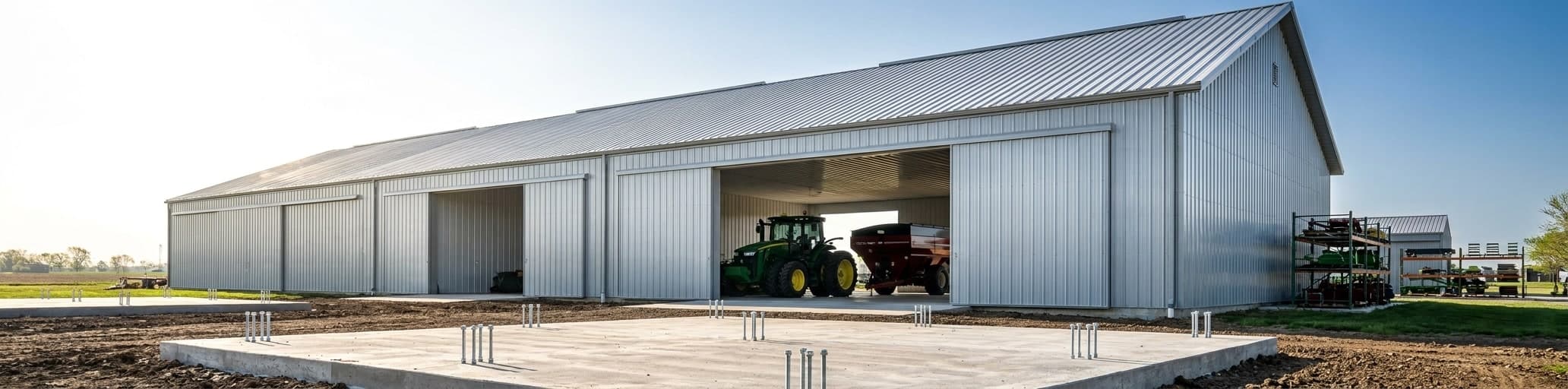

We walk you through right-sizing a metal barn for agricultural or residential use, pricing the full lifecycle cost against wood alternatives, and specifying ventilation and features that maximize efficiency. Steel's clear-span design, durability, and lower maintenance costs deliver measurable savings that compound across decades of ownership.
Introduction: Why Spring Is Prime Time for a Metal Barn Upgrade
Steel barns cost less upfront than pole barns and eliminate the seasonal repainting, sealing, and weather repairs that quietly drain your budget year after year.
From Seasonal Tune-Up to Long-Term Asset
Spring catches every deferred maintenance problem at once — a warped door, a leaking roof, a rotting post. Patching a wood or pole barn season after season is a cost that quietly compounds.
Steel changes that math. A pre-engineered steel frame can stand for more than a century, while a metal roof outlasts most competing materials with a service life of 40 to 80 years.[3] Galvanized panels coated with zinc resist rust without chemical treatment, and steel won't rot, crack, or attract termites — which means your annual maintenance checklist shrinks every year you own the building.[1] Because steel is non-combustible and performs well in seismic conditions, insurers typically charge lower premiums than they do for wood-frame structures, adding measurable savings across a 20-year ownership window.[3] That's what spring metal barn designs for farm efficiency are really asking you to do: stop budgeting for repairs and start investing in a structure that holds — and adds — value to your operation.[2]
How Modern Steel Barns Outperform Wood & Pole Barns
The cost gap alone makes the case: wood pole barns run $25 to $100 per square foot to build, while steel barns land between $17 and $30.[4] That's before you account for what happens after construction. Pole barns combine wood framing with metal siding, and the wood side of that equation demands regular repainting, sealing, and weather-damage repairs — costs that add up quietly across every season you own the structure.[5] Steel sidesteps that entire cycle.
An all-steel barn resists pests, won't warp or rot under humidity swings, and handles wind and snow loads that progressively stress wood frames.[4] On lifespan, the gap is just as clear: a well-maintained pole barn lasts 40 to 60 years; an all-steel building routinely exceeds 50 years with minimal upkeep, and many last far longer.[5] That difference doesn't just affect your maintenance calendar — it shapes your resale value and how lenders and insurers price your asset. If you want the full 20-year cost breakdown between steel and wood barns, the math consistently favors steel by a margin that widens every year you hold the building.
What This Guide Will Help You Decide
Three decisions determine whether a metal barn works for your operation long-term: what you need it to do, how much space you actually require, and which build options fit your budget without compromising function.
Before investing in a metal barn kit, evaluate your requirements by factoring in the number of livestock, the size of your farm equipment, and any additional storage or workspace needs — and anticipate future changes in your operation that might shift those numbers.[6] Intended use drives every other spec: a livestock barn prioritizes ventilation, stall partitions, and feed storage; an equipment shed needs wide-clearance access doors and a layout sized to your largest machinery; a workshop or hobby-farm build calls for utility connections and organizational systems that a basic storage structure skips entirely.[6] This guide works through all three decisions in sequence — footprint sizing for agricultural and residential footprints, a full price breakdown covering upfront costs and long-term savings, and the ventilation, lighting, and partitioning features that separate a barn that merely stands from one that actively improves how your farm runs.[7] Right-Sizing Your Barn: Agricultural vs. Residential Dimensions
Clear-Span Footprints for Tractors, Combines & Livestock Corridors
Traditional framed buildings surrender more than 30% of usable floor space to interior support columns — space you're paying per square foot to lose.[8] Clear-span construction solves that by carrying all roof loads through the exterior sidewalls via rigid steel frames, leaving the entire interior width open from wall to wall.[8] For farm operations, that distinction isn't academic: a combine header attachment can span 40 feet, and any column interrupting its path turns a routine pull-in into a precision parking exercise. The entire interior width becomes usable, unobstructed floor space — no columns to route equipment around, no posts breaking up livestock pen layouts.[9] If you're sizing for modern farm equipment, that farm equipment storage building dimension decision starts with clear span, not square footage.
Door height is where most buyers miscalculate, and the consequences are expensive to fix after the fact. For most modern tractors with enclosed cabs, plan for a minimum 14 to 16 feet of door opening height; tractors running large header attachments or grain carts push that requirement to 16 to 20 feet.[9] The critical rule: door opening height drives eave height, and eave height drives the entire vertical structure of the building — so plan for the tallest piece of equipment you'll ever run through that door, attachments included, and then add clearance above it.[9] Pre-engineered clear-span frames are available up to 300 feet wide, meaning the span itself is rarely the limiting factor — but you need that number locked in before quoting, because changing it after engineering begins adds cost at every step.[9] Width should match your widest implement plus adequate maneuvering room on each side; a 50×100 footprint handles most large-scale equipment comfortably, while a 60-foot-wide clear span gives you room for commercial-grade farm vehicles, wide-aisle organization, and multi-machine storage without a single interior column in the way.[10]
Livestock corridors demand a different sizing logic than equipment bays. Instead of clearance for machinery, you're designing around animal movement, handling lanes, pen divisions, and access points — and steel's material properties give you a functional edge here beyond just open floor space.[9] Steel panels resist moisture, don't harbor insects the way wood does, and can be cleaned and disinfected without damaging the structure — all meaningful advantages in a working livestock environment where biosecurity and wash-down cycles are routine.[9] Species-specific ventilation, pen layouts, handling lanes, and access door placement should all be engineered around how animals actually move and how your crew manages them, not adapted from a generic template designed for storage.[9] Planning those corridor widths, door clearances, and aisle dimensions at the design stage — rather than retrofitting them later — is what separates a barn that functions smoothly every morning from one that creates friction every time you move animals through it.
Compact Kits for Hobby Farms, Vehicle Garages & Workshop Hybrids
Not every operation needs a 50×100 clear span. Hobby farms, residential properties with a few acres, and anyone storing two or three vehicles face a different set of constraints — and compact kits address them directly. Small kits in the 500-2,000 sq ft range cover uses from lawn equipment overflow and seasonal storage to dedicated carports and small animal shelters, sized to fit properties where total acreage limits your footprint options.[13] For hobby farm setups running a few horses, pigs, or sheep, a medium kit with a 12- to 14-foot eave height adds enough interior volume for basic stall partitions and hay storage without requiring a full agricultural-scale build.[13]
For vehicle garages, the 30×40 (1,200 sq ft) is the most common garage-shop footprint because it fits two vehicles and still leaves wall space for a functional workshop — but the 30-foot width is the real constraint.[12] Two vehicles can fit, but with a tight aisle: door-open clearance and cart movement get difficult if you're not disciplined about layout from the start.[12] The practical fix is committing at least one long wall to uninterrupted bench and tool storage — once you break both long walls with overhead doors and windows, the building feels cramped regardless of square footage.[12] Stepping up to a 40×50 (2,000 sq ft) changes that dynamic by delivering genuine zone separation between parking, active workspace, and dedicated storage, so you're not constantly shuffling equipment to do basic work.[12] Most buyers don't regret the larger footprint, because tools multiply, storage needs grow, and a "temporary" project has a way of becoming permanent — that extra space keeps the building from getting tight two years in.[12]
| Footprint | Sq Ft | Best use | Key limitation |
|---|---|---|---|
| 24×30 | 720 | Single vehicle + light storage | Minimal workshop room |
| 30×40 | 1,200 | 2-car garage + workshop wall | 30-ft width limits aisle + door swing |
| 40×40 | 1,600 | 2-car + storage bay + hobby workshop | Requires disciplined door placement |
| 40×50 | 2,000 | Parking + full shop + dedicated storage zone | Higher upfront cost |
| 40×60 | 2,400 | Hobby farm multi-use: livestock, equipment, workshop | Site prep scales up |
Workshop hybrids — buildings that need to handle parking, active work, and storage simultaneously — expose the most common compact-kit mistake: choosing square footage before locking in height. If you anticipate an overhead lift, wall-mounted storage systems, or a mezzanine office above a workbench area, steel buildings with lofts give you that vertical dimension without expanding your foundation footprint. Eave height determines what you can do with the interior vertically, and that decision costs far less to make at the design stage than as a retrofit.[12] Standard compact configurations like a 30×40 with a side shed add covered-but-separate storage without enlarging the main structure — a practical layout for hobby farms where a workshop and equipment shelter serve distinct daily functions, and where keeping those functions physically separated prevents each one from crowding the other.[11]
Height & Bay Spacing Rules for Hay Lofts, RV Cover Height, and Mezzanine Offices
Eave height and bay spacing aren't aesthetic choices — they're load-path decisions that lock in what you can do with the interior long after the building is up. The universal starting rule: your eave height must clear the top of the tallest door opening by at least 2 feet.[14] A 10-foot door needs a 12-foot eave; a 12-foot RV door needs a 14-foot eave minimum.[14] For RV storage specifically, that baseline is rarely enough. A Class C RV runs roughly 13 feet tall, a fifth-wheel trailer taller still — so plan for the largest vehicle you'll ever park inside, not just what you own at signing, and add a margin above it.[15] Bay width follows the same forward-looking logic: a single RV bay should be at least 36 feet wide, with 3 to 5 extra feet on each side for door-open clearance, walking access, and hookup connections.[15] Undercut that width and the building feels tight the first time you try to unhitch under load.
Hay loft sizing introduces a vertical stacking problem that the 2-foot door rule doesn't fully address. You need clearance above the loft floor for bale height plus the arm movement of whoever is stacking — and that headroom has to exist after the loft structure itself consumes vertical space. A steel building with a loft solves this without enlarging your foundation footprint: a mezzanine or attic-truss configuration adds a true upper storage tier within the existing shell.[15] Bay spacing anchors where the structural columns land and how loft beams span between them — for a standard pre-engineered steel building, 25-foot bay spacing is the common structural module, and that interval shapes every interior layout decision above the floor.[16]
Mezzanine offices stack two occupiable levels inside one shell, which makes eave height the single most consequential spec in the entire design. Both levels need functional clearance — the lower floor for equipment or vehicle movement, the mezzanine level for an actual working environment — and neither can borrow headroom from the other.[14] Steel buildings are available in heights from 10 to 30 feet, but mezzanine configurations get impractical at the lower end of that range, where the eave height simply can't support two usable floors with adequate clearance on each.[14] The cost-effective move is committing to a taller eave at the design stage: adding eave height later means re-engineering the primary frame, while specifying it upfront is a straightforward line item that keeps the project within budget and avoids a costly structural retrofit down the road.[14]
Price Breakdown: Up-Front, Lifetime & Hidden Savings
Steel buildings cost 20 to 30 percent less per square foot than stick-built homes, and lower insurance premiums compound those savings across your building's lifetime.
Cost per Square Foot vs. Traditional Construction
The kit price is where the cost comparison starts — and steel has a clear edge. Pre-engineered metal building kits run $15 to $20 per square foot; add the slab, delivery, and labor for a turnkey installed build and the number lands between $24 and $43 per square foot.[17] Wood pole barn kits overlap that range at $10 to $25 per square foot, but that figure excludes the repainting, sealing, and structural repairs that wood demands season after season — costs that don't show up in the original quote but absolutely show up in your operating budget.[19] The real separation appears when you stack steel against traditional stick-built construction: a standard stick-built home runs $150 to $250 per square foot, and custom builds push $300 to $450, while a finished metal barndominium comes in at $65 to $160 per square foot — a 20 to 30 percent savings that holds even when you finish the interior to full residential standards.[18] For agricultural operations, commercial developers, or anyone comparing build options before committing, the full prefab steel vs. wood cost breakdown shows how that per-square-foot gap compounds across a project's lifetime into capital you keep on hand for equipment, site prep, or future expansion.
| Build type | Kit / shell cost per sq ft | Installed / finished cost per sq ft |
|---|---|---|
| Steel building kit | $15-$20 | $24-$43 (turnkey) |
| Wood pole barn | $10-$25 | Higher once maintenance cycles are included |
| Stick-built home | N/A | $150-$250 standard; $300-$450+ custom |
| Metal barndominium (finished) | N/A | $65-$160 standard; up to $300 high-end custom |
Insurance & Tax Incentives for Fire-Resistant, Recyclable Steel
Steel's non-combustibility is the property that most directly cuts your insurance costs.
Because noncombustible materials reduce fire risk and storm damage claims, many insurers price steel structures at up to 30% lower premiums than equivalent wood-frame buildings.[21] That gap reflects actuarial reality: steel doesn't feed a fire, resists wind loads, and shrugs off the seismic and weather events that generate the most expensive claims.[21] For a deeper look at how that fire resistance translates to measurable premium reductions on farm structures specifically, the steel farm building fire resistance breakdown shows exactly what insurers are pricing when they quote a steel barn versus a wood-frame alternative.
On the tax side, steel buildings may qualify for energy-efficiency deductions under Section 179D, with many states stacking additional rebate programs tied to high-performance insulation assemblies on top of that federal incentive.[22] These programs apply to commercial, agricultural, and mixed-use owners — not just large developers — and they directly offset the kit and installation costs that dominate your upfront budget.[20] Recyclability adds a third financial dimension most buyers don't account for at purchase: steel's recycled content routinely exceeds 90%, and every structure remains fully recyclable at end of life.[22] That residual material value supports stronger resale potential — steel buildings hold their structural integrity longer than traditional construction, a durability profile that both appraisers and buyers recognize when pricing the asset.[20]
Maintenance-Free Coatings: Galvanized, Galvalume & Paint Warranties Explained
The coating stamped on your steel panels determines whether you're doing maintenance in year 15 or year 50 — and the wrong choice for your specific use case costs more than the upgrade would have. Galvalume is a steel sheet hot-dipped with 55% aluminum, 43.4% zinc, and 1.6% silicon, giving it corrosion resistance two to four times better than standard galvanized steel.[23] It carries a 25.5-year substrate warranty and has self-healing properties at cut edges: when red rust appears, it eventually stops spreading rather than advancing across the panel.[23] Galvanized steel uses a pure zinc coating with no substrate warranty, and once that zinc layer is compromised — through weathering, mechanical damage, or prolonged moisture — red rust spreads continuously without stopping.[23] In service-life terms, Galvalume roofs routinely reach 40 to 70 years; galvanized roofs in similar conditions typically run 20 to 30 years.[24] For equipment storage, hay barns, workshops, and residential structures, Galvalume is the stronger long-term choice across every performance metric — and the right pairing with a 20-year steel farm building maintenance cost comparison that consistently favors lower-touch materials.
The one exception that flips the decision entirely: Galvalume is not suitable for animal confinement.[23] Manure breaks down into ammonia gas over time, and that ammonia reacts with the aluminum-zinc coating, causing premature failure before the substrate warranty ever becomes relevant.[23] For hog barns, dairy facilities, poultry houses, and any structure where animals live and waste accumulates, galvanized is the correct substrate — and ventilation design becomes critical to how long that system actually performs.[23] Galvanized's higher formability also makes it easier to work with in stamped flashings and specialty agricultural details, which matters when you're fitting panels around stall partitions, feed doors, and wash-down access points.[23] Specify galvanized for animal confinement, Galvalume for everything else — that one call removes the single biggest coating-failure risk in agricultural construction.
Paint warranties are the third layer of protection, and they operate independently from substrate warranties — meaning you can lose one without losing the other. Galvalume systems typically carry both a 25.5-year substrate perforation warranty and a separate paint warranty covering color retention and surface adhesion; galvanized systems generally offer no substrate warranty at all, which makes the paint finish the only documented protection on the system.[23] One hard geographic rule applies to both materials: substrate and paint warranties are void within 1,500 feet of a coastline, where salt-air exposure accelerates coating breakdown faster than any warranty is structured to cover.[23] In coastal or high-salinity environments, neither galvanized nor Galvalume is the right answer — aluminum panels are the correct specification for persistent salt-spray conditions.[24] Inland and in standard agricultural climates, the warranty gap between Galvalume and galvanized is the clearest signal in the entire coating decision: one substrate comes with documented manufacturer protection, and the other doesn't.
Must-Have Features That Maximize Farm Efficiency
Pair ridge vents with soffit intake vents and add a solar fan to prevent the ventilation stalls that leave barns dangerously hot on windless summer days.
Smart Ventilation Packages: Ridge Vents, Solar Fans & Automated Louvers
Ventilation is where most barn builds leave measurable money on the table. An unventilated metal roof can push interior temperatures to 130 degreesF or above on a summer afternoon — a threshold that stresses livestock, accelerates hay spoilage, and degrades stored equipment.[25] The baseline engineering standard is the 1:300 rule: one square foot of net free ventilation area for every 300 square feet of floor space, split equally between intake and exhaust.[26] Metal buildings in humid climates need 20% more than that baseline, because metal roof panels conduct heat faster than other materials and create rapid condensation cycles that passive venting alone can't counter.[26]
Ridge vents handle the exhaust side of that equation by sitting at the roof's peak — the highest-pressure zone for convective airflow, where hot air naturally collects and stalls without a dedicated exit path.[26] For pitched steel barn roofs, a hybrid system pairing continuous ridge vents with soffit or eave intake vents outperforms any single-point exhaust configuration because it drives a consistent thermal stack through the full interior volume, not just the area nearest the vent.[26] The ridge vent does nothing in isolation: without adequate intake area, the exhaust has no replacement air to draw in, and the system stalls — often making interior temperatures worse than no active venting at all.[25]
Solar fans solve the stall problem that passive ridge systems hit during low-wind, high-heat conditions — exactly when your barn needs the most cooling.[25] A roof- or gable-mounted solar fan with a built-in panel runs hardest when the sun is brightest, automatically matching output to peak heat load without any electrical hookup, thermostat wiring, or grid connection.[25] The operating cost is zero: the fan draws no utility power, keeps running through outages as long as there's daylight, and requires virtually no maintenance after installation.[25] Field data backs the performance: combining solar fans with existing ridge vents produced a 22 degreesF interior temperature drop and a 40% reduction in cooling costs in one documented warehouse installation.[26] In livestock barns — where ammonia buildup from waste accelerates both animal stress and structural corrosion — that active air exchange is a biosecurity decision as much as a thermal one.[25] For a closer look at how those specs translate to a working barn footprint, the 40×80 metal barn ventilation specs breakdown shows exactly how exhaust capacity, intake placement, and fan sizing interact in a real agricultural build.
Automated louvers bring the third layer of control that ridge vents and solar fans can't provide on their own: temperature-triggered actuation that opens or closes based on interior conditions rather than sun intensity or ambient wind.[25] A hybrid approach — automated louvers handling peak midday heat combined with ridge vents providing baseline passive exhaust — adapts to conditions that shift hour by hour across a working farm day, rather than running at a fixed rate regardless of actual need.[26] Running active ventilation only during peak heat hours, roughly 10 AM to 3 PM, cuts energy consumption by up to 60% compared to fans operating continuously around the clock.[26] For operations managing livestock, grain storage, and equipment under the same roof, that programmable control is the difference between a ventilation package that responds to your barn and one that simply exists inside it.
LED Skylight Strips, Motion Lighting & Solar-Battery Backup
Skylight placement on a metal roof peak maximizes incoming daylight without any electrical draw — their position at the highest point of the structure lets you reduce daytime lighting loads while adding passive solar heat during winter months.[28] That natural light doesn't replace your LED system; it works alongside it. In documented barn installations, LED fixtures equipped with daylight sensors automatically dim when sunlight enters through skylights, cutting energy use by 40% across the occupied footprint.[29] When full-width skylights exceed your budget, solar tubes — polished sheet-metal conduits sealed with a weatherproof acrylic dome — funnel daylight into the interior for as little as $500, a cost that pays back directly through reduced electricity consumption.[28] LED panel lights cover the remaining illumination load with uniform, natural-quality light and a service life measured in decades rather than seasons, making them the most cost-effective complement to any daylight integration strategy in a working barn.[27]
Motion-activated lighting handles the zones that full-time overhead illumination simply wastes energy covering. Occupancy sensors integrated into LED high-bay fixtures dim or cut output entirely when areas are unoccupied — corridors, secondary storage wings, and access lanes that see intermittent traffic throughout a farm day are the obvious targets.[29] Sizing those fixtures to the task matters: barn environments generally require 30 to 100 lumens per square foot, with the upper end of that range applying wherever precision work demands it — milking stations, processing areas, and feed prep zones all fall into that category.[29] A hybrid approach pairs primary LED high bays covering roughly 80% of the floor area with motion-activated task lights at active work stations, so the building responds to how you actually use the space rather than lighting empty bays at full power around the clock.[29]
The single biggest lighting vulnerability in any agricultural building is grid dependency during outages — which tend to arrive exactly when your operation is under the most stress. Solar-powered fixtures with a wall-mounted exterior panel charge interior lights with no permanent rooftop installation or grid connection required, and entry-level options are available for under $40.[28] Battery-powered units extend that independence further: they require no external electricity source at all, suit any budget, and can be added or repositioned without professional installation as your layout evolves.[28] Energy Star-certified LED fixtures pull the system together — they last 15 times longer than standard incandescent bulbs while consuming 90% less energy, which means a solar-charged battery bank delivers substantially more runtime per charge cycle than any older lamp technology could.[28] For operations running livestock, equipment storage, and feed rooms under one roof, that efficiency multiplier is what turns solar-battery backup from a nice-to-have into a practical, always-ready fallback that keeps your barn functional when the grid isn't.
Partitioning Kits for Feed, Fertilizer & Multi-Species Livestock Zones
The clear-span interior that makes steel ideal for equipment storage is the same property that makes it work for multi-species operations — every square foot of the floor plan is yours to divide, and nothing about the structure dictates where that division happens.[30] A working barn running cattle, horses, and poultry simultaneously needs hard separation between species zones, dedicated feed storage, and a fertilizer area that stays isolated from both — and steel handles each requirement without the material compromises that drive up maintenance costs in wood-framed alternatives.[31] Steel is inorganic, which means partitioned walls don't rot, harbor insects, or absorb moisture between cleaning cycles the way wood framing does.[30] That matters in feed rooms, where humidity and grain dust create exactly the conditions that accelerate wood deterioration and pest activity.[31] For fertilizer storage, steel's non-combustibility is the critical spec: chemical fertilizers are a fire-risk category, and a non-combustible partition wall between a fertilizer bay and the rest of your operation is the structural decision that keeps that risk contained.[30] Steel barns can be configured for dairy and milking operations, stables, chicken and turkey houses, livestock pens, and hay or crop storage — all under one roof, all in separately partitioned zones that are engineered before the first panel goes up rather than carved out after the fact.[31][30] The practical advantage of steel frame farm building systems that accept future add-ons is that your partition layout isn't fixed to the structure — as species counts change or feed storage requirements grow, the clear-span frame accommodates reconfiguration without touching the primary framing, so your barn adapts to the operation instead of constraining it.
Conclusion: Future-Proofing Your Operation
Checklist for Matching Barn Size to Growth Plans
Most buyers size a barn for today's operation and discover within three years that 'just enough' has become 'not enough.' The fix is building a forward-looking inventory before you finalize any footprint. Purpose drives every number: livestock barns scale by headcount and species-specific minimums, equipment sheds scale by the footprint of your largest implement plus maneuvering clearance, and mixed-use builds need zone allocations for each function before you can add them together.[32] Specifying expandable end walls at order time is the single most cost-effective growth hedge available — when you're ready to add length, you remove the end wall, extend the sidewalls, and reinstall it, adding square footage without disturbing the primary frame or existing operations.[33] Buildings in the 3,000 to 10,000 square foot range carry the lowest cost per square foot, so if your growth plan puts you near that threshold within five years, building to it now almost always beats the cost of a later addition.[32] Investing roughly 15% more at the design stage also tends to reduce long-term maintenance costs and lower insurance premiums — a margin that pays back faster than most buyers expect.[32] The full-service agricultural building contractor checklist walks through how to lock these specs in before you sign, so nothing gets value-engineered out after the fact.
Work through each item below before requesting a quote — every box you leave blank is a spec that gets decided for you later, usually at a higher cost:
- Primary use — List every function the barn must perform: livestock housing, equipment storage, feed/fertilizer isolation, processing, or mixed residential-farm use.[33]
- Headcount and equipment inventory — Document current animal counts and machinery dimensions, then project both 5 years forward to set your minimum clear-span width and stall count.[33]
- Eave height — Identify the tallest piece of equipment or the highest-clearance door you'll ever need, add 2 feet minimum above it, and lock that number in before engineering begins.[32]
- Expandable end walls — Specify this feature at order time if any growth scenario adds building length; retrofitting it after fabrication adds cost at every step.[33]
- Site dimensions and setbacks — Subtract required setbacks, pavement, and easements from total lot area to confirm the expansion direction is physically available.[33]
- Zoning and code ceiling — Check local ordinances for height and footprint limits before committing to a size, since exceeding them mid-project resets your permit timeline.[33]
- Budget horizon — If your 5-year plan crosses the 3,000-10,000 sq ft cost-efficiency window, building to that threshold now versus adding later is typically the lower total-cost path.[32]
Financing, Delivery & DIY Assembly Timelines
Buying a barn kit outright is rarely how these projects get funded. Traditional bank or credit union loans, construction loans, and SBA loans are all viable paths depending on your building's intended use, your credit profile, and the scale of the project.[36] Your initial deposit at order time typically runs 10-30% of the kit cost — enough to release engineering drawings but not a full capital commitment upfront.[34] Once those drawings are in hand, you can finalize your foundation spec, permit application, and contractor schedule before the remaining balance comes due.[34] If your growth plan puts you near the 3,000-10,000 sq ft cost-efficiency window, structuring financing to build to that threshold now rather than adding a loan for a future addition typically produces a lower total borrowing cost — and the financing options guide for steel builds walks through how to position your application for each loan type based on intended use and build scale.
Delivery logistics are simpler than most buyers expect. Your kit ships in a single delivery directly to your job site — no coordinating multiple suppliers, no staging separate material orders, no mid-project exposure to price swings.[34] Have a forklift or comparable lifting equipment ready to offload the truck, and a dry, level area staged to store components before erection starts.[34] Site prep needs to be complete before the kit arrives: a level, prepared pad and a poured concrete foundation with anchor bolts already in place so your crew can move straight from delivery to erection without waiting on concrete cure time.[34]
Assembly timelines depend almost entirely on building size and crew. Structures under 2,000 sq ft typically go up in a few days; a 10,000 sq ft building takes weeks rather than the months that conventional construction requires.[34] Pre-engineered kits erect in roughly 30% less time than stick-built alternatives, and approximately 40% of buyers self-build using the included step-by-step plans — no welding required, and most assembly steps need only common construction tools.[34][35] If your footprint exceeds 2,000 sq ft, bringing in an experienced erection crew compresses the schedule and reduces the risk of assembly errors that create costly corrections later.[34] The truss-setting phase is where equipment matters most: one documented self-build had all six trusses bolted in place in under three hours once a Gradall was on site — a step that would have stretched across multiple days working by hand.[35]
Next Steps: Free Quote, Custom 3-D Builder & Dealer Locator
The fastest way to move from plan to price is a 3D design tool, and the best ones cost nothing to use.
Online 3D building estimators let you configure size, roof style, wall panels, door and window placement, and color combinations — then generate a quote directly from the saved design without a single back-and-forth call.[39] The process is straightforward: enter your ZIP code so the tool accounts for your regional load requirements, select building type and dimensions, choose your customization options, and submit — a building specialist follows up with an accurate price based on exactly what you configured, not a ballpark estimate.[39] Mueller's 3D Design Tool follows the same logic: design your virtual building, save it, and click through to a free quote with your specs already locked in.[37] Morton's free 3D Studio requires no training and works on any major browser; when your design is finalized, you send it directly to a local sales consultant who works through budget, site prep, and timeline with you.[38] For vetting the right local prefab contractor to execute the build, have your 3D design in hand before the first conversation — it shifts the discussion from vague estimates to firm specs, keeps contractors accountable to your actual requirements, and removes the single biggest variable that inflates post-signing change orders.
The design tool is where indecision costs nothing; the change order is where it costs the most.
- Steel barns cost $17-$30/sq ft vs. wood pole barns at $25-$100/sq ft, with dramatically lower lifetime maintenance.
- Clear-span construction eliminates interior columns, giving you unobstructed floor space for equipment and livestock layouts.
- Galvalume coating lasts 40-70 years; galvanized lasts 20-30 years–but galvanized is required for animal confinement due to ammonia exposure.
- Ridge vents plus solar fans reduce interior temperatures by 22 degreesF and cut cooling costs 40% in documented installations.
- Building to the 3,000-10,000 sq ft range now costs less per square foot than adding length later through expandable end walls.
- Specify eave height, door clearance, and expandable walls at design time–retrofitting these changes after fabrication multiplies costs.
- https://www.vikingbarns.com/blog/strong-reasons-to-own-a-metal-barn
- https://americansteelinc.com/blog/modern-metal-barn-designs/
- https://www.metalcarports.com/blog/long-term-value-metal-building/
- https://www.americanmetalbuildings.com/blog/steel-barn-buildings-vs-wood-barns-a-cost-comparison/?srsltid=AfmBOoqQhgYK7Qx4xOLpsLa3IyMqS4r68VI_em-saz6STnNZb3wRr4Sf
- https://www.omni-builders.com/home-tips/pole-barn-vs-metal-building-cost-maintenance-longevity-compared
- https://www.metalcarports.com/blog/barn-kits/
- https://www.metalbuildingoutfitters.com/10-best-budget-friendly-metal-barn-options-for-agriculture/
- https://www.vikingbarns.com/blog/clear-span-metal-buildings-guide
- https://www.rigidbuilding.com/agricultural-metal-buildings/
- https://www.steelstructuresamerica.com/metal-building-sizes/
- https://summertownmetals.com/pole-barn/
- https://www.americanmetalbuildings.com/blog/30×40-vs-40×50-metal-building-expert-comparison-and-what-actually-works-in-2025-2026/?srsltid=AfmBOopYHgvZkhX2BzV57hwO4SDHZMTEsAgab6cDYtyTj4nx9BhrUKsJ
- https://www.hansenpolebuildings.com/pole-barn-prices/?srsltid=AfmBOoqqea15_p3PdsLqlR3DCgzRTNbeqDx1BkA0vFY3V-GZI1wLVEVh
- https://www.buildingsguide.com/products/standard-size/30×40-metal-building/?srsltid=AfmBOor3sbh8UHR98F7jsmfrR3TTLMebY9wLYn5zqdBnxT0iYoC6MFdH
- https://permabilt.com/designing-a-multi-use-pole-barn-that-adapts-to-your-needs/
- https://www.buildingsguide.com/standard-sizes/60×100-metal-building/?srsltid=AfmBOopWgA7S3jDwC4ULhvsiUpsij_y_KEV9G6YQBtyQEGMvZF5dM4qK
- https://www.buildingsguide.com/metal-building-prices/?srsltid=AfmBOooUidm6OQuDcilQmzaDtns1FvdEYI1ggLvkojdUonjq6MYyF3Yr
- https://www.providencejournal.com/press-release/story/11795/americans-turning-to-metal-buildings-for-affordable-living/
- https://www.hardsteelbuildings.com/post/are-metal-buildings-cheaper-than-wood
- https://www.hswilliams.com/blog/commercial-metal-buildings-cost-vs-value-analysis
- https://www.buildingsguide.com/build/advantages-of-pre-engineered-steel-buildings/?srsltid=AfmBOop_qLr-SX06izP0LGOTstMCZyqI4MCGBrBhZfAEklXPu2mHHQr-
- https://www.suburbanbuildings.com/advantages-of-steel-buildings-in-boerne/
- https://sheffieldmetals.com/learning-center/galvalume-vs-galvanized-metal/
- https://www.englertinc.com/articles/difference-between-galvalume-and-galvanized-metal-roofing-projects
- https://www.buildwithrise.com/stories/solar-attic-fans-a-complete-guide
- https://chinaexhaustfan.com/the-ultimate-guide-to-roof-ventilation-choosing-between-powered-and-unpowered-fans/
- https://gensteel.com/resources/case-studies/metal-building-lighting-options/
- https://alansfactoryoutlet.com/blog/shed-lighting-ideas/?srsltid=AfmBOooJMqv2wmWNXqfmED8HvO3QWq4X1siFgSw06u-VFPHqw-XPicsy
- https://jqzlighting.com/collections/led-high-bay-light?srsltid=AfmBOooXw-Fd8sYostB3LEdnkjvnvxS0NqTUEibyp5uisNEGiw1RI359
- https://www.rhinobldg.com/blog/steel-buildings-for-bigger-farms-prefabricated-metal-buildings-for-americas-agricultural-industry
- https://www.rhinobldg.com/blog/metal-barns-and-outbuildings-for-rural-living
- https://www.buildingsguide.com/standard-sizes/?srsltid=AfmBOorHjlXQzBLqLXZz2OEXm1VU_tkB7PYqL6rB_6zhUUgHdCS1Sxve
- https://www.vikingbarns.com/blog/choose-the-right-dimensions-for-your-custom-steel-barn
- https://www.buildingsguide.com/metal-building-kits/?srsltid=AfmBOooEilWSh7EuU-QW_LULRO0kFqcJELl-gUtUw7Les49XAHz9WTZ_
- https://www.worldwidesteelbuildings.com/construction/build-it-yourself/
- https://www.metalbuildingoutlet.com/diy-metal-building-kits/
- https://www.muellerinc.com/3d-tool
- https://mortonbuildings.com/design-your-morton-building
- https://www.vikingsteelstructures.com/metal-building-3d-estimator?srsltid=AfmBOorVQGBKsKAAwrZS38fc6zITHWhEuezJGPfYpD53NEgB-lHcznbf