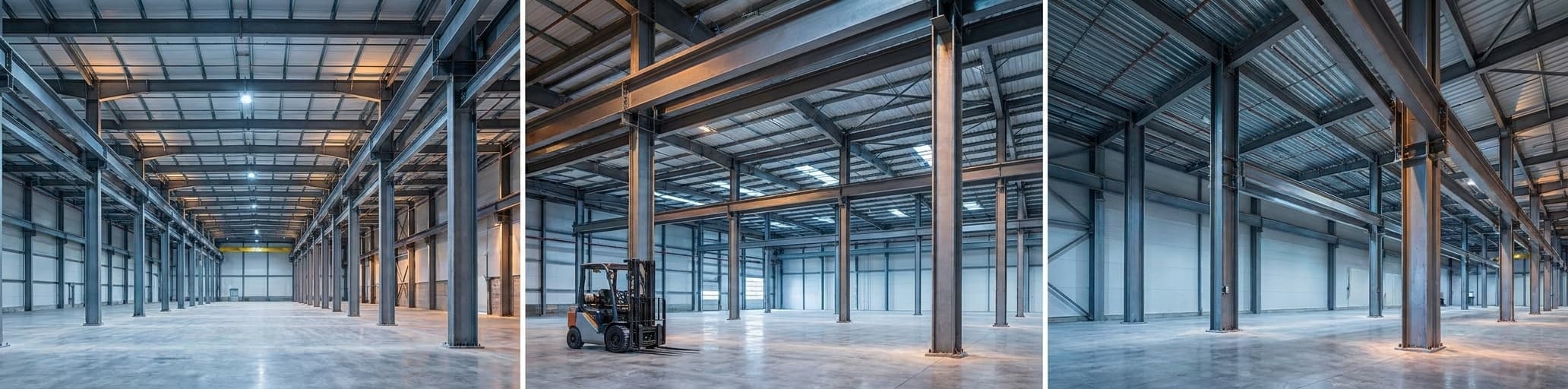

We help you understand why steel frame structures outperform wood through superior load paths, fire ratings, and structural durability. Steel's non-combustibility and dimensional stability deliver insurance savings up to 30% and maintenance costs half those of wood, compounding into substantial long-term value.
Steel Frame Structure Fundamentals
Hot-rolled steel frames deliver the strength and cost-effectiveness you need for primary columns and rafters, while cold-formed members handle walls and floors with superior precision and speed.
Hot-formed vs. cold-formed steel frames
Hot-rolled steel starts as a thick slab or billet heated above 1,700 degreesF, then passed through powerful rollers and left to cool at room temperature.[1] That natural cooling leaves minimal internal stress, which makes the material easy to weld and bend–but it also introduces dimensional variation of +/-2-5%.[1] For your steel frame structure, hot-rolled shapes show up where raw load capacity matters most: wide-flange beams, primary columns, and main-frame rafters that carry the building's full gravity load.[1] You're not after precision here; you're after strength and cost-effectiveness at scale.[3] Cold-formed steel (CFS) is a different animal entirely. Manufacturers feed flat steel coils through roll-forming machines at room temperature, progressively bending the material into studs, joists, track, and channels without any added heat.[2] The cold-forming process work-hardens the steel, pushing its strength roughly 20% above comparable hot-rolled material, while also delivering the tight dimensional accuracy that framing crews depend on for fast, repeatable layouts.[1] Every CFS member ships with a zinc-based corrosion-protective coating already applied–standard on both structural and nonstructural products–whereas hot-rolled shapes typically arrive with no coating or a basic paint finish.[2] The practical split is straightforward.
Hot-rolled sections carry your primary steel frame–the columns and rafters that handle gravity and lateral loads. Cold-formed members, typically under 1/8" thick, handle walls, floors, and roofs where the high strength-to-weight ratio keeps material and erection costs down.[2] Because CFS profiles are consistent stud to stud and joist to joist, two workers can install prefabricated panels on site with fewer field changes and less jobsite waste.[2] For owners planning warehouses, agricultural steel buildings, hangars, or retail spaces, understanding this division before you break ground keeps your specification clean and your project within budget.
Load path efficiency in steel frame structures
In a steel frame structure, every load–gravity, wind, and seismic–travels through a defined skeleton of beams and columns directly to the foundation.[5] That's the core difference from a load-bearing system, where walls carry and transfer the load instead, locking you into thick wall assemblies and restricting where doors, windows, and open spans can go.[5] Because steel routes force through discrete members rather than continuous walls, engineers can use fewer of them, spaced further apart, without compromising how the load reaches the ground.[4] That efficiency translates directly into longer spans with no interior columns, more usable floor area, and a building layout you can actually adapt–whether you're fitting out a warehouse floor, staging aircraft in a hangar, or configuring retail space.[4] The vertical studs and horizontal tracks of a CFS system distribute both structural and non-structural loads across the whole frame, meaning the load path logic stays consistent as the building scales up in size or complexity.[4] Understanding how structural steel components interact within that path is what lets engineers specify the right member sizes up front–and keeps your project within budget instead of discovering undersized framing during construction.
Key advantages over wood framing systems
Wood has one structural problem you can't engineer away: it keeps moving after it's built. Timber dries and shrinks for years after the tree was cut, which means wood-framed walls rack, joints open up, and fasteners work loose over time.[6] Steel doesn't do any of that. A cold-formed steel stud installed today carries the same geometry and load capacity a decade from now–no warping, no twisting, no seasonal swelling from moisture cycles.[7] That dimensional stability directly reduces callbacks, remediation costs, and the kind of structural drift that forces owners to repair rather than just maintain.
Biological resistance is the second major gap. Wood is inherently vulnerable to mold, rot, termites, and carpenter ants–threats that cause costly hidden damage and typically require ongoing chemical treatment to manage.[6] Steel doesn't support any of those failure modes.[8] For warehouses, hangars, agricultural facilities, and retail buildings where long service life and minimal intervention are non-negotiable, that difference compounds year over year. Wood buildings carry an economic life of roughly 15-20 years and often need siding and roofing replaced within 7-10 years; a properly specified steel frame structure can stay structurally sound for well over 50 years with nothing more than routine inspections.[7][8] Non-combustibility is the third advantage, and it affects both safety and operating costs.
Steel will not ignite, which is a hard advantage over wood that no fire treatment fully replicates.[6] Insurance underwriters recognize this distinction: because CFS and structural steel are non-combustible, carriers routinely offer lower premiums for steel-framed buildings, and those savings persist through the full life of ownership.[6] Lumber price volatility adds one more reason to choose steel–frequent shortages push contractors toward lower-grade "green" wood that warps and cracks in service, degrading both energy efficiency and structural integrity.[7] Steel arrives to spec, fits together precisely, and holds its performance regardless of what the lumber market does.
Load Paths & Structural Performance
Steel's separate load paths for gravity and lateral forces let you build clear-span warehouses without interior columns while keeping every member properly sized for actual forces.
How steel frame structures transfer vertical & lateral loads
Steel handles gravity and lateral loads through completely separate paths, and knowing how each one works tells you a lot about why steel outperforms wood when buildings get larger or face serious wind and seismic exposure.
Gravity loads–the dead weight of the structure plus any live loads like equipment, inventory, or snow–travel downward through a steel portal frame in a direct sequence: roof load transfers to secondary rafters, those rafters pass force to primary purlins, the purlins connect to columns via bolted end plates, and the columns deliver everything straight to the foundations.[9] No load accumulates in one spot; each member hands off to the next in a clean chain, which is exactly why engineers can specify a 40×80 clear-span steel warehouse without interior columns and still keep every member sized correctly for the actual force it carries.[9] Lateral loads–wind and seismic forces acting horizontally on the building–demand a different path entirely.[9] Steel frame structures handle them through one or more of three systems: moment frames, where beam-to-column connections are made rigid so the frame resists bending forces and transfers them to the footings; shear walls, which act as vertical cantilevers with high in-plane stiffness to push lateral forces down to the foundation; or braced frames, where diagonal steel members carry lateral loads as axial tension and compression so beams and columns can focus purely on gravity.[10] The floor or roof diaphragm ties these vertical systems together–its high in-plane stiffness distributes lateral forces evenly across the frame elements rather than concentrating them in one location.[10] For warehouse, hangar, and agricultural owners, that redundancy matters: a properly braced steel frame can absorb wind events and seismic activity that would rack and permanently damage a wood-framed building, with no hidden damage to discover after the storm passes.
Comparative deflection and vibration control
Deflection and vibration are where the material difference between steel and wood becomes most tangible–not just on paper, but underfoot.
Lightweight timber floors require dedicated vibration assessment frameworks because lower material stiffness makes serviceability, not strength alone, the governing design criterion at commercial spans.[12] The volume of analytical methods developed specifically for this problem–including SCI P354, Eurocode 5, CCIP-016, and AISC Design Guide 11–reflects how persistently vibration challenges follow timber floor systems into real buildings.[12] Steel's cross-sectional geometry and material properties allow engineers to size members directly to vibration and deflection limits from the start, rather than discovering compliance gaps after construction.[11] For warehouse, aviation, and agricultural owners running forklifts, crane systems, or precision equipment, that upfront control matters: a 40×80 steel building with crane operations can be engineered to specific vibration thresholds during design, keeping sensitive operations stable without costly post-construction remediation.[11]
Long-span capabilities and future adaptability
Wood framing becomes structurally impractical beyond roughly 60 feet–double joists crowd ceiling space, column drops become unavoidable, and design flexibility disappears.[14] Steel removes that ceiling entirely.
Pre-engineered steel frames can clear-span up to 250 feet, and structural steel carries no code-imposed height restriction regardless of building type.[13][14] That range covers warehouses, aviation hangars, sports complexes, and agricultural facilities without forcing interior columns into your floor plan–columns that would otherwise dictate where equipment goes, how traffic flows, and what you can store.[14] The adaptability advantage compounds that span capability over time.
Steel framing is engineered as a kit-of-parts assembly: every beam, column, and connection can be modified, relocated, or extended–horizontally or vertically–without rebuilding the structure from the ground up.[13] If your operation grows, your facility grows with it. Steel frame farm buildings designed for future add-ons demonstrate exactly how that logic plays out–new bays attach without disrupting active operations or compromising the existing frame.[13] Wood offers neither capability: span limits are fixed by available member sizes, and reconfiguring a timber structure after the fact typically means demolition and new construction rather than modification.[14]
Fire Ratings & Life-Safety Benefits
Steel's non-combustibility means your structural frame maintains load-carrying capacity through fires that would collapse wood framing, keeping the building standing for evacuation and suppression.
Inherent fire resistance of steel frame structures
Steel's non-combustibility isn't a feature you add–it's built into the material itself, and it changes the entire fire dynamic inside a building from the moment ignition starts.
Wood framing actively fuels a fire; a steel frame structure removes itself from that equation by contributing zero combustible material, which directly reduces the building's total fire load and limits how far flames can spread.[15] The physics reinforce this: steel's melting point sits at approximately 2,700 degreesF, while building fires average around 1,000 degreesF and almost never exceed 1,800 degreesF–meaning your structural members maintain load-carrying capacity through fire events that would collapse a wood frame long before suppression crews arrive.[15] Independent research on steel exposed to high-temperature dry grass fire regimes found no significant structural damage to test samples, a result that matters directly for agricultural, aviation, and warehouse owners operating in fire-exposed environments where combustible inventory, fuel, or stored grain is already on site.[8] That preserved structural integrity during a fire isn't just a safety statistic–it's the difference between a building that remains standing for evacuation and suppression versus one that contributes to its own destruction.
Owners evaluating steel farm building fire resistance will find this same principle applies across every occupancy type: non-combustible framing buys time, reduces damage scope, and keeps the structure repairable rather than a total loss.[15]
Code-approved assemblies and UL listings
UL listings and code-approved assemblies are the mechanism that converts steel's inherent non-combustibility into enforceable, inspectable fire protection.
Building codes base structural fire protection requirements on the ASTM E119 standard fire test–also designated NFPA 251 and UL 263–which evaluates the relative fire endurance of complete construction assemblies under controlled laboratory conditions, not individual materials in isolation.[16] The IBC requires a registered design professional to designate whether each floor, roof, and beam assembly is classified as restrained or unrestrained, because that classification drives the fire protection thickness specified for structural steel members.[16] UL Design D982 eliminates that variable for steel assemblies by providing identical protection thickness requirements for 2-hour ratings regardless of which classification applies–simplifying your specification and reducing field error risk.[16] The assembly logic extends to every component: fire-rated framing and glazing tested only to NFPA 252/257 cannot substitute in applications where codes require assemblies tested to ASTM E119, even when the fire-protection rating appears numerically equivalent on paper.[17] A hollow metal frame listed to 90 minutes under NFPA 252 still cannot be used in a 60- or 90-minute exit enclosure where ASTM E119 compliance is required, because the entire assembly–frame, glazing, and all–must meet the same standard.[17] Penetrations compound the risk further: every pipe, conduit, or cable punched through a fire-rated wall needs a listed firestop system carrying its own UL System number matched to the specific wall type and penetrating item, and a single unsealed hole compromises the entire rated assembly regardless of how precisely the surrounding wall was built.[18] For warehouse, hangar, agricultural, and retail owners, the practical checklist is short: confirm the UL assembly number on your drawings, verify that every component within that assembly is listed to the same test standard, and document firestop compliance before walls close–because catching a mismatch on paper costs nothing compared to a failed inspection or a post-fire claim denial.
Protective coatings and intumescent systems
Steel's non-combustibility gets you most of the way there, but intumescent coatings are what convert that material advantage into a code-enforceable fire-resistance rating.
When exposed to heat, intumescent coatings expand up to 50 times their original thickness, forming a low-conductivity char layer that slows heat transfer to the steel beneath.[19] That expansion matters because structural steel begins losing roughly 50% of its load-carrying capacity at 1,100 degreesF–well below the temperatures a building fire can generate–so the coating's job is to delay that threshold long enough for occupants to evacuate and suppression crews to act.[19] Properly specified and applied, intumescent systems deliver ratings from one to four hours depending on product selection and substrate, making them the go-to solution for exposed steel beams and columns in warehouses, aviation hangars, and any occupancy where both aesthetics and fire ratings matter–intumescent coatings cure to a smooth, paint-like finish that doesn't require enclosing steel members in bulky assemblies.[19] The critical installation variable is dry film thickness (DFT): the coating must be applied at the exact thickness specified in the manufacturer's data sheet and verified with calibrated gauges, because under-application directly reduces the achieved fire rating, and that gap won't be visible to the naked eye during inspection.[20] Compliance requires products UL-tested per UL 263/ASTM E119–not just any coating marketed as fire-resistant–and documentation of film thickness readings throughout the application should be retained for inspections and any future insurance claims.[19][20] For steel frames in agricultural, warehouse, or industrial facilities where combustible inventory or fuel is already on site, pairing non-combustible framing with a properly specified intumescent system closes the remaining gap between steel's inherent fire behavior and the rated assembly your jurisdiction and insurer both require.
Insurance Savings & Long-Term Value
Steel frame structures qualify for noncombustible classification, reducing your commercial insurance premiums by up to 30% compared to wood-framed buildings, with savings that compound annually.
Lower premiums for steel frame structures
Insurance underwriters base premiums on building classification, and steel frame structures consistently land in the "noncombustible" category–the designation that directly triggers lower rates.[23] That single classification can reduce commercial and industrial insurance premiums by up to 30% compared to wood-framed equivalents, and since commercial rates tend to climb roughly 5% annually, the gap compounds in your favor every year you hold the building.[23] For large-scale projects, the spread is sharper: builder's risk premiums for CFS-framed construction run 25-75% lower than comparable wood-framed projects in active markets, because insurers price the reduced probability of catastrophic fire damage directly into the policy.[22] The Ohio hotel case puts real numbers on that range–a 4-story, 400-unit project built with CFS carried a builder's risk premium of $360,000; the same coverage for a wood-framed version would have cost $1.6 million, a difference of over $1.2 million on a single build.[21] Two dedicated programs formalize those savings into structured products.
The STEEL Advantage Insurance Program, launched by the Steel Framing Alliance and DiBuduo & DeFendis Insurance Brokers, offers builders using steel framing up to a 43% discount across a broad range of insurance products.[21] The Zurich Builders Risk Plan through US Assure is structured specifically for CFS-framed projects, applying the noncombustible classification to reduce premiums against combustible-frame baselines from the first day of coverage.[21] Beyond builder's risk, CFS construction typically carries shorter schedule durations–reducing workers' compensation exposure on the jobsite–and owners who secure a formal noncombustible designation from their underwriter may qualify for additional discounts on property and liability coverage that persist through the full ownership period.[21] For warehouse, agricultural, aviation, and retail owners comparing steel vs. wood costs over time, insurance savings alone can close a meaningful portion of the initial material cost gap within the first few policy cycles.
Reduced maintenance and replacement cycles
The annual maintenance cost gap between steel and wood is where the ownership math becomes undeniable. Steel frame structures average just $0.40 to $0.80 per square foot per year in maintenance costs, compared to $1.50 to $3.50 per square foot for traditional construction–a spread that compounds into substantial savings over a 20-year hold.[25] Wood buildings drive that higher figure through a predictable sequence of recurring expenses: repainting or staining every few years, termite and pest treatments, rot remediation after even minor water intrusion, and siding or roofing replacement well before the structure itself reaches end of life.[24] Steel eliminates every item on that list.
There's no repainting cycle, no pest contract, and no rot repair–because steel doesn't support any of those failure modes.[24] For warehouse, agricultural, aviation, and retail owners running tight operating budgets, that difference isn't a marginal improvement; over 20 to 30 years, the recurring repair costs on a wood-framed building frequently exceed whatever upfront savings the lower material cost appeared to offer.[24] Replacement cycles follow the same pattern. A properly specified steel frame structure routinely delivers a service life of 40 to 60 years or more, with structural performance that doesn't degrade between inspection cycles.[25] When repairs are needed, prefabricated metal roof and wall panels can be replaced in sections rather than requiring full-system teardowns, which keeps capital planning predictable and minimizes operational disruption.[25] Steel framing itself doesn't warp, crack, shrink, or attract pests–so the members you install today carry the same geometry and load capacity a decade from now without intervention.[26] For owners running forklifts through a warehouse, storing grain in an agricultural facility, or housing aircraft in a hangar, that consistency means fewer surprise repairs and more predictable total cost of ownership.
You can find a practical breakdown of which inspections actually matter–and which routine tasks steel lets you skip entirely–in this guide to agricultural steel building maintenance tasks you can skip.
Resale value and accelerated depreciation benefits
Steel frame structures carry a financial advantage that compounds well before any sale closes.
The IRS requires commercial buildings to depreciate over 39 years under straight-line rules–a slow drip that locks your capital away for decades when you could be reinvesting it.[27] A cost segregation study rewrites that timeline by breaking your building into individual components–specialized electrical systems, HVAC equipment, land improvements, interior fixtures–and legally reclassifying them into 5-, 7-, or 15-year depreciation schedules instead of 39.[27] On a typical commercial steel building, an engineering-based study can shift 20% to 40% of the total depreciable basis into those faster schedules, front-loading deductions into the first few years of ownership rather than spreading them across four decades.[27] When you pair that reclassification with bonus depreciation–which allowed a 60% immediate write-off on qualifying assets in 2024–the combined effect can produce first-year tax savings large enough to offset a meaningful portion of your construction cost.[27] The study itself runs $5,000 to $25,000, but properties with a depreciable basis above $1.2 million almost always recover that investment many times over; for warehouse, aviation hangar, agricultural, and mini-storage owners evaluating long-term ROI, the numbers consistently favor a full study.[27] Resale value follows the same logic as operating economics: buyers pay for predictability, and a steel frame structure delivers it in ways a wood building structurally cannot.
Lower maintenance obligations, a documented noncombustible classification, and a 40- to 60-year service life translate directly into lower cap rates and stronger appraisals at the point of sale, because a buyer's lender sees reduced risk when deferred maintenance isn't embedded in the asset.[28] The one planning item you need to address before you sell is depreciation recapture–the IRS will tax the accelerated deductions you claimed as ordinary income when the property changes hands.[27] Structuring a 1031 exchange lets you defer that recapture tax by rolling proceeds into your next acquisition rather than paying the bill at closing, preserving the full benefit of the accelerated deductions across your portfolio rather than giving a portion back at exit.[28] Depreciation recapture is also why cost segregation works best as a hold-period strategy rather than a flip tool: the longer you own the asset and reinvest the freed-up cash flow, the greater the compounding effect.[27] For capital improvements that also strengthen the building structurally–lateral bracing upgrades, roof system replacements, seismic enhancements–those costs qualify as capital improvements that must be capitalized and recovered through depreciation, meaning the same accelerated-schedule logic applies to reinvestment spending, not just the original construction cost.[29]
- Steel frame structures enable clear spans up to 250 feet without interior columns, compared to wood's practical 60-foot limit, maximizing usable floor space.
- Steel buildings average $0.40-$0.80 per square foot annually in maintenance versus $1.50-$3.50 for wood, eliminating pest treatments, rot repairs, and repainting cycles.
- Non-combustible steel framing qualifies for insurance premiums up to 30% lower than wood-framed buildings, with builder's risk discounts reaching 25-75% in active markets.
- Steel maintains full structural integrity through building fires averaging 1,000-1,800 degreesF, while wood framing collapses well below those temperatures.
- Properly specified steel structures deliver 40-60+ year service lives with no warping, shrinking, or pest damage, compared to wood's 15-20 year economic life.
- Cost segregation studies can shift 20-40% of a steel building's depreciable basis into 5-7 year schedules, front-loading tax deductions and offsetting construction costs.
- Cold-formed steel studs gain 20% strength through work-hardening and arrive with zinc-based corrosion protection, enabling faster prefabricated panel installation.
- https://metalprobuildings.com/what-is-the-difference-between-hot-rolled-and-cold-formed-steel/
- https://buildsteel.org/why-steel/cold-formed-steel-101/cfs-practical-guide-for-designers-builders-and-owners/
- https://titansteelstructures.com/prefab-building-types/hot-rolled-vs-cold-formed-steel-a-comparison/
- https://www.scottsdalesteelframes.com/building-with-steel/steel-framing-system
- https://gharpedia.com/blog/difference-between-steel-framed-and-load-bearing-structure/
- https://framecad.com/blog/steel-vs-wood-framing
- https://norsteelbuildings.com/us/steel-building-basics/steel-vs-wood/
- https://highcountrymetalworks.com/post/steel-frame-structure
- https://calcs.com/blog/load-transfer-in-residential-structures-from-roof-to-foundation
- https://thestructuralblog.com/types-of-structural-systems/
- https://eureka.patsnap.com/report-compare-axial-load-capacity-in-timber-vs-steel-frames
- https://www.mdpi.com/2075-5309/12/12/2061
- https://www.aisc.org/architecture-center/resources/the-steel-advantage/comparision-to-other-materials/
- https://www.cecobuildings.com/resources/podcast/pre-engineered-metal-buildings-compared-to-wood-and-concrete/
- https://framecad.com/blog/enhancing-us-residential-construction-fire-safety-with-steel-framing
- https://www.structuremag.org/article/origins-of-fire-resistance-ratings-for-steel-assemblies/
- https://safti.com/articles/decoding-fire-rated-framing-requirements/
- https://academy2.youngarchitect.com/fire-rated-walls/
- https://www.croccoatings.com/fire-resistant-coatings-building-codes/
- https://fireproofing.us/intumescent-coatings/?srsltid=AfmBOooxEWPnhmTMwsn6VL5CqMcNkU25zerw2ftX1p4Zu3g_NOUKkV07
- https://buildsteel.org/why-steel/economics/framing-material-can-lower-insurance-premiums/
- https://framecad.com/blog/maximizing-insurance-savings-steel-framing-vs-wood
- https://miracletruss.com/why-metal-buildings-can-decrease-the-cost-of-your-insurance-premium/
- https://americansteelinc.com/blog/steel-building-vs-wood-concrete/
- https://metalcon.com/blog/what-makes-metal-buildings-more-resilient-than-traditional-construction/
- https://www.ibeehivesteelstructures.com/blog/why-structural-steel-framing-outperforms-wood-in-construction/
- https://acme-re.com/2025/12/what-is-cost-segregation-in-real-estate/
- https://mhpas.com/roi-or-money-pit-prioritizing-home-renovations-with-roi-and-tax-in-mind/
- https://saundersseismic.com/blog/maximize-your-business-tax-savings-with-a-seismic-retrofit/