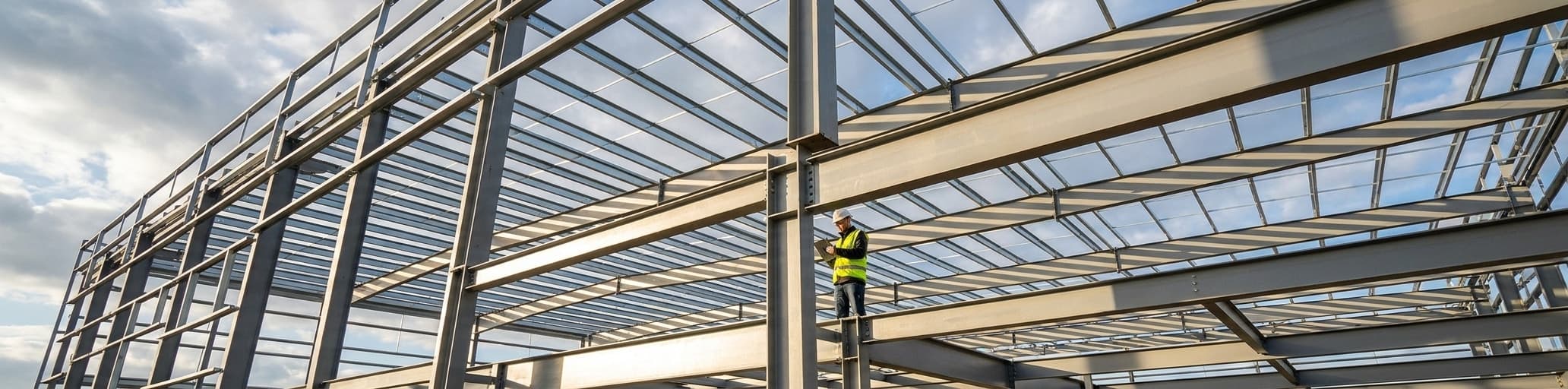

Steel frame structures dominate modern construction because their strength-to-weight ratio delivers wider clear spans, lighter foundations, and faster build times than concrete or timber alternatives. We help you match the right frame type–portal, truss, moment-resisting, or space frame–to your building's function and local loads, keeping your project within budget and on schedule.
Introduction to Steel Frame Structures
Steel frames deliver 70% of multi-storey commercial buildings because they combine unmatched clear spans, factory-fabricated precision, and infinite recyclability into genuine cost savings.
Why steel frames dominate modern construction
Steel frames are selected for roughly 70% of multi-storey commercial buildings, and that dominance isn't accidental.[2] Three advantages drive the preference: a strength-to-weight ratio that enables column-free clear spans no concrete or timber equivalent can match, off-site fabrication that ships pre-cut components to your site ready to bolt together, and infinite recyclability that satisfies sustainability requirements without redesigning your structure.[1] That combination matters directly to your bottom line — clear spans mean more usable square footage per dollar of structure, while factory-fabricated components cut weather delays and keep your schedule intact.[1] Steel also pairs natively with BIM workflows; the sector adopted computer-numerically controlled fabrication early, so engineering drawings translate straight to shop-cut steel with minimal rework or site error.[2] If you want to understand how these advantages play out in practice, a solid grounding in structural steel components is a good starting point before you evaluate which frame type fits your project.
Core benefits of steel frame structures
Steel's durability is its most underappreciated cost advantage for property owners and developers.
Steel doesn't rot, warp, twist, or attract termites — problems that quietly drain maintenance budgets in wood-framed buildings year after year.[4] Its non-combustible framing won't fuel a fire, which translates into lower insurance premiums and genuine code compliance confidence across commercial, agricultural, aviation, and retail applications.[4] The design flexibility adds another layer of value: steel accommodates long clear spans without interior load-bearing walls, making it the natural fit for warehouses, hangars, and open retail floors — and those same frames accept future extensions or reconfiguration without major structural surgery.[4] On the cost side, a World Steel Association study found steel-framed buildings can save up to 10% in construction costs versus traditional materials, with prefabrication and reduced on-site waste driving the bulk of those savings.[4] If you want to see how those savings compound over time, the 20-year maintenance cost breakdown between steel and pole barn construction puts the long-term numbers in plain terms.
How this guide explores types of steel frame structures
Not every steel frame solves the same problem, and choosing the wrong type costs you money — in overbuilt structure, costly retrofits, or spans that simply don't match your use case.[5] This guide walks through the full spectrum of types of steel frame structures: from the rigid portal and braced frames that dominate warehouses, hangars, and agricultural buildings, to specialized trusses, space frames, and hybrid systems built for complex long-span challenges.[5] The world of steel construction divides into distinct categories, each with its own methodology, advantages, and ideal applications — and knowing those distinctions is the difference between a cost-effective build and an expensive overdesign.[7] Beyond cataloguing frame types, the guide also covers how pre-engineered systems compare to custom fabrication, how BIM and off-site production compress your schedule, and how to match frame type to your specific site conditions, occupancy, and budget.[6] Work through it in order and you'll finish with a decision framework you can take directly into a project conversation — not just a list of options.
Fundamental Concepts and Components
Columns, beams, and connections form the three-part skeleton that determines your clear-span distances, load distribution, and structural reliability under stress.
Key elements: columns, beams, and connections
Columns, beams, and connections are the three-part skeleton that every steel frame structure depends on — and understanding what each one does makes every other frame decision easier.[8] Columns are vertical members that receive compressive loads from every floor and roof surface above, then channel that combined weight straight down to the foundation.[9] Their placement determines your clear-span distances: columns set at wider intervals open up the column-free floor space that makes a prefab warehouse, hangar, or open retail floor actually functional — tighter intervals reduce material costs but eat into usable square footage.[9] Beams span horizontally between columns, distributing floor and roof loads evenly across the frame; they're fabricated in I-beam, H-beam, and box profiles, with the specific shape selected based on the span length and load intensity your occupancy requires.[9] Connections — the bolted or welded joints at every intersection — are where the system either holds under extreme stress or doesn't.[8] Bolted connections use high-strength fasteners to transfer shear and moment forces across the joint without permanent fusion, which means you can disassemble or reconfigure sections later; welded connections fuse the members into a monolithic assembly better suited to seismic and high-wind environments where joint slip isn't acceptable.[8] The structural members themselves are hot-rolled or cold-formed steel with yield strengths typically ranging from 250 MPa to 450 MPa, giving engineers precise, repeatable numbers to work from when sizing every column and beam for your site conditions and occupancy loads.[8]
Structural principles and load paths
A load path is the continuous route forces travel from their point of application down to the ground — and maintaining it without interruption is what separates a safe frame from a failure waiting to happen.[11] Gravity loads follow a predictable vertical sequence: roof loads transfer into purlins, then primary beams or trusses, then columns, and finally into the foundation.[11] Lateral forces from wind and seismic events take a more complex horizontal route — cladding transfers pressure into floor diaphragms, which act as horizontal beams channeling the force into shear walls, braced frames, or moment-resisting frames before it reaches the foundation.[10] Stiffness controls how load distributes between parallel members: a stiffer beam in the same system attracts significantly more force than a flexible one, even if the flexible member is technically stronger — which means two seemingly identical sections in your frame can carry very different shares of the total load.[10] That distinction matters directly to how you detail connections and size secondary members.
Most structural failures trace back to disrupted load paths rather than inadequate material strength — a misaligned connection, missing brace, or underspecified base plate can redirect forces into members that were never designed for them.[11] For applications like warehouses carrying crane rails or dense racking, mapping these paths during the design phase eliminates the expensive surprises that surface after the slab is poured.
Evolution of steel framing technology
Steel framing evolved from a fragmented, unregulated craft into a precisely engineered system within roughly 70 years — and understanding that timeline explains why the pre-engineered buildings you can order today are so reliable.
The turning point was 1856, when the Bessemer process enabled mass production of affordable, high-quality steel, replacing brittle iron and making tall construction viable for the first time.[12] William Le Baron Jenney applied that material breakthrough in 1885 with the Home Insurance Building in Chicago: a 10-story structure where a steel skeleton of vertical columns and horizontal beams carried all structural loads, eliminating the thick masonry walls that had previously capped building height.[14] Jenney also introduced the curtain wall — exterior cladding hung on the steel frame rather than bearing any structural load — which unlocked larger windows, more floor area, and faster construction sequences that still define commercial and industrial facades today.[14] Early connections relied on riveting, but advanced welding technology eventually replaced it, producing stronger joints at lower cost and setting the stage for the high-wind and seismic detailing used in modern warehouses and hangars.[12] Standardization arrived in 1921 with the founding of the American Institute of Steel Construction, which unified a fragmented industry operating without universally accepted codes or practices; its first Steel Construction Manual, published in 1927, gave engineers and fabricators a shared reference that now runs to its 15th edition and underpins every building code in the country.[13] Computer-aided design, BIM, and automated manufacturing then closed the gap between engineering drawing and fabricated steel — the same digital-to-physical pipeline that allows components for your warehouse, hangar, or agricultural building to arrive on site pre-cut and ready to bolt together with minimal rework.[12]
Comparison with alternative building systems
Material selection is a cost decision before it's anything else, and the gap between steel, concrete, and timber is wide enough to change what your project can actually do. Steel delivers an ultimate strength of 400-500 MPa and enables a workforce roughly 10-20% smaller than a comparable concrete build — a direct reduction in labor cost before you account for schedule compression.[15] Concrete gets strong in compression (17-70+ MPa), but it demands formwork, temperature-controlled curing conditions, and a large on-site crew; none of those constraints apply to a steel frame that arrives pre-cut and bolts together in nearly any weather.[16] Timber is the lightest option and carries the lowest material volume requirement, but its moisture sensitivity, fire vulnerability, and span limitations cap its practical ceiling at roughly 15 stories — and international design firm SOM has explicitly stated that critically stressed members in taller structures are best designed in steel or concrete, not timber.[16] The recyclability gap also matters for long-term project economics: structural steel produced in the U.S. averages 92% recycled content and is 100% recyclable into new steel products, while concrete can only be down-cycled and roughly 56% of timber harvested for lumber is lost to chips, sawdust, or landfill during milling.[16] For a detailed cost comparison of steel versus wood across a 20-year ownership window, the steel barn cost vs wood barn analysis puts those numbers in direct dollar terms.
| Criterion | Structural steel | Reinforced concrete | Timber |
|---|---|---|---|
| Ultimate strength | 400-500 MPa[15] | 17-70+ MPa (compressive)[15] | Variable; lower overall[15] |
| Span capability | Longest[17] | Moderate[17] | Shortest[17] |
| On-site workforce | 10-20% smaller than concrete[15] | Large crew required[17] | Minimal fixings on site[17] |
| Weather sensitivity | Erects in nearly all conditions[16] | Temperature-dependent curing[16] | Expands and contracts with moisture[16] |
| Recyclability | 92% recycled content; 100% recyclable[16] | Down-cycled only[16] | ~56% of milled timber is wasted[16] |
| Practical height limit | None[16] | Viable for high-rise[15] | ~15 stories[16] |
| Fire performance | Non-combustible framing[16] | Fire-resistant[17] | Requires treatment[17] |
For warehouse, hangar, agricultural, and retail applications where clear spans and low maintenance drive every decision, that table resolves most material debates before the first design drawing is made.[16]
Primary Types of Steel Frame Structures
Haunch brackets at rafter-column junctions let you specify lighter steel sections across the span, reducing material tonnage without sacrificing structural capacity.
Rigid (Portal) Frames: design and typical uses
Portal frames are the dominant structural choice for low-rise steel buildings — and the geometry explains why.[18] Each frame pairs two vertical columns with a set of pitched rafters meeting at a central ridge, connected at each rafter-column junction by haunch brackets that absorb and redistribute the bending moment before it can over-stress the joint.[18] That detail matters directly to your budget: by stiffening the corners, haunches let engineers specify lighter steel sections across the rest of the rafter span, reducing material tonnage without reducing capacity.[18] Rafters are pitched between 5 degrees and 20 degrees — shallower or steeper creates structural inefficiencies — and that pitch doubles as a drainage system, shedding rain and snow without additional waterproofing measures.[18] Column bases are either cast into concrete pads for hot-rolled frames or bolted to foundations with anchor plates for cold-rolled systems, and wall and roof bracing ties the parallel repeated bays together into a stable three-dimensional structure that resists both vertical gravity loads and lateral wind pressure.[18][19] The result is a clear-span interior with no internal columns — maximum usable floor area from the first day you open the doors.[18]
Six portal frame variants handle the spectrum from a single-bay workshop to a commercial warehouse exceeding 300 feet wide.[19] Choosing the right one before you finalize your structural drawings saves real money:
| Frame type | How it works | Best-fit applications |
|---|---|---|
| Single-span | Two columns, one rafter pair, single clear span | Garages, small workshops, agricultural storage |
| Multi-span | Multiple bays with intermediate columns | Retail showrooms, light industrial, large agricultural facilities |
| Tapered | Variable-depth sections that taper toward the ridge | Large warehouses, distribution centers where efficiency per ton of steel matters |
| Lean-to | Single-pitch roof off a primary frame | Extensions, covered loading docks, equipment shelters |
| Canopy | Rafter extends beyond the column line | Covered porches, carports, outdoor staging areas |
| Truss portal | Triangulated truss replaces solid rafters for the longest spans | Commercial warehouses requiring the widest unobstructed interior |
For the building types most common on a project list — warehouses, hangars, agricultural barns, retail showrooms, and manufacturing facilities — portal frames win on four practical grounds.[18][20] First, clear-span interiors eliminate column placement conflicts, so you can run racking, crane rails, or aircraft straight through without routing around structure.[18] Second, the prefabricated components arrive on site pre-cut and bolt together quickly, compressing your schedule compared to on-site fabricated alternatives.[18] Third, the modular bay system means expansion is an add-on rather than a structural overhaul — you extend the building by repeating bays along the length.[18] Fourth, with appropriate fire-resistant coatings, portal frames meet stringent fire safety requirements for manufacturing, storage, and warehouse occupancies without changing the base design.[18] Those four factors — open spans, fast erection, scalability, and code compliance — make portal frames the cost-effective default for the majority of pre-engineered steel projects you'll encounter.
Braced Frames: lateral stability solutions
A steel frame handles vertical gravity loads well on its own — but lateral forces from wind and earthquakes are a different problem entirely. Without a dedicated lateral system, even a well-designed frame can sway or rack under sideways pressure, with columns and beams offering insufficient resistance on their own.[21] Braced frames solve this by introducing diagonal steel members that form triangles within each rectangular bay; because a triangle can't distort without changing the length of its sides, the geometry itself provides the lateral rigidity.[21] That load path is both direct and efficient: lateral forces travel as pure axial tension or compression through the diagonal members rather than bending the beams and columns, which means you get high stiffness with minimum steel tonnage.[22] Bracing is widely recognized as a highly efficient and economical method for resisting lateral forces precisely because diagonal members work primarily in axial stress, resulting in minimum member sizes across the structural system.[23] For warehouses, agricultural buildings, hangars, and industrial facilities, this matters practically: diagonal braces run inside wall cavities or along end bays, leaving the interior clear-span completely unobstructed.[21]
Two distinct engineering families cover most braced-frame applications, each handling seismic risk differently. Concentrically braced frames (CBFs) connect all members — beams, columns, and bracing — at common points, creating a straightforward triangulated truss that carries lateral force purely through axial stress in the braces.[23] Common CBF configurations include cross-bracing (X-brace), inverted V-brace (chevron brace), single diagonal, and K-brace arrangements, each positioning steel at different angles within the bay to intercept loads from multiple directions.[22] Eccentrically braced frames (EBFs) take a different approach: the brace connects to the beam at a deliberate offset from the column, creating a short "link" segment designed to yield and absorb seismic energy in a controlled, predictable way before the brace itself buckles.[21] That link acts as a structural fuse — it takes the damage so the rest of the frame stays intact — which is why EBFs dominate high-seismic specifications while CBFs remain the cost-effective default for the moderate-wind and low-to-moderate-seismic zones that cover the majority of commercial and agricultural projects across the U.S.[22][23]
| Feature | Concentric braced frame (CBF) | Eccentric braced frame (EBF) |
|---|---|---|
| Load mechanism | Pure axial (tension/compression) in braces[23] | Axial braces + bending in link beam[23] |
| Common configurations | X-brace, chevron, single diagonal, K-brace[22] | Diagonal with link offset at beam[23] |
| Connection complexity | Simple — all members meet at common joints[23] | Complex — link detailing requires precision[23] |
| Seismic performance | Reliable in moderate zones; energy dissipation limited[23] | High ductility; built for high-seismic zones[21] |
| Best fit | Warehouses, industrial, agricultural buildings[21] | High-seismic commercial, multi-story structures[21] |
Beyond the primary bracing system, a complete lateral load path depends on secondary bracing elements that are easy to underspecify but code-critical in practice. Purlins and girts — the roof and wall framing members — brace the compression flanges of main beams and columns against sideways buckling; without them, a correctly sized primary member can still fail laterally before reaching its design capacity.[21] Sag rods and bridging tie secondary framing members together, preventing twist under load.[21] The entire system functions as a chain: cladding and roof decking collect wind pressure and act as diaphragms, transferring shear forces into collector beams (drag struts), which deliver those forces to the primary braced frames, which route them down the columns to the foundation.[21] Every link in that chain must be designed for the specific forces it carries — a missing brace or underspecified connection redirects loads into members that were never sized for them, and that's where most structural problems originate.[21] For industrial steel buildings, hangars, and agricultural facilities where wind exposure and occupancy loads are significant, mapping this complete load path during the design phase is the single most cost-effective step you can take before fabrication begins.
Moment‑Resisting Frames: flexibility for open spaces
Where braced frames solve the lateral load problem with geometry — diagonal members forming rigid triangles — moment-resisting frames (MRFs) solve it with connection rigidity alone.[24] There are no diagonal braces, no shear walls interrupting your floor plan: instead, beams and columns connect through specially designed rigid joints that transfer bending moment directly across the intersection, allowing the entire frame to flex under lateral wind or seismic force without losing structural integrity.[26] That distinction is the entire reason MRFs dominate mid-rise and high-rise commercial buildings, prefab retail buildings, and mixed-use developments where open floor plans and large unobstructed interior spans are non-negotiable design requirements.[24] Because no diagonal member needs to cross your bay, you get column-free spaces that can be partitioned, re-partitioned, or left completely open — and that flexibility extends to large window openings and curtain wall facades that a braced frame would force you to work around.[26]
The trade-off is in the connections. Rigid beam-column joints are the mechanical core of every MRF — they must resist rotation under load, which demands precise fabrication, careful panel-zone detailing per AISC 360 Chapter J, and connections sized to transfer both shear and full bending moment at every intersection.[24] That complexity pushes connection costs higher than a comparable braced frame, and it also makes deflection management more demanding: because the frame relies on controlled flexure rather than axial stiffness, drift under lateral load must be tracked carefully against serviceability limits throughout the design process.[24] Engineers must check beams and columns for combined flexural, shear, and axial capacity under all relevant load combinations, and foundations must be designed to resist both axial and lateral forces simultaneously — spread footings sized for bearing pressure, overturning, and sliding, not just gravity loads.[24]
AISC classifies moment frames into three performance tiers, and the right tier depends directly on your seismic design category. Ordinary Moment Frames (OMFs) require the simplest calculations and minimal supplemental connection detailing, making them the cost-effective default for low-to-moderate seismic zones that cover most commercial and industrial projects across the U.S.[25] Intermediate Moment Frames (IMFs) and Special Moment Frames (SMFs) demand either pre-qualified connections per AISC 358 or conformance demonstration through laboratory testing — requirements that add cost and engineering time but deliver substantially higher ductility and energy dissipation during major seismic events.[25] SMFs are specifically engineered to undergo controlled deformation without losing structural integrity, which is why they're the standard in high-seismic regions where collapse prevention under extreme ground motion is the governing design objective.[26] Hollow Structural Section (HSS) columns add a further option within the MRF family: their uniform bi-axial geometry delivers equal strength in every direction, makes them inherently efficient under compression, and allows internal fireproofing — an advantage wide-flange shapes can't match — though HSS moment connections in IMF and SMF applications currently require either proprietary systems or laboratory testing because no generic pre-qualified HSS seismic connection exists in AISC 358 for North American practice.[25]
The table below maps each MRF tier to its engineering demands and best-fit project types:
| Frame classification | Connection requirement | Seismic design category fit | Typical applications |
|---|---|---|---|
| Ordinary Moment Frame (OMF) | Standard detailing, simple calculations[25] | Low to moderate seismic zones[25] | Retail, light commercial, low-rise industrial[26] |
| Intermediate Moment Frame (IMF) | Pre-qualified connection or lab testing per AISC 358/341[25] | Moderate to high seismic zones[25] | Mid-rise commercial, mixed-use, institutional[26] |
| Special Moment Frame (SMF) | Special detailing; highest ductility demand[26] | High seismic zones[25] | High-rise, hospitals, critical facilities[26] |
| HSS column variant | Proprietary or tested connection required[25] | Moderate to high (with conformance demo)[25] | Architecturally exposed frames, multi-axis loading[25] |
For commercial, retail, and institutional projects where open floor plans, large glazing, and architectural freedom are priorities, MRFs deliver what braced frames can't: a completely unobstructed interior that the structural system never interrupts.[26] The cost premium in connection fabrication is real, but for occupancies where interior layout flexibility directly drives lease value or operational efficiency — offices, showrooms, churches, healthcare facilities — that premium pays back across the life of the building.[26]
Wall‑Bearing Steel Frames: load distribution method
Wall-bearing steel frames work on a fundamentally different logic than the column-and-beam systems discussed above: instead of funneling gravity loads through discrete vertical columns, they distribute those forces across continuous steel stud walls running the full height of the structure.[27] Cold-formed steel (CFS) bearing walls — built from light-gauge steel studs typically spaced 16 or 24 inches apart — are the dominant form of this system, and their load path is direct: floor and roof loads transfer axially through the wall studs and route straight down to the foundation without the deep transfer beams or heavily reinforced slabs that column grids demand.[6] That directness is what makes the system architecturally valuable in multi-story residential and mixed-use buildings: because bearing walls stack floor-to-floor in the same position as the unit demising walls, corridor walls, and interior partitions already required for habitability, you get structural support from walls your layout needs anyway — no column intrusions, no compromised unit plans, no utility conflicts between mechanical risers and structural members.[27]
The hybrid podium application is where wall-bearing steel frames earn their place as one of the most practical types of steel frame structures for mid-rise residential development. A developer building beyond the five-story limit of Type V-A wood construction can introduce CFS bearing wall levels beneath the wood-framed floors rather than defaulting to a full steel or concrete podium with its disruptive column grid.[27] Up to two levels of CFS bearing walls can support the wood floors above while satisfying IBC Section 510.2 horizontal separation requirements, and the assembled system weighs less than cast-in-place concrete — reducing foundation loads, shrinking footing sizes, and lowering seismic demand on the shear walls throughout.[27] CFS studs in this application come in 3⅝-inch, 6-inch, and 8-inch depths; the 3-hour fire-rated assemblies required at podium levels add roughly 1.5 to 2 inches of drywall thickness per rated side, producing a minor dimensional shift at the lowest floor without disturbing unit layouts, window alignments, or stacked utility risers.[27] The same cold-formed steel principles that make this system cost-effective in residential podium construction also underpin cold-formed steel agricultural buildings, where lightweight framing, shop fabrication, and direct load paths reduce both material tonnage and erection time.
Lateral stability in a wall-bearing system follows the same stacking logic as gravity loads. At wood-framed levels, shear walls use drywall or structural panel sheathing; at CFS levels, the same walls sheathed in steel sheets or light-gauge X-braces carry lateral force downward — the corridor and demising walls that run continuously from the roof to the foundation serve double duty as the complete lateral system.[27] Where open areas break that stack — a lobby, ground-floor retail frontage, or parking bay — reinforced masonry cores, concrete cores, or steel moment frames pick up the lateral load through collector members and chord connections that must be precisely detailed to transfer concentrated shear forces without redirecting them into members sized only for gravity.[27] Regardless of which lateral strategy you choose, ASCE 7 Section 12.2.3.2 permits a two-stage analysis similar to traditional podium design, and a correctly stiffened CFS restraint system can satisfy those requirements — substantially reducing seismic loads on the wood shear walls above and cutting the cost of those elements.[27] Panelizing the CFS walls in a fabrication shop rather than stick-framing them on site is the cost-effective default: entire floor levels can be wall-installed in two to three days, shop tolerances are tighter than field framing, and that schedule compression compounds across every floor you add to the building.[27]
| Design factor | Wall-bearing CFS frame | Traditional column-grid podium |
|---|---|---|
| Load path | Continuous axial compression through stud walls[27] | Point loads through discrete columns to transfer beams[27] |
| Floor plan impact | Walls align with existing unit layout[27] | Column grid may conflict with unit and window layout[27] |
| Lateral system | Stacked shear walls from roof to foundation[27] | Separate shear core or braced frame required[27] |
| Foundation loads | Lighter — reduced concrete volume[27] | Heavier — concentrated column reactions[27] |
| Fabrication method | Shop-panelized; installed in days per floor[27] | Site-fabricated or crane-set; longer schedule[27] |
| Fire rating | 3-hour assembly via additional drywall layers[27] | Spray-applied fireproofing on exposed steel members[27] |
Specialized and Emerging Frame Systems
Truss geometry directly shapes your project costs: Pratt trusses minimize weight for 20-100 meter spans, while Warren trusses simplify fabrication and support consistent roof connections.
Steel Trusses and long‑span solutions
A steel truss achieves structural efficiency through one principle: triangulation converts applied loads into pure axial forces — tension and compression — distributed across a network of members, eliminating the bending stress gradient that makes a solid beam inherently wasteful at long spans.[29] Under gravity loading, the top chord compresses, the bottom chord carries tension, and the web members transfer shear as axial forces; every part of every member is fully stressed in the same direction.[29] That efficiency compounds at scale — for spans beyond 30 meters, a truss typically saves 40-60% in primary structural steel compared to an equivalent solid beam, which is why trusses dominate long-span warehouses, distribution centers, aircraft hangars, and wide-bay agricultural buildings where column-free clear spans drive every cost decision.[29] Research on high-performance long-span transfer twin trusses in hospital construction confirms that optimized truss design achieves multiple simultaneous benefits: reduced self-weight, uniform deflection across primary trusses, lower column reactions at the foundation, and increased headroom — all from the same structural system.[30]
The geometry you choose has direct cost implications. The Pratt truss puts diagonals in tension under gravity loads — tension members can be lighter than compression members because they don't need to resist buckling — making it the lowest-weight option for warehouses, factories, and logistics facilities spanning 20-100 meters.[29] The Warren truss uses alternating diagonal angles (with or without added verticals) that equalize member forces, and its regular geometry simplifies fabrication while providing consistent nodes for purlin attachment across roof bays; it's also the standard configuration for horizontal crane girder assemblies.[29] The North Light (saw-tooth) truss is an asymmetric profile with a steep glazed face for diffuse natural daylighting — one of the most practical options for industrial workshops where solar heat gain is a concern.[29] The Vierendeel truss eliminates diagonals entirely, with rectangular panels connected by rigid moment joints that open the web for architectural glazing or mechanical penetrations, but it runs 40-80% heavier than an equivalent Warren configuration; reserve it for transfer floors, pedestrian bridges, and architecturally exposed frames where the clear web opening justifies the premium.[29] The table below maps each configuration to its structural behavior and best-fit applications:
| Truss type | Span range | Force pattern | Best-fit applications |
|---|---|---|---|
| Pratt (N-configuration) | 20-100 m[29] | Diagonals in tension under gravity[29] | Warehouses, factories, logistics centers[29] |
| Warren (equilateral) | 20-100 m; up to 300+ m in bridges[29] | Alternating tension/compression diagonals[29] | Distribution centers, crane girders, gantries[29] |
| North Light (saw-tooth) | Light industrial spans[29] | Asymmetric; steep glazed face for daylighting[29] | Industrial workshops requiring natural light[29] |
| Vierendeel | Transfer-floor spans[29] | Bending at rigid joints; no diagonals[29] | Architectural exposures, bridge walkways, high-rise transfer floors[29] |
| Space frame (3D truss) | 60-200+ m[29] | Biaxial distribution through 3D node-strut system[29] | Aircraft hangars, stadiums, exhibition halls, airports[29] |
The IBC establishes 60 feet as the threshold where truss engineering escalates: any truss at or beyond that span requires a registered professional to design both permanent and temporary bracing per IBC 2015 Section 2303.4.[28] Permanent bracing — typically plywood or OSB roof diaphragm panels fastened directly to the top chord — prevents lateral buckling of compression flanges under service loads; the bottom chord also needs bracing even in tension, to hold the truss aligned perpendicular to the roof deck, with sag rods and cross-bridging at roughly 10-foot intervals handling that requirement.[28] For spans over 70 feet, modular erection is the standard installation method: groups of trusses are assembled with permanent sheathing attached on the ground, then the entire module is crane-lifted into position, because a single unbraced long-span truss is unstable out-of-plane and can buckle or topple during installation.[28] Long-span trusses also accumulate significant dead-load deflection, so pre-cambering — fabricating with an upward bow equal to 75-100% of the calculated dead-load deflection — is standard practice; without it, the installed truss sags below its intended geometry, creating roof drainage problems and fitment issues at the eave.[29]
Where single-plane trusses reach their span limit, space frames extend the concept into three dimensions by interconnecting planar trusses through a node-and-strut system — typically ball-and-socket or welded ring nodes with circular hollow section members.[29] The biaxial load distribution allows highly efficient member sizing that no planar truss can match, which is why space frames are the structural solution for aircraft hangars spanning 60-200+ meters, exhibition halls, stadium roofs, and airport terminals.[29] Design always requires full 3D finite element analysis; simplified hand methods don't apply at the span scales where space frames are economically justified.[29] Common real-world applications for long-span open-web trusses include school gymnasiums, church gathering rooms, and light commercial construction — anywhere a large open room is the primary requirement — with the most common span range falling between 60 and 100 feet.[28] For steel truss buildings where long-term maintenance cost matters as much as first cost, the combination of factory-fabricated members, predictable axial load paths, and scalable geometry keeps both initial construction cost and operating cost lower than wood or concrete alternatives across the building's full service life.[29]
Space Frames and grid structures
Space frames extend the triangulation principle from a single plane into three dimensions — instead of a planar truss, a space frame interconnects linear elements through a repeating grid of nodes, creating a hyperstatic system that distributes loads simultaneously in every direction.[33] That spatial force distribution is the core engineering advantage: because loads travel through dozens of redundant members rather than a single load path, members work almost entirely in axial tension and compression, with negligible bending — which is why these structures can cover spans from 60 to over 200 meters using members that are far lighter than equivalent solid beams or single-plane trusses.[33] The double-layer configuration is the most common form, pairing an upper and lower grid connected by vertical or diagonal members; single-layer space frames suit shorter or decorative spans, while triple-layer systems handle very large stadiums and exhibition centers where combined span and load exceed what two-layer geometry can efficiently resolve.[33]
Grid structures share the same underlying logic but are distinguished by geometry: rods connected in a repeating grid pattern that can remain flat as a two-dimensional plane or curve into a three-dimensional reticulated shell.[32] Both forms deliver lightweight construction with high rigidity and excellent seismic resistance — the geometric redundancy that makes them span long distances also makes them one of the most reliable types of steel frame structures in high-seismic zones.[32] That seismic performance is why grid structures appear regularly in gymnasiums, exhibition halls, and theaters — occupancies where long clear spans and life-safety performance under dynamic loads are both required.[32] Real-world landmark applications confirm the range: the Beijing National Stadium, King Fahd International Stadium, and Kansai International Airport Terminal all rely on space frame geometry to cover vast column-free areas while maintaining structural efficiency that conventional frames cannot match at those scales.[33]
The construction sequence follows the same parallel-fabrication logic that makes other prefabricated steel systems cost-effective, but at a larger scale: components are machined and assembled into modules off-site, transported to the project location, then lifted and bolted or welded into final position.[31] Factory fabrication delivers tighter tolerances than field framing can produce — and in a space frame, that precision is non-negotiable, because a misaligned node redirects axial forces into bending that the members were never sized to carry.[31] The challenges are real and worth pricing in before you commit. Node connections are complex to fabricate, full 3D finite element analysis is mandatory (hand methods don't apply at these spans), and material costs run higher than conventional framing — roughly $50-80 per square meter for smaller projects and $100-200 per square meter for large airport or stadium applications.[33] Anti-corrosion protection also requires active management: space frames typically occupy open or semi-open environments where coating treatment and periodic inspection are maintenance requirements, not optional extras, and the hollow interior geometry makes hidden surfaces difficult to access.[31] For aviation hangars, airport terminals, and large-span exhibition or sports facilities where column-free interior area directly drives operational and revenue value, a properly designed and maintained steel space frame delivers a service life of 50-100 years — making those upfront costs a straightforward investment rather than a premium.[33]
Curved and arch steel frames
work on a different structural principle than every frame type discussed above: the arch geometry converts applied loads into axial compression along the curve rather than bending stress, which means the steel is working more efficiently per pound throughout the entire span.[36] That efficiency is most visible at landmark scale — the Gateway Arch in St. Louis uses a stainless steel exterior over a hot-rolled carbon steel interior frame, and its 192-meter height stands without a single internal column, carrying all structural loads through compression in the arch itself.[34] The Avicii Arena in Stockholm applies the same principle at a building scale, spanning a 110-meter diameter with a curved space frame from mid-section upward — no internal supports interrupt the interior that hosts world-class sports and concerts.[35] Space frames used in curved arch applications are valued precisely because they allow builders to create shapes that would be practically impossible or cost-prohibitive with conventional rectangular framing.[35]
For warehouse, agricultural, aviation, and storage applications, pre-engineered arch buildings translate that structural principle into six distinct profiles, each matched to a different combination of span, wall geometry, and use case.[36] The Q-style (classic Quonset) is the most traditional: a single-radius clear-span arch that comes to the ground on both sides, available from 16 to 125 feet wide.[36] The S-style adds straight sidewalls beneath the curved roof, increasing usable wall space for tractors, shelving, and machinery — available from 10 to 75 feet.[36] The R/C-style is a curved roof with open sides, functioning as a container cover or carport in widths from 10 to 130 feet and heights from 8 to 30 feet.[36] The A and X styles deliver more conventional peaked-roof appearances with straight or sloped walls respectively, while the T-style mirrors the S but with sloped walls for maximum drainage in high-precipitation regions.[36]
| Style | Wall type | Width range | Best-fit applications |
|---|---|---|---|
| Q (Quonset) | Arch to ground, no sidewalls[36] | 16-125 ft[36] | Storage, agricultural, equipment shelters[36] |
| S | Straight sidewalls + curved roof[36] | 10-75 ft[36] | Machinery storage, workshops with wall-mounted equipment[36] |
| A | Straight sides + peaked roof[36] | 16-40 ft[36] | Garages, small workshops, conventional-look storage[36] |
| X | Sloped walls + peaked roof[36] | 20-60 ft[36] | Agricultural buildings, residential storage[36] |
| T | Sloped walls + curved roof[36] | 10-75 ft[36] | High-drainage agricultural and commercial applications[36] |
| R/C | Curved roof + open sides[36] | 10-130 ft[36] | Carports, container covers, walkway shelters, equipment staging[36] |
The practical advantages of arch buildings compound at every stage of your project. Every arch style is engineered as a clear-span structure with no interior columns, so you get the same unobstructed floor area that makes portal and truss frames productive — in a geometry that erects faster and demands less on-site labor.[36] All six styles can be extended in virtually unlimited length without structural redesign, which makes them a cost-effective answer for operations planning future expansion without starting over.[36] The curved shell distributes loads efficiently across its entire surface, and each building is engineered to meet the specific wind and snow load requirements of your site — not generic national minimums.[36] Steel arch buildings resist rot, pests, and warping that drain wood-structure maintenance budgets, and long-term rust protection is backed by a 50-year limited warranty against rust-through perforation.[36] For agricultural storage, prefab aviation hangars, riding arenas, workshops, and covered loading areas, arch frames are one of the most cost-effective types of steel frame structures available when your project calls for long clear spans, minimal maintenance, and room to grow.
Hybrid systems integrating concrete, timber, or composites
Hybrid steel frames pair steel's structural efficiency with a secondary material — typically cross-laminated timber (CLT), concrete, or fiber-reinforced composites — assigning each material to the role it performs best rather than forcing a single material to do everything.[37] The most practical form for commercial and multi-story construction is the steel-CLT hybrid floor plate: steel columns and primary beams carry vertical and lateral loads exactly as they would in a conventional portal or moment frame, but the composite deck slab is replaced with factory-fabricated CLT panels that attach directly to the steel.[39] AISC formalized this system in Design Guide 37: Hybrid Steel Frames with Wood Floors, which establishes that the CLT slab acts as a continuous lateral brace to the top flange of secondary beams — a detail that eliminates lateral torsional buckling and lets engineers specify lighter beam sections than an unbraced equivalent would require.[39] Steel is designed per AISC 360, the CLT floor per the National Design Specification for Wood Construction, and the connection between them manages fire protection, vibration, and composite interaction — three considerations that differ from a standard composite deck but remain workable within existing codes.[39]
The structural and schedule benefits compound at the foundation level. A hybrid CLT floor plate is lighter than a reinforced concrete alternative, which means columns carry less cumulative dead load, footing sizes shrink, and on pile-supported sites up to 85% fewer piles may be required compared to a traditional concrete frame.[37] That foundation reduction translates directly into cost savings and schedule compression before a single above-grade component is erected.[37] Eliminating formwork, reinforcement placement, and concrete curing from your floor cycle also removes weather dependencies that add unpredictable delays; CLT panels arrive pre-cut from the factory and install immediately without waiting for material to cure.[37] For projects adding floors to existing structures — an increasingly common scenario in commercial renovation — the lightweight nature of hybrid floor plates makes it structurally feasible to add stories that a heavier concrete system would rule out entirely.[37]
The carbon reduction is a practical budget consideration as much as a sustainability credential. Embodied carbon in a steel-CLT hybrid floor plate is typically less than half that of a conventional concrete floor plate solution, and optimizing panel dimensions so factory deliveries arrive with full truck loads reduces both delivery count and associated fuel cost.[37] Steel-timber composite (STC) beams — where a steel section and a timber member act compositely through mechanical connectors — extend this principle from floor plates to primary spanning members, with research confirming STC beams deliver weight savings and deflection performance that neither material achieves independently.[38] Fiber-reinforced polymer (FRP) composites represent an emerging third category: used primarily in connection hardware, reinforcing plates, and hybrid beam sections where corrosion resistance and low weight matter more than raw compressive strength.[38] The common thread across all three hybrid approaches is the same logic that governs every well-designed steel frame: put each material where its properties solve the specific problem, and you get a lighter, faster, less expensive structure than any single material could deliver.
| Hybrid combination | Primary structural role | Key advantage over single-material system |
|---|---|---|
| Steel frame + CLT floor | Steel carries loads; CLT replaces composite deck slab[39] | Up to 85% fewer piles possible; eliminates LTB in secondary beams; halves floor embodied carbon[37][39] |
| Timber-concrete composite (TCC) | Timber beam in tension; concrete topping in compression[38] | Higher composite stiffness than timber alone; lower mass than full concrete slab[38] |
| Steel-timber composite (STC) beam | Steel and timber act compositely via mechanical connectors[38] | Weight savings and deflection performance neither material achieves independently[38] |
| Steel frame + FRP components | Steel primary frame; FRP connectors or reinforcing elements[38] | Corrosion resistance in wet or chemically aggressive environments[38] |
Prefabrication, Modular Construction, and Digital Tools
Factory-engineered PEB systems arrive as precision-cut, numbered kits ready to bolt together, letting your foundation work proceed while fabrication happens in parallel.
Pre‑engineered building (PEB) systems
A pre-engineered building (PEB) is a complete structural system — columns, rafters, secondary framing, cladding, doors, and accessories — designed, engineered, and fabricated in a factory, then shipped to your site as a numbered kit ready to bolt together.[40] That distinction separates PEBs from every other types of steel frame structure discussed in this guide: you're not buying raw steel and building from scratch, you're receiving a precision-engineered assembly where every member has already been sized, cut, drilled, surface-treated, and tagged before it leaves the factory.[40] Primary frames use tapered steel members that vary in depth along their length — thicker at the haunch where bending stress peaks, thinner toward the ridge where it drops — and that variable section approach reduces steel tonnage by 15-30% compared to equivalent conventional hot-rolled sections.[40] The result is a lighter structure, smaller foundation loads, and a lower total material cost, all without reducing the span or load capacity your project requires.[42] Standard clear-span PEB frames are routinely engineered up to 60 meters; specialist heavy-frame designs reach 90 meters — wide enough to house multiple wide-body aircraft without a single interior column interrupting the floor.[40] For project owners who want to understand exactly what arrives at the site and in what sequence, the prefab building kit delivery timeline explains how the engineering, fabrication, and shipping phases stack up from contract to erection.
The efficiency case for PEB systems rests on one mechanism: parallel workflows.[40] While your foundation is being poured, factory fabrication of every structural component is already underway — so you're not waiting for steel to arrive before site work can proceed or waiting for concrete to cure before fabrication can start.[40] A typical mid-size industrial or commercial building in the 3,000-5,000 m² range erects in 6-8 weeks on site, against 6-12 months for an equivalent conventionally constructed building.[40] That schedule compression is direct revenue — every week your warehouse, hangar, or retail building isn't operational is revenue you're not collecting.[41] On cost, PEMBs deliver savings of 10-20% compared to traditional construction made from wood, concrete, or conventional steel, driven by standardized components, reduced crew size, and the elimination of on-site cutting and welding.[42] Because engineers know exactly how much steel a project requires before fabrication begins, material waste drops sharply — PEB construction generates 30-40% less construction waste by weight than comparable conventional builds, reducing both disposal costs and environmental impact.[40] Those savings compound: less steel tonnage means fewer truck deliveries; lighter framing means less concrete in the foundation; factory tolerances tighter than field framing mean fewer fit-up corrections during erection.[42]
For warehouses, aircraft hangars, agricultural facilities, churches, and retail buildings — the occupancy types where clear spans and fast occupancy drive every budget decision — PEB systems cover the complete application spectrum.[40] The table below maps frame type to application so you can match system to project before your first design conversation:
| PEB frame type | Clear span range | Best-fit applications |
|---|---|---|
| Single-span rigid portal | Up to 60 m standard; 90 m heavy-frame[40] | Warehouses, distribution centers, aviation hangars[40] |
| Multi-span portal with intermediate columns | Beyond 90 m[40] | Large manufacturing halls, agricultural complexes[40] |
| Mezzanine-integrated frame | Varies by bay and load[40] | Retail showrooms, offices, self-storage with upper floor[40] |
| Crane-equipped heavy frame | Up to 90 m; crane capacity 200+ tonnes[40] | Manufacturing, MRO facilities, industrial plants[40] |
| Insulated sandwich panel system | Any span[40] | Cold-chain logistics, food processing, climate-controlled storage[40] |
Expansion is built into the system from day one: because all on-site connections are bolted rather than welded, you can add bays along the length of any PEB without demolishing or restructuring the existing frame.[40] That modularity means your agricultural storage building, retail strip center, or industrial facility can grow as your operation grows — without starting over or paying for a structural overhaul.[40] On the sustainability side, a typical PEB contains 25-35% recycled steel content and is 100% recyclable at end of life, and the factory-fabrication process eliminates on-site offcuts that drive conventional construction waste figures.[40] Insulated panel systems achieve U-values as low as 0.19 W/m²K, which directly reduces HVAC operating costs across the building's full service life — a practical budget advantage, not a marketing credential.[40] For property owners and developers who need a building that performs from day one, expands without pain, and stays cost-effective across decades of ownership, PEB systems are the single most efficient delivery mechanism available for single-storey and low-rise construction.[40][41]
Modular steel kits and off‑site fabrication
Modular construction takes the off-site fabrication principle one step further than a standard PEB kit — instead of shipping individual pre-cut members for field assembly, modular systems deliver fully enclosed structural sections, or "modules," that arrive at your site nearly complete and bolt together into a finished building.[43] Steel dominates this delivery model: structural steel captured 41.4% of the U.S. modular construction market by revenue in 2022, a lead driven by its mechanical properties — high strength, ductility, seismic resistance, and compatibility with shop fabrication into H-beams, columns, angles, I-beams, and T-shapes that no other material matches in a factory environment.[43] The practical result is that 60-90% of the construction work for a modular steel building happens inside a climate-controlled facility before your site is touched, which eliminates the weather delays that stretch conventional build schedules and create unpredictable cost overruns.[43] That factory completion rate is the single biggest schedule lever available in commercial, agricultural, and industrial construction — site work and module fabrication run simultaneously, so the building is ready to erect the moment your foundation passes inspection.[43]
For property owners budgeting a warehouse, hangar, retail building, or agricultural facility, the pricing predictability of modular steel kits is as valuable as the schedule compression. Because components are precision-cut and pre-drilled in a controlled environment, fabrication errors that trigger costly on-site rework are largely eliminated before the first truck leaves the factory.[45] Builders avoid the common cost variables that inflate traditional construction budgets — weather stoppages, material damage from site exposure, and reactive crew scheduling — which makes your project cost more predictable from contract signing through final inspection.[45] Cold-formed steel (CFS) modular components extend this advantage into the lightweight structural category: CFS panels and frames are manufactured to tight tolerances, arrive pre-assembled into wall and floor sections, and install without the heavy crane equipment that hot-rolled steel erection typically demands.[45] The non-combustible nature of the steel throughout the assembly also contributes directly to your insurance premium — steel doesn't fuel a fire, maintains structural integrity longer under heat than wood or light-gauge aluminum, and meets or exceeds stringent building codes because quality control happens in the factory before the module ships, not after it's already bolted in place on your site.[45] The Peppers Kings Square Hotel in Perth, Australia, is the benchmark case: 120 suites completed in 11 months, with primary structural and façade elements installed in just 11 weeks — a result the design team attributed explicitly to prefabricated modular construction reducing construction time and controlling cost.[43] For a cross-section of proven applications where modular and prefab steel systems consistently outperform conventional builds, the evidence runs from warehouses and retail showrooms to aviation and agricultural facilities.
Single-source procurement is the operational advantage that ties the whole system together. When all structural components — primary frames, secondary framing, wall panels, roof sections, doors, and accessories — come from one supplier engineered as a matched system, you eliminate the coordination gaps between separate vendors that generate field fit-up problems and schedule disputes.[44] Components arrive pre-cut and pre-drilled, sized to work together without on-site modification, and every piece is traceable to the same engineering package that was reviewed before fabrication began.[44] That traceability matters at inspection: the building was engineered to comply with local wind, snow, seismic, and fire safety requirements during the design phase, not retrofitted to meet code after construction exposed a gap.[44] Expansion stays simple under the same logic — bolted connections throughout the assembly mean you can remove an end wall, add new bays, and scale your facility without demolishing existing structure or re-engineering the original frame.[44] Whether you're adding storage bays to an agricultural complex, extending a distribution center, or expanding a retail strip, the modular kit system keeps that growth cost-effective and fast every time you need it.
| Modular kit advantage | What it means for your project |
|---|---|
| 60-90% factory completion rate[43] | Weather delays eliminated before site work begins |
| Precision-cut, pre-drilled components[44] | On-site labor and rework costs drop sharply |
| Predictable pricing from factory controls[45] | Budget holds without material damage or weather variables |
| Non-combustible CFS and hot-rolled steel[45] | Lower insurance premiums; code compliance built in |
| Single-source procurement[44] | One contact, matched components, no vendor coordination gaps |
| Bolted connections throughout[44] | Future expansion without structural overhaul |
BIM and parametric design for steel frames
BIM shifts steel frame engineering from a sequential process — design, then document, then coordinate — into a single connected model where every decision is visible to every discipline simultaneously.[46] In a BIM environment, the structural steel model isn't a drawing; it's a data-rich 3D object that carries section sizes, material grades, connection details, fabrication sequences, and erection sequences as embedded attributes.[46] Parametric modeling is the mechanism that makes that data actionable: building elements are defined by specific parameters and rules rather than fixed geometry, so when one dimension or specification changes, every related component updates automatically across the entire model without manual redrafting.[47] For a steel portal frame or moment frame where column depths, haunch dimensions, rafter pitches, and connection plate sizes are all geometrically interdependent, that automatic propagation eliminates the coordination errors that surface as costly field fit-up problems when those relationships are managed manually.[48] Parametric BIM modeling describes the process of design rather than just recording an individual result — which means the same model that sized your columns for 60-meter clear spans can generate a dozen valid design variants in the time it previously took to redraft one.[48]
The practical payoff for your warehouse, hangar, or agricultural facility shows up before fabrication begins. LOD 400 BIM models — the highest fabrication-ready detail level — give the shop floor precise component geometry, connection specs, and installation sequence so that pre-cut members arrive on site with tolerances tight enough to bolt together without modification.[46] Shop drawings and IFC files derived directly from the parametric model replace the manual translation step that historically introduced errors between the engineer's design intent and the fabricator's cutting files; because the drawings regenerate automatically with every model change, the version on the shop floor is always current.[46][48] Clash detection runs continuously in the same environment — mechanical ducts, electrical conduit, and structural members all occupy the same digital space, so a purlin that conflicts with a rooftop HVAC unit is flagged in the model weeks before steel is cut, not discovered during erection.[46] That early resolution is where BIM pays for itself most directly: fixing a clash in a parametric model costs minutes, while fixing the same problem in fabricated steel costs days and real money.
For prefab buildings where cost and speed are the deciding factors, parametric BIM closes the gap between engineering approval and factory output. Once a parametric model is created and validated for a given frame type, it can be refined and reused across future projects — automating the repetitive sizing and detailing tasks that consume engineering hours on every similar build.[48] Visual scripting tools make parametric models accessible without deep programming knowledge, which means your project team can explore span variations, eave height adjustments, or bay spacing changes in real time during the design conversation rather than waiting for a revised drawing set.[48] The result is a digital-to-physical pipeline where the engineering drawing and the shop-cut steel are the same object at different stages of production — a workflow that compresses your schedule, reduces material waste, and delivers components that fit together on the first attempt every step of the way.
Sustainable manufacturing and circular‑economy practices
Steel's sustainability credentials aren't marketing language — they're measurable at every stage of production and construction. The U.S. EPA reports that construction and demolition activities generate over 600 million tons of waste annually, more than double the volume from all household trash combined, which makes material efficiency a direct budget issue before it becomes an environmental one.[49] Cold-formed steel framing addresses this through roll forming technology: components are fabricated on demand to exact project lengths, reducing steel framing waste to less than 1% of total material input — a figure no wood or concrete system can approach.[50] That precision eliminates the on-site cutting, off-cut disposal, and dumpster overages that quietly inflate conventional build costs. Steel plants extend this efficiency further through closed-loop manufacturing: process water is filtered and recycled back into production rather than routed to municipal treatment facilities, reducing both operational overhead and strain on community water supplies.[49]
The circular economy case for steel frames rests on one hard number: structural steel is 100% recyclable at end of life and returns to the production cycle without losing its mechanical properties.[50] Unlike concrete — which can only be down-cycled into lower-grade aggregate — steel retains full structural value through multiple life cycles, meaning the warehouse, hangar, or agricultural building you erect today contributes raw material to the next build at full quality, not to a landfill.[50] For property owners planning 50-year service lives, that end-of-life recyclability means your structure carries residual material value that wood and concrete don't hold.[50] Modular and prefabricated steel construction reinforces this further: components arrive pre-cut to spec, install without on-site modification, and generate 30-40% less construction waste by weight than equivalent conventional builds — a direct reduction in disposal costs and environmental impact from the first delivery.[49] Peer-reviewed research on circular economy practices in modular construction confirms that prefabricated steel systems enable end-of-life disassembly and material recovery that poured-in-place systems structurally cannot replicate, extending the value of circular-economy thinking from the production phase through the entire building lifespan.[51] When you account for the agricultural steel building maintenance tasks you can skip entirely by choosing non-combustible, non-rotting steel frames, the combination of low production waste, closed-loop manufacturing, and full recyclability makes steel the most defensible material choice across a building's complete lifecycle.[50]
Procurement decisions now carry documentation requirements that matter for permitting, financing, and green building compliance. Environmental product declarations (EPDs) and lifecycle assessments give you measurable data on a steel system's carbon footprint and recyclability — not manufacturer claims.[49] Requiring EPDs from your steel supplier before contract, the same way you'd require structural calculations, keeps your project ahead of code requirements tightening across commercial, industrial, and agricultural occupancies — and positions you to satisfy clients and lenders who increasingly expect verified environmental accountability from the materials going into their buildings.[49]
Selecting the Right Frame for Your Project
Start with what your building actually does–occupancy drives structural decisions far more directly than aesthetics, pointing you to the right frame type before design begins.
Matching frame type to building function and occupancy
Every frame type covered in this guide solves a specific problem — and the fastest way to narrow your selection is to start with what your building actually does, not how it looks. Occupancy drives structural decisions more directly than aesthetics ever will. Pre-engineered rigid portal frames account for over 60% of new low-rise commercial construction in the U.S. precisely because their clear-span geometry maps directly onto the functional requirements of warehouses, distribution centers, retail big-box stores, agricultural buildings, and aircraft hangars — occupancies where unobstructed floor area is the primary revenue driver.[7] When your layout demands column-free space for racking, equipment, aircraft, or livestock, a portal frame delivers that without overbuilding. Moment-resisting frames take over where open floor plans need to coexist with large glazing, irregular footprints, or architectural flexibility — making them the standard choice for retail showrooms, churches, healthcare facilities, and mixed-use commercial developments where interior reconfiguration adds long-term lease value.[6] Custom conventional steel frames enter the picture when height, structural complexity, or design specificity exceeds what a standardized system can address: high-rise office towers, hospitals, universities, and civic buildings where design is non-negotiable and structural demands are extreme.[7] The decision rule is straightforward — pre-engineered systems deliver speed, value, and predictable cost for functional applications; conventional fabrication unlocks the design freedom that complex or tall structures require.[7] Your occupancy, span requirement, and budget tolerance together point to one frame type before your first drawing is made. Use the table below to map your project type directly to the right structural system.
| Building type / occupancy | Primary functional requirement | Best-fit frame type |
|---|---|---|
| Warehouse / distribution center | Maximum clear-span storage area | Pre-engineered rigid portal frame[7] |
| Aircraft hangar | Wide unobstructed span, tall clearance | Portal frame (truss portal for widest spans)[7] |
| Agricultural storage / barn | Clear span, low maintenance, expandable | Pre-engineered portal or arch frame[7] |
| Retail big-box / showroom | Open floor plan, large glazing, fast occupancy | Portal or moment-resisting frame[7] |
| Church / worship facility | Open gathering space, architectural flexibility | Moment-resisting or truss portal frame[6] |
| High-rise office / mixed-use | Height, complex design, design-led facade | Custom conventional steel frame[7] |
| Hospital / institutional | Extreme structural demands, unique layout | Custom conventional steel frame[7] |
| Multi-story residential (podium) | Stacked unit layout, lightweight structure | Wall-bearing CFS frame[6] |
| Manufacturing / heavy industrial | Crane loads, long spans, high live loads | Pre-engineered heavy frame with bracing[7] |
For prefab worship buildings, retail spaces, and agricultural facilities where fast occupancy and single-source accountability matter most, a pre-engineered system is the cost-effective default every time — because its factory-engineered components arrive on your site ready to bolt together, without the custom fabrication timeline that more complex frame types require.[52]
Environmental, seismic, and geographic considerations
Your site's geographic and environmental profile should shape your frame selection before budget or aesthetics enter the conversation. Every steel building is engineered to meet local building codes for high winds, heavy snow loads, and seismic activity — but the frame type you choose determines how efficiently it handles those forces.[52] Steel's combination of strength and flexibility allows it to absorb seismic energy without cracking, which is why steel framing is one of the most reliable structural choices in earthquake-prone zones.[53] In high-wind coastal regions or hurricane corridors, that same flexibility matters: pre-engineered systems are site-engineered to your specific wind exposure category, not generic national minimums, so your building meets the actual forces your location produces rather than an averaged figure.[7] Geographic considerations also determine your thermal detailing requirements. Steel is highly conductive to heat, so every steel frame — regardless of type — must incorporate a thermal break between framing and cladding to prevent heat loss and condensation buildup inside the wall cavity.[53] In humid coastal climates or regions with freeze-thaw cycling, even galvanized framing can rust if moisture exposure is sustained, which means your cladding system, drainage details, and vapor management strategy are as important to long-term performance as the frame itself.[53] For sites with steeply sloping terrain, lightweight steel framing — particularly cold-formed systems — offers a practical advantage: the reduced structural mass requires less excavation and smaller foundations than heavyweight concrete alternatives, keeping your site preparation costs in check before the first column is set.[53] Pre-engineered steel buildings often arrive with pre-certified designs that streamline the permit process for standard environmental load categories, while custom fabricated frames require full site-specific engineering review — a distinction that directly affects your permit timeline and design fees.[7] If your project sits in a region where multiple environmental variables stack — high seismic risk combined with heavy snow loads or hurricane-level wind exposure, for example — frame selection and connection detailing must be resolved together rather than sequentially, because each load combination changes how forces interact through the same structural members.[7] For region-specific examples of how environmental codes affect the entire building package, the Florida barndominium guide covering hurricane ratings shows how geographic requirements cascade from frame type through cladding, connections, and foundation design.
| Environmental factor | Impact on frame selection | Practical design response |
|---|---|---|
| High seismic zone | Demands ductile connections; EBF or SMF preferred[7] | Specify moment or eccentrically braced frame; pre-qualify connections per AISC 341[7] |
| High-wind / hurricane exposure | Lateral bracing and cladding anchors govern design[52] | Site-specific wind engineering; pre-certified PEB designs streamline permits[7] |
| Heavy snow load | Roof pitch, purlin spacing, and rafter depth all increase[52] | 5 degrees-20 degrees portal pitch sheds snow; engineer to local ground snow load, not national average[52] |
| Humid or coastal climate | Moisture exposure accelerates corrosion on galvanized framing[53] | Specify appropriate coating system; detail drainage and vapor management at cladding junctions[53] |
| Steep or unstable terrain | Heavyweight concrete requires extensive excavation[53] | Cold-formed steel reduces structural mass and foundation demand on difficult sites[53] |
| Extreme heat / cold cycling | Steel conductivity causes thermal bridging and condensation[53] | Mandatory thermal break between framing and cladding in every climate zone[53] |
Cost, schedule, and construction method trade‑offs
The single most common mistake in steel frame budgeting is treating material cost as the whole story. A rule of thumb used by steel fabricators and value engineers breaks total structural steel cost into four roughly equal parts: 30% material, 30% shop fabrication, 30% field erection, and 10% engineering, detailing, and painting.[55] That means labor — shop hours plus crane time — accounts for 60% of what you'll spend, which immediately reframes the comparison between frame types.[55] A braced frame costs less per connection than a moment-resisting frame, but the moment frame eliminates diagonal members that obstruct bay access, equipment runs, and facade glazing — and that functional gain can pay back the connection premium across the building's first lease cycle.[54] Similarly, a design that trims 100 lbs of steel but adds five welding hours is a net loss: the labor cost of those hours exceeds the saved material cost, a trade-off that's invisible if you're only watching tonnage.[55] Value in steel frame construction is better expressed as a ratio — function and performance in the numerator, cost and schedule risk in the denominator — and every frame-type decision moves both sides of that equation simultaneously.[55]
Schedule is where steel frame selection translates most directly into money you can count. For a logistics facility earning $400,000 per month in rental revenue, completing two months earlier by choosing a pre-engineered portal frame over a cast-in-place concrete alternative is worth $800,000 before you account for a single difference in material cost — a calculation that's routinely omitted from material-only comparisons but is one of the primary reasons institutional developers specify steel for industrial assets.[54] Pre-engineered building frameworks deliver the shortest construction programme for single-storey applications between 500 m² and 100,000 m² of floor area, consistently outperforming conventional steel and concrete on installed cost per square metre, schedule compression, and expandability for future growth.[54] The mechanism is parallel workflow: factory fabrication of pre-cut, pre-drilled components runs simultaneously with your foundation work, so no phase waits on the previous one to finish.[54] For a straightforward read on how that sequencing plays out from contract signing through final erection, the 30×40 steel building timeline breakdown shows each phase and its dependencies in plain terms.
Construction method trade-offs — PEB versus conventional fabrication versus on-site cutting and welding — follow directly from your frame type choice and determine both your schedule risk and your cost predictability. PEB portal frame systems use tapered built-up I-sections that vary in depth along their length, matching the actual bending moment diagram rather than carrying a constant cross-section through lower-stress zones; that variable geometry delivers 15-30% less steel weight than equivalent constant-depth hot-rolled sections, which shrinks foundation loads and material cost simultaneously.[54] Conventional fabrication using standard rolled sections and a separately engaged fabricator suits multi-storey or highly bespoke structures where design specificity exceeds what a standardized PEB system can address — but it extends your engineering-to-fabrication timeline and introduces coordination gaps between designer and fabricator that PEB single-source procurement eliminates.[54] Bay geometry is the third lever: structural optimization research shows that frame geometry decisions made at schematic design can influence the cost of the structural frame by 30-40%, because bay spacing governs column count, foundation count, connection count, and erection picks simultaneously.[55] Wider bays reduce total column and foundation quantity even as individual beam weights increase — and for warehouses, hangars, and agricultural buildings where column-free floor area drives revenue, that trade-off almost always favors the wider span.[55] The table below maps the primary construction method variables so you can enter your first project conversation with the trade-offs already resolved.
| Decision variable | Lower-cost option | Higher-cost option | When the premium pays back |
|---|---|---|---|
| Connection type | Braced frame (pinned connections, shear only)[55] | Moment frame (rigid connections, full moment transfer)[55] | When open bays, large glazing, or layout flexibility drive lease or operational value[54] |
| Fabrication method | PEB tapered sections (15-30% less tonnage)[54] | Conventional constant-depth rolled sections[54] | Conventional justified for multi-storey or high-complexity designs[54] |
| Bay geometry | Tight column grid (light beams, more columns)[55] | Wide bay spacing (heavier beams, fewer columns/foundations)[55] | Wider bays win when clear-span area is the revenue driver[55] |
| Construction sequence | Parallel factory + site (PEB)[54] | Sequential site fabrication and erection[54] | Every month of schedule compression = direct rental or operational revenue[54] |
| Labor intensity | Bolted connections (fast erection, reusable)[55] | Full-penetration welded connections (slower, higher shop cost)[55] | Welded justified in high-seismic or high-wind zones requiring monolithic joints[54] |
Performance criteria: span, load, and flexibility requirements
Span, load capacity, and flexibility work as three independent filters — get all three right and your frame type selects itself. Span drives the first cut: red iron rigid portal frames handle the widest clear bays and highest eave heights, making them the only viable choice for wide warehouses, aircraft hangars, and large agricultural buildings where column-free interior space is the core requirement.[56] Cold-formed and tube frames cap out at smaller bay spacing and lower eave heights to meet loading requirements — practical for workshops and smaller storage, but out of their depth for industrial-scale clear spans.[56] Load capacity is the second filter: red iron is the only framing category capable of supporting crane rails, large hanging loads, lofts, and mezzanines — the load types common to manufacturing, MRO facilities, and heavy agricultural operations.[56] Cold-formed frames explicitly cannot carry crane loads or large point loads, which rules them out of any application where overhead material handling is planned now or in the future.[56] Flexibility cuts two ways. Structural flexibility means the frame absorbs lateral wind and seismic forces without cracking; steel's combination of strength and ductility enables that performance in ways concrete and timber cannot match at equivalent spans.[52] Operational flexibility means the building can grow or serve a new occupancy without structural overhaul — and for operations planning future add-ons, steel frame farm building systems engineered for seamless bay extensions show exactly how that bolted-connection modularity works in practice. Pre-engineered steel buildings deliver speed, value, and efficiency for functional applications; custom fabrication unlocks design freedom for complex or tall projects — and identifying which side of that line your project falls on is the final decision before your first design conversation.[7]
| Performance criterion | Tube frame | Cold-formed frame | Red iron (rigid portal) | Custom conventional frame |
|---|---|---|---|---|
| Clear span / bay width | Limited — smaller spacing required[56] | Limited — smaller spacing required[56] | Wide — large bays and clear spans[56] | Unlimited — project-specific[7] |
| Eave height range | Lower[56] | Lower[56] | Higher — more versatility[56] | Unrestricted by system[7] |
| Crane and hanging loads | Not suited — lower strength[56] | Not capable[56] | Fully capable[56] | Fully capable — custom-engineered[7] |
| Lofts / mezzanines | Not recommended[56] | Not recommended[56] | Supported[56] | Supported[7] |
| Weather / seismic resilience | Vulnerable at anchor points in harsh weather[56] | Adequate for moderate conditions[56] | Survives extreme weather events[56] | Engineered to site-specific loads[7] |
| Site-specific engineering | Not engineered per site[56] | Not engineered per site[56] | Engineered to local codes[7] | Full site-specific review required[7] |
| Operational flexibility | Low — limited expansion path[56] | Moderate — bolted panels[56] | High — modular bay addition[7] | Variable — design-dependent[7] |
Future Trends and Innovations in Steel Framing
Higher-strength steel grades reduce frame weight and foundation loads while enabling lighter connection plates that cut fabrication costs and installation time.
High‑strength alloys and advanced connections
High-strength low-alloy (HSLA) steel and ultra-high strength grades — spanning S700 through S960 — are changing the material math on every frame type covered in this guide.[57] The mechanism is straightforward: these grades deliver higher tensile strength at a smaller cross-sectional area, which means lighter primary frames, reduced column footprints, and lower foundation loads on the same span.[59] For warehouses, hangars, and agricultural facilities where column weight compounds directly into foundation concrete volume, that efficiency carries through every phase of the project — fewer crane picks, faster erection, and a lighter cumulative load on the slab below grade.[59] The scale of this shift is measurable: modern high-rise buildings are constructed with roughly half the steel volume used for equivalent structures in the 1930s, a compression driven entirely by advances in alloy metallurgy and connection engineering rather than changes in span or load requirements.[58] Advanced High-Strength Steel (AHSS) extends this further by pairing high strength with high formability, allowing components to be cold-stamped or hot-formed into connection geometries that were previously impractical to fabricate at volume — a capability that directly benefits the complex rigid joints in moment-resisting frames where plate thickness and weld volume drive fabrication cost.[58] At the connection level specifically, higher-grade base steel allows smaller, lighter connection plates to transfer equivalent moment and shear forces, reducing the material and installation time that panel-zone detailing demands in seismic and high-wind applications.[57] Nippon Steel introduced advanced high-strength structural steel products in 2024 targeted at earthquake-resistant infrastructure, confirming that alloy selection at the connection level is now a design lever, not just a material substitution.[59] For property owners specifying prefab warehouse or industrial steel buildings where long-term structural performance and cost-effective fabrication both matter, HSLA-grade framing delivers the same certified load capacity with less raw tonnage — keeping your project within budget without compromising the span, eave height, or connection integrity your occupancy requires.
3D‑printed steel components and robotics
Two metal additive manufacturing techniques are moving from research labs into commercial steel construction, and understanding the difference tells you where each one fits your project. Selective laser melting (SLM) fuses metal powder layer by layer with a high-powered laser, producing intricate geometries with tight tolerances — but its fixed powder-bed dimensions, high cost, and slow build rate cap practical component size and push it toward aerospace and precision hardware rather than structural steel.[61] Wire arc additive manufacturing (WAAM) takes the opposite approach: a robotic arm melts steel wire with an electric arc and deposits it layer by layer at deposition rates and component scales that SLM cannot match, making it the method relevant to actual building construction.[61] The proof is already installed.
The MX3D footbridge in Amsterdam — a 12-meter stainless steel pedestrian span with a free-form geometry that conventional hot-rolling cannot produce — was fabricated entirely by WAAM robotic arms and has been monitored by embedded structural health sensors since its 2021 unveiling.[61] Hong Kong's 'Weaving Love' pavilion, completed in 2024, extended WAAM to a full outdoor structure: a 5.0 m x 4.8 m x 3.55 m stainless steel assembly weighing 2.64 tonnes, fabricated in segments on eight-axis robotic printing stations and installed in a single day.[61] Compared directly to equivalent CNC machining, that project achieved a 52% reduction in construction time, 67% cost savings, and 80% less material waste — figures driven by topology optimization of load paths, algorithmic print-path planning that minimized residual stress, and 3D scanning at every fabrication stage to verify dimensional accuracy against the digital model.[61] The same robotic fabrication logic applies at the connection level, where research on nature-inspired topology optimization of tubular steel joints produced configurations with up to 2.5 times more resistance and 10 times more stiffness than conventional options, translating into up to 35% savings in steel frame costs.[62] For warehouses, hangars, and agricultural facilities, the near-term practical impact lands specifically at joints and transfer nodes — the high-stress intersections where material can be precisely concentrated rather than uniformly distributed — while primary portal and truss members remain more cost-effectively produced by conventional rolling for standard spans.[61][62] The genuine limitation holding WAAM back from mainstream structural applications is the absence of codified design parameters: material anisotropy from thermal gradients means mechanical properties vary with print orientation, design codes don't yet standardize WAAM steel specifications, and every project currently requires bespoke physical testing to establish design strength — a process that adds engineering time and cost before fabrication begins.[61] Active EU-funded research programs such as ConstructAdd are working to close that gap by building experimental databases and developing standardized design guidelines for 3D-printed structural steel components.[62] Robotically assembled discrete lattice systems represent a parallel track: instead of printing solid members, robotic cells assemble prefabricated node-strut elements into structural lattices that achieve high strength-to-weight ratios and are designed from the outset for disassembly and material recovery at end of life.[60] That reversibility maps directly onto the circular-economy logic covered in the previous section — components that bolt together robotically in a factory can be unbolted and reused, rather than demolished into down-cycled aggregate. For property owners specifying steel buildings today, the actionable takeaway is targeted: WAAM-fabricated connections and topology-optimized nodes are entering the supply chain for complex or architecturally exposed structural elements, and specifying a fabricator with documented additive manufacturing capability at joints — rather than conventional welded gusset plates — can reduce both connection steel tonnage and long-term fatigue risk in high-load applications like crane rails and transfer beams.
Integrated energy‑efficient envelope systems
The envelope — walls, roof, and glazing — is where your steel frame type and your monthly operating cost actually intersect. Steel conducts heat efficiently, which means every unaddressed thermal bridge between a structural member and the cladding system becomes a direct HVAC expense.
Integrated energy-efficient envelope systems solve this by treating wall assemblies, roof panels, and window systems as one engineered package, not separate line items bolted onto a finished frame. Advanced energy-efficient envelope technologies focus specifically on walls, windows, and roofs as the three interdependent components that determine a building's overall thermal load.[64] On the composite framing side, embedding concrete into or atop light gauge steel joists and beams simultaneously boosts load-carrying capacity and thermal performance while improving fire resistance and reducing overall structural weight — all from the same assembly, with no separate insulation retrofit required.[63] Light gauge steel also enables expansive glazing systems that flood interiors with natural light, which reduces artificial lighting loads and supports people-centered design in retail, church, and office occupancies without compromising structural stability.[63] At the retrofit end of the spectrum, an Oak Ridge National Laboratory integrated package — lightweight overclad panels, fiberglass window frames, variable refrigerant flow heat pumps, and heat pump water heaters — targets a 75% reduction in thermal loads for existing buildings, which translates directly to at least 50% lower electricity use.[65] For a warehouse, agricultural facility, or hangar running climate control year-round, that 50% electricity reduction is a hard-dollar operating budget line, not a sustainability credential.
Less than 2% of residential and commercial envelopes are retrofitted each year because most approaches are intrusive and costly — the integrated panel systems available for pre-engineered steel frames sidestep that barrier entirely by combining structure and thermal performance into a single factory-fabricated assembly that installs during initial erection, not years later as an expensive add-on.[65]
Outlook for the next decade of steel frame construction
The numbers set the floor. The global steel market was valued at USD 1.16 trillion in 2024 and is projected to reach USD 1.46 trillion by 2030 — a 3.8% compound annual growth rate driven by infrastructure expansion, automotive sector demand, and government-backed sustainability mandates.[67] For commercial, industrial, agricultural, and aviation construction in the U.S., that growth trajectory has a direct implication: rising global demand competes for the same fabricated steel your project needs, which makes lead time management and single-source procurement more valuable — not less — as the decade progresses.[66] The steel framing market itself spans floors, roofs, walls, metro stations, stadiums, aircraft hangars, and bridges across building and construction, transportation, and energy generation end uses — a breadth that insulates the sector from single-industry downturns and sustains demand for every frame type covered in this guide.[68]
The production shift that will most directly affect your building's material specifications over the next decade is the transition to green steel. Hydrogen-based direct reduction and electric arc furnaces powered by renewable energy are set to gain significant market share by 2030, displacing coal-based blast furnace production that currently accounts for roughly 7% of global CO₂ emissions.[67] In October 2024, EMSTEEL and Masdar launched the MENA region's first green hydrogen-based steel pilot project in Abu Dhabi, producing certified green steel aligned with net-zero targets.[67] Boston Metal followed in April 2025 with electrochemical steelmaking technology — electricity replaces coal entirely, emitting only oxygen — with potential to reduce annual carbon emissions by 3 billion tons if scaled.[67] For property owners specifying pre-engineered warehouses, hangars, or agricultural facilities, certified green steel availability will increasingly intersect with environmental product declaration requirements from lenders and municipalities, making material traceability a procurement variable rather than a sustainability credential.[66] Circular economy adoption will accelerate alongside this: steel's 100% recyclability positions it as the default choice when regulatory frameworks penalize down-cycled or landfilled structural materials, and that advantage compounds for every bolted pre-engineered frame designed for eventual disassembly and component recovery.[66]
Technology convergence — AI, IoT sensors, digital twins, and automated fabrication — will compress the gap between project approval and steel delivery in ways that directly protect your schedule.[66] Smart factory systems already optimize cutting sequences and minimize off-cut waste; by 2030, predictive maintenance powered by digital twins will extend that control to the equipment producing your building's components, reducing fabrication delays caused by unplanned downtime.[66] Customization will also expand without adding cost: as parametric models and automated CNC lines work from the same digital file, tailoring bay spacing, eave heights, or crane capacities to your specific occupancy becomes a configuration step rather than a custom engineering project.[66] Supply chains will diversify in parallel — regional production and reduced single-source material dependency are direct responses to the volatility exposed since 2020, and that diversification stabilizes the pricing predictability that makes pre-engineered steel budgets reliable from contract signing through final erection.[66] The pre-engineered steel buildings designed for fast occupancy and single-source accountability available today are the platform those advances will build on — and every investment in frame selection, connection detailing, and envelope performance you make now positions your building to benefit from those improvements across its full service life.[67]
- Steel's 92% recycled content and infinite recyclability without quality loss give it a sustainability advantage over concrete and timber across a building's full lifecycle.
- Pre-engineered building systems compress erection schedules by weeks because tapered frame geometry, factory fabrication, and pre-numbered kits eliminate field cutting, welding, and custom detailing.
- Insulated metal panels and thermally broken attachments address steel's thermal bridging problem, achieving U-factors as low as 0.030 while functioning as air barrier, vapor retarder, and cladding.
- https://www.e-architect.com/articles/structural-steel-in-modern-architecture
- https://www.newsteelconstruction.com/wp/steel-dominates-the-commercial-buildings-market/
- https://framecad.com/blog/7-benefits-of-steel-frame-construction-for-commercial-buildings
- http://willusinfra.com/top-5-advantages-of-using-steel-frame-structures-in-building-projects/
- https://chinastructuralsteel.com/blog/different-types-of-steel-structures-a-complete-guide/
- https://www.scottsdalesteelframes.com/building-with-steel/steel-framing-system
- https://colonyconstruction.com/a-guide-to-the-main-types-of-steel-structures-for-modern-construction/
- https://www.xometry.com/resources/machining/steel-framing/
- https://piccometal.com/steel-frame-structure/
- https://www.sepcoengineering.com/structural-load-paths-explained-how-forces-actually-travel-through-buildings-and-why-mistakes-cause-failures/
- https://xtdsteel.com/steel-structure-building/steel-building-load-path/
- https://www.birkbeck-structures.com/exploring-the-history-of-first-steel-structures/
- https://www.aisc.org/aisc/about-aisc/a-legacy-of-steel
- https://us.ternium.com/en/media/news/iconic-steel-architecture–08425309525
- https://skyciv.com/technical/steel-vs-timber-vs-concrete/
- https://www.aisc.org/architecture-center/resources/the-steel-advantage/comparision-to-other-materials/
- https://www.strucompare.com/apps/compare/comparison.html
- https://www.springfieldsteelbuildings.com/blog/steel-portal-frames-ultimate-guide/?srsltid=AfmBOoo95LlOrv6URr4nwHvurxotdJh304o_uk6YjOn_EkCEGsJRVg_u
- https://calcs.com/blog/portal-frames-types-and-design-considerations
- https://strucalc.com/blog/learning/portal-frame/
- https://ztsteelstructure.com/steel-frame-stability-systems-a-guide-to-bracing-lateral-design/
- https://ccpia.org/types-of-lateral-force-resisting-systems-in-commercial-buildings/
- https://www.sciencedirect.com/topics/engineering/bracing-system
- https://www.calcbook.com/post/moment-frame-design
- https://steeltubeinstitute.org/resources/seismic-applications-hss-moment-resisting-frames/
- https://constrofacilitator.com/moment-resisting-frames-for-building-safety-and-earthquakes/
- https://www.structuremag.org/article/steel-stud-bearing-walls/
- https://www.structuremag.org/article/long-span-open-web-trusses/
- https://pebsteel.com/en/steel-trusses-guide/
- https://www.mdpi.com/2075-5309/13/3/751
- https://www.safsteelstructure.com/news/advantages-and-challenges-of-space-frame-structures/?srsltid=AfmBOooonDIPIBNPg6w3Tj8XZEViyPt3QKcx9qsg0UX1t_NZnVY4HkqA
- https://www.servicesteel.org/resources/steel-structure-frames
- https://www.lianfangsteelstructure.com/What-Is-A-Space-Frame-Structure-Design-Principles-Applications-And-How-To-Build-It-id42051106.html
- https://www.birkbeck-structures.com/10-famous-steel-constructions/
- https://strucsoftsolutions.com/blog/5-spectacular-steel-frame-buildings-part-1/
- https://torosteelbuildings.com/options-and-finishes/steel-arch-buildings/
- https://www.wsp.com/en-us/insights/a-hybrid-approach-to-mass-timber
- https://www.sciencedirect.com/science/article/abs/pii/S0950061822031610
- https://krex.k-state.edu/items/0ab8334c-dd5e-49b5-a0ba-58695dba1a4a
- https://pebsteel.com/en/pre-engineered-buildings-guide/
- https://www.tylerbuilding.com/post/pre-engineered-metal-buildings-vs-traditional-builds-a-comprehensive-comparison
- https://bluescopebuildings.com/the-efficiency-behind-pre-engineered-metal-building-construction/
- https://metalcon.com/blog/what-are-the-advantages-of-prefab-modular-construction/
- https://www.buildingsguide.com/build/advantages-of-pre-engineered-steel-buildings/?srsltid=AfmBOorz0nuYdQx1FIhOciCJoFqpBjq0cegagunYyg0dHfGFnNsFMsRt
- https://www.bandtmfg.com/the-benefits-of-prefabricated-cold-form-steel-modular-buildings-a-smarter-solution-for-modern-construction/
- https://www.vec-us.com/blog/why-integrate-bim-in-prefabricated-construction
- https://www.bimassociates.com/blog/parametric-modeling-how-it-works/
- https://www.allplan.com/blog/parametric-bim-modeling/
- https://deslinc.com/blog/sustainable-manufacturing-practices-in-construction
- https://www.scottsdalesteelframes.com/operations/a-better-path-toward-sustainability-with-roll-forming-technology
- https://www.sciencedirect.com/science/article/pii/S2352710225004188
- https://iconsteelbuildings.com/types-of-steel-buildings/
- https://www.building.govt.nz/getting-started/smarter-homes-guides/construction-and-materials/steel-frame-construction
- https://pebsteel.com/en/steel-framework-systems-guide/
- https://structures.com.sg/the-ultimate-guide-to-value-engineering-steel-structures-design-cost-leed/
- https://www.texassteel.com/building-blog/metal-building-frame-guide
- https://www.sciencedirect.com/science/article/abs/pii/S2352012425026372
- https://www.ussteel.com/2023-sustainability-report/introduction/the-future-of-steel
- https://www.strategicmarketresearch.com/market-report/steel-sections-market
- https://www.sciencedirect.com/science/article/pii/S0926580526001937
- https://pmc.ncbi.nlm.nih.gov/articles/PMC12474970/
- https://alperkanyilmaz.com/research/automated-fabrication/
- https://www.scottsdalesteelframes.com/uncategorized/innovative-applications-of-steel-frames-in-modern-construction
- https://www.sciencedirect.com/science/article/pii/S2352484725008571
- https://www.energy.gov/cmei/buildings/integrated-retrofit-solutions-residential-and-commercial-buildings
- https://eoxs.com/new_blog/steel-2030-predictions-and-emerging-trends-for-the-industrys-future/
- https://www.nextmsc.com/report/steel-market-mc3212?srsltid=AfmBOooLZG5lYM2UzHcavbxZ2ItnuaWtM5rZ2fu0aI42QAG1KigpVfu7
- https://www.industryarc.com/Report/16222/steel-framing-market.html